County Wexford Ireland · Co. Wexford · New Ross Save · Share
POSTED FROM
NEW ROSS
CO. WEXFORD · IE

New Ross
Ros Mhic Thriúin, Co. Wexford

The Ireland's Ancient East
STOP 01 / 03
Ros Mhic Thriúin · Co. Wexford

An 800-year-old Norman port that built itself a famine ship to remember by.

New Ross sits on the steep west bank of the River Barrow, where the tide still pushes thirty kilometres inland from the sea. William Marshal - the great Norman knight, regent of England, the man who held King John's kingdom together - founded the town with his wife Isabel de Clare around 1207. Marshal had married into half of Leinster through Isabel; together they laid out a planned port and threw a bridge over the Barrow, and within a century New Ross was the busiest harbour on the island, ahead of Waterford and Dublin both.

The river built it and the river hollowed it out. In 1845 a New Ross merchant family, the Graves, launched an emigrant barque called the Dunbrody. Within months the potato crop failed, and for the next six years the Dunbrody and ships like her ran the corridor to Quebec and Boston with as many people as could be packed below decks. One of those people, in 1848, was a twenty-six-year-old cooper from Dunganstown called Patrick Kennedy. His great-grandson came back in June 1963.

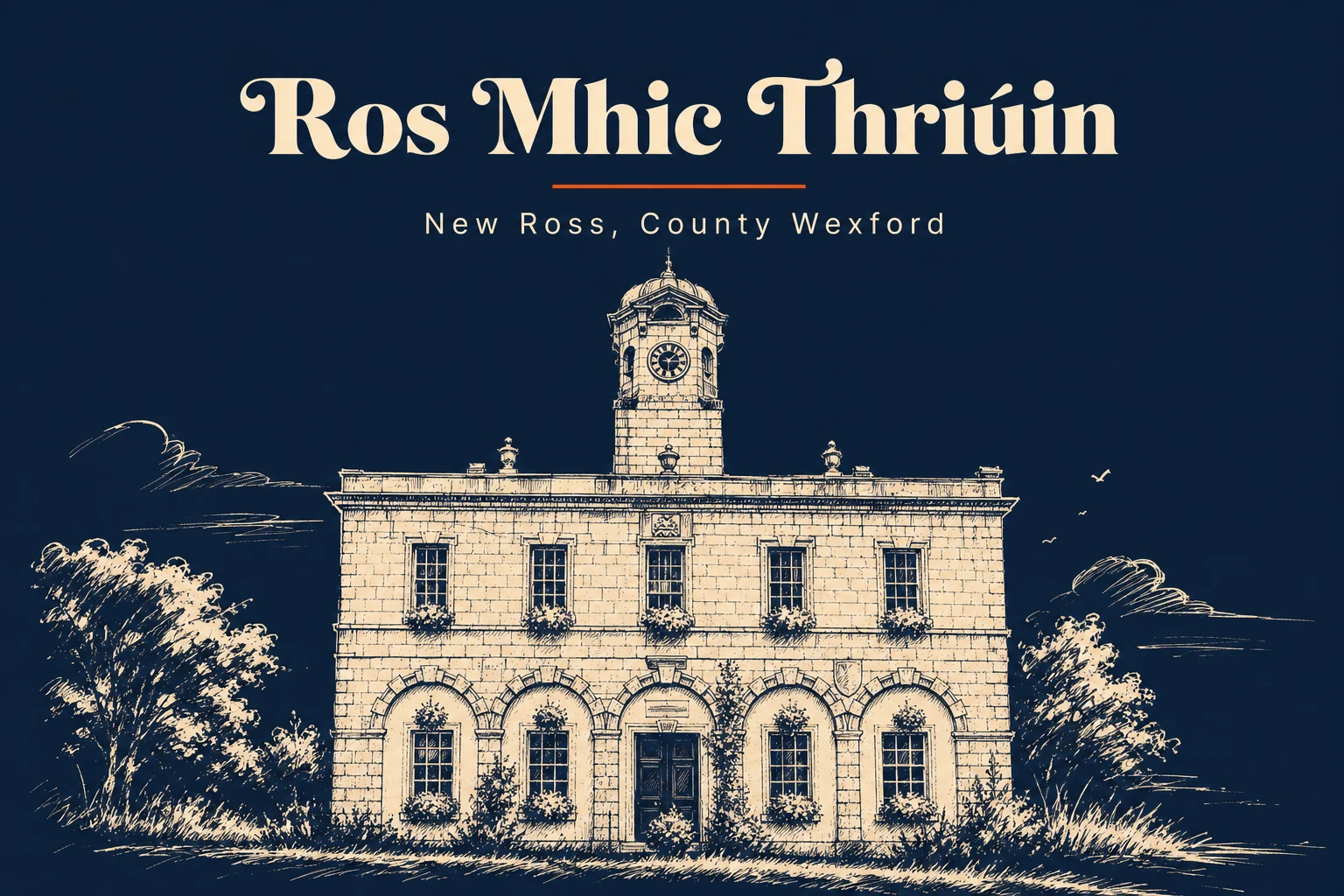
What you see today is a working town that knows what it is. The Dunbrody replica sits at the quay where the original loaded. The Kennedy Homestead is still run by Patrick Kennedy's descendants in the same farmyard. The Ros Tapestry - fifteen hand-embroidered panels of Marshal-era history - hangs in a building on the waterfront. The Tholsel watches the river. St Mary's is a roofless 13th-century shell on the highest point in the town, and you can still trace the medieval streets in the way the lanes climb.

Don't try to do it all in an afternoon. The Dunbrody alone takes ninety minutes, the Homestead is a half-day with the drive, and the Arboretum twelve kilometres south asks for another. Stay one night. Walk the quay at dusk when the bypass traffic is gone and the river goes still and the place quietly reverts to what it has always been.
Population
~8,600
Walk score
Quayside to the Tholsel in ten minutes, all uphill
Founded
c. 1207 - William Marshal & Isabel de Clare
Coords
52.3956° N, 6.9378° W
01 / 09

At a glance.

Three things every local will eventually mention. Read these and you've already understood more than most day-trippers do.

02 / 09

The pubs.

None of these are themed Irish pubs, because they don't need to be. A few that earn the trip:

P.J. Roche's

Locals, history
Pub on the quay

On The Quay, run by Pat and Rebecca Roche. Old wood, old stories, regulars who know the river. A pint here is a pint in the old town.

Mannion's

Gastro-leaning
Country pub & food

Out at Mount Elliott on the edge of town. Run by Emmet and Lisa Hall, kitchen led by Nigel Teague. Local, sustainable, organic where they can. The food is the reason most people make the trip.

Galavan's

No nonsense
Town-centre pub

5 North Street, up the hill from the quay. The kind of straight-up Wexford pub that has not had to reinvent itself for anyone. Pints, talk, occasional music.

03 / 09

Where to eat.

PlaceTypeLocal note
Bearú Restaurant & café €€€ Named for the Barrow (An Bhearú). Dave and Siobhán moved down from Dublin and opened it; the Irish Times reviewed it kindly in 2024 and it was Best Newcomer at the Irish Restaurant Awards. Café by day, contemporary dinner Friday and Saturday. Book the dinner.
Café Nutshell Café & lunch €€ 8 South Street, in the town centre. Soup, panini, salads, a counter of bakes and a decent Illy. The kind of lunch that gets you up the hill afterwards.
The Holy Grail World-cuisine restaurant €€ Up in Irishtown, run by Shijo and Parvathi Bhaskaran. Indian, Chinese, European all on one menu and somehow it works. A long-running family operation, not a tourist gesture.
Mannion's kitchen Gastro pub €€ If the dining-room version of the night appeals more than the bar version, the same kitchen plates the same food. Sunday lunch is a known quantity locally.
04 / 09

Where to sleep.

PlaceTypeLocal note
Brandon House Hotel & Solás Croí Spa 4-star hotel & spa Out on the N25 on the edge of town. 78 rooms, a 20-metre pool, a spa with a thermal suite. The wedding hotel for half the south-east, but rooms are easy to come by midweek. Solid base for the Hook Peninsula and the Kennedy Homestead.
A B&B in town B&B Several family-run guesthouses sit between the Quay and Irishtown. Walking distance to the Dunbrody, the Tholsel, the pubs. Book direct where you can.
A house out toward Hook Head Self-catering Drive twenty minutes south down the peninsula and prices halve and the views go full Atlantic. The Hook lighthouse is forty minutes away. Use New Ross as your supply town.
05 / 09

Stories & lore.

The reason to come back. The things every local will eventually tell you about, usually after the second pint.

How the town got built

William and Isabel

William Marshal was the most famous knight in Christendom - tournament champion, regent of England under three kings, the man Magna Carta was negotiated through. He married Isabel de Clare, daughter of Strongbow, and inherited half of Leinster with her. Around 1207 the two of them founded New Ross as a planned Norman port at the head of the tide on the Barrow. Marshal threw a bridge across the river, laid the streets at right angles to it, and walled the town. Within a hundred years it was the busiest harbour in Ireland.

A famine ship at the quay

The Dunbrody

The original Dunbrody was a three-masted barque built in Quebec in 1845 for the Graves family of New Ross merchants. She was meant to carry timber. Then the potato crop failed, and for six years she carried emigrants instead - 313 to Quebec on a single 1847 crossing. The replica that sits on the quay today is a full-scale reconstruction: you walk the deck, you go below, costumed performers play the captain and the steerage passengers. It is the most honest emigration museum on the island.

The cooper from Dunganstown

Patrick Kennedy

Eight kilometres south of New Ross, in a stone farmhouse at Dunganstown, a twenty-six-year-old cooper called Patrick Kennedy made up his mind to leave in 1848. He walked to the harbour at New Ross and boarded the Washington Irving for Boston. He worked barrels in East Boston for the rest of his short life and died there in 1858. His great-grandson John F. Kennedy came back to the same farmyard on the 27th of June 1963, drank tea with the cousins, and was assassinated in Dallas five months later. His sister Jean Kennedy Smith opened the homestead as a museum in 1990. It is still run by the family.

Marshal-era history in thread

The Ros Tapestry

Since 1998 a rotating cast of more than 150 stitchers have been working on fifteen embroidered panels, each six feet by four and a half, telling the story of the Norman conquest of the south-east through Marshal and Isabel. Fourteen are finished. The exhibition centre is on the quay, and the panels are extraordinary up close - you see the individual stitches and you see what the medieval world thought it looked like, all at once.

06 / 09

Things to do outside.

Wear waterproofs. Bring a sandwich. Tell someone where you're going if it's the mountain.

The Quayside Walk Start at the Dunbrody, walk south along the river past the Ros Tapestry centre, climb up to the Tholsel and back down. The river view is the point - the Barrow is wide and tidal here and the light off it at evening is unusual.
1.5 kmdistance
30 mintime
Kennedy Homestead & Dunganstown Drive south on the R733 for fifteen minutes. The homestead is the original farmyard, run by Patrick Kennedy's descendants, with a thoughtful interpretive centre attached. Allow two hours. The lane down to the house is a single track.
8 km drivedistance
Half daytime
JFK Arboretum & Sliabh Coillte Twelve kilometres south of town, opened by de Valera in 1968. 623 acres, 4,500 species of tree and shrub, a road to the summit of Sliabh Coillte at 271m for a panorama over the Barrow estuary, the Hook, and on a clear day the Comeragh and Blackstairs Mountains.
2-5 kmdistance
2-3 hourstime
Barrow Way to St Mullins The official Barrow Way towpath ends at St Mullins, sixteen kilometres upriver. Drive there, walk the towpath north toward Graiguenamanagh - flat, traffic-free, the river beside you the whole way. The stretch south of St Mullins down to New Ross is tidal and not a marked trail.
16 km northdistance
Half day by biketime
07 / 09

When to go.

There is no bad time. There are different times.

Spring
Mar-May

Arboretum azaleas come out in May and the place is at its best. Quay is quiet. Dunbrody opens its longer hours from April.

◉ Go
Summer
Jun-Aug

Long evenings on the river, the Norman events around the Marshal anniversaries (early July is usually good), and the Hook Peninsula is twenty minutes away. Book Bearú ahead.

◉ Go
Autumn
Sep-Oct

The river goes silver, the trees in the Arboretum turn, and the town gets back to itself once the school holidays end. The honest season.

◉ Go
Winter
Nov-Feb

Dunbrody runs reduced hours November-February. The Homestead and Arboretum still open but check the day. Cold wind comes off the river. Bring layers.

◐ Mind yourself
08 / 09

What to skip.

Honestly? Don't bother.

If a local was sitting beside you, this is the bit where they'd lean in.

×
The drive-through visit

It is a town built on a hill that takes a half day to do properly. If you have ninety minutes, you will see the Dunbrody and miss the rest. Stay a night.

×
The Kennedy trail done in an afternoon with no booking

Homestead, Arboretum and Dunbrody is a full day with driving. Two of the three is more honest. Book the Dunbrody and Homestead online; both run timed entries.

×
Looking for the medieval town from the bypass

The N25 Rose Fitzgerald Kennedy Bridge - Ireland's longest, opened 2020 - carries you over the Barrow at speed and shows you nothing of the old town. The medieval streets are the steep climb on the west bank. Get off the bypass and go up the hill.

×
Trying to walk the towpath all the way to Graiguenamanagh from the quay

The Barrow Way is a marked walking route, but it ends at St Mullins, sixteen kilometres upriver from New Ross. The stretch from St Mullins down to the town is tidal and not a maintained path. Drive to St Mullins and start there.

+

Getting there.

By car

Dublin to New Ross is 2 hours on the M9 to Knocktopher and then the N25 east - about 145km. Waterford is 25 minutes west across the Rose Fitzgerald Kennedy Bridge. Wexford town is 35 minutes east on the N25.

By bus

Bus Éireann 370 runs Waterford-Wexford via New Ross several times a day. Bus Éireann 4 runs Dublin-Waterford and stops at New Ross. Local Link covers the smaller villages on the Hook.

By train

No train. Nearest station is Waterford Plunkett (25 minutes by car or bus).

By air

Dublin (DUB) is 2 hours. Waterford Airport (WAT) is 30 minutes but flights are limited. Cork (ORK) is 2 hours.