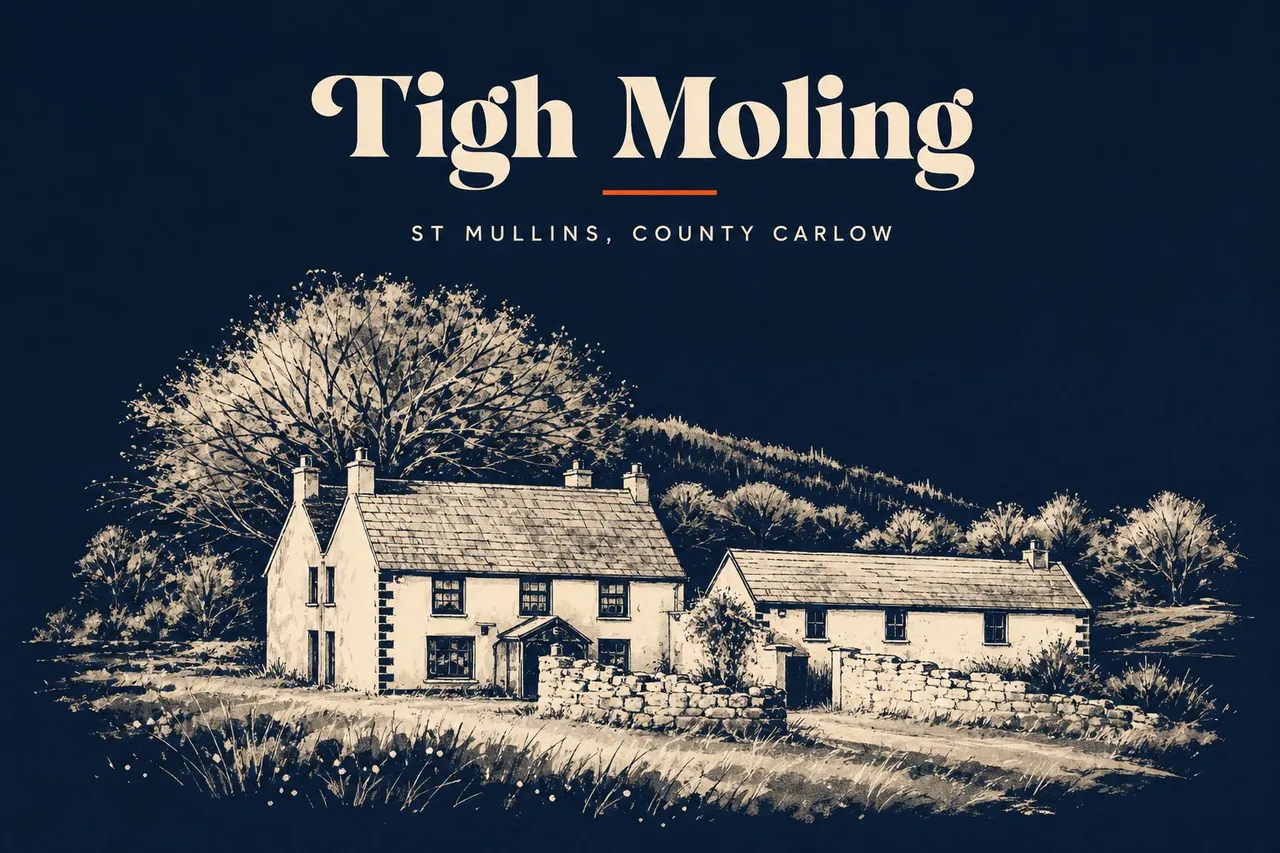
Tigh Moling · Co. Carlow
A seventh-century monastery, 1798 rebel graves, and one pub by the river.
St Mullins is where the Barrow becomes tidal - the point where the river, after 114 kilometres of canal towpath and soft inland water, meets the pull of the sea. The monks knew this. St Moling chose the spot in the seventh century and built a monastery that became, for a time, a centre of the Irish Christian world. He was Bishop of Ferns, and the manuscript now called the Book of Mulling - held at Trinity College Dublin - takes its name from him and from this place. The surviving manuscript was written a century or more after his death in 697, by three scribes working in the insular tradition he had established here. The book survived. The monastery did not survive intact, but its bones are still here: a truncated round tower, the ruins of a medieval church, a high cross worn soft by weather, a holy well. All in one compact field above the river, OPW-managed, always open.
The 1798 graves make St Mullins something other than a standard monastic site. The rebellion came through this part of Wexford and Carlow in the summer of 1798 - Father John Murphy's insurgency, the United Irishmen, the brutal suppression that followed Vinegar Hill. Men were buried here, some of them in hurried or unmarked graves, some commemorated in later stone. Standing in that graveyard, medieval monastery at your back and 1798 headstones at your feet, you get a version of Irish history that no heritage centre can compress into a panel. It is all one story, if you stand in the right place long enough.
The Pattern Day - St Mullin's Pattern, last Sunday of July - is still observed. Pilgrims come to pray at the holy well and walk the monastic site. It is not a festival or a heritage event; it is a living religious observance that has continued here for centuries, with a small crowd and no entrance fee and no commentary track. If you want to understand what a pattern day is and what it has always been, this is the place to see one.