County Carlow Ireland · Co. Carlow · Bagenalstown Save · Share
POSTED FROM
BAGENALSTOWN
CO. CARLOW · IE

Bagenalstown
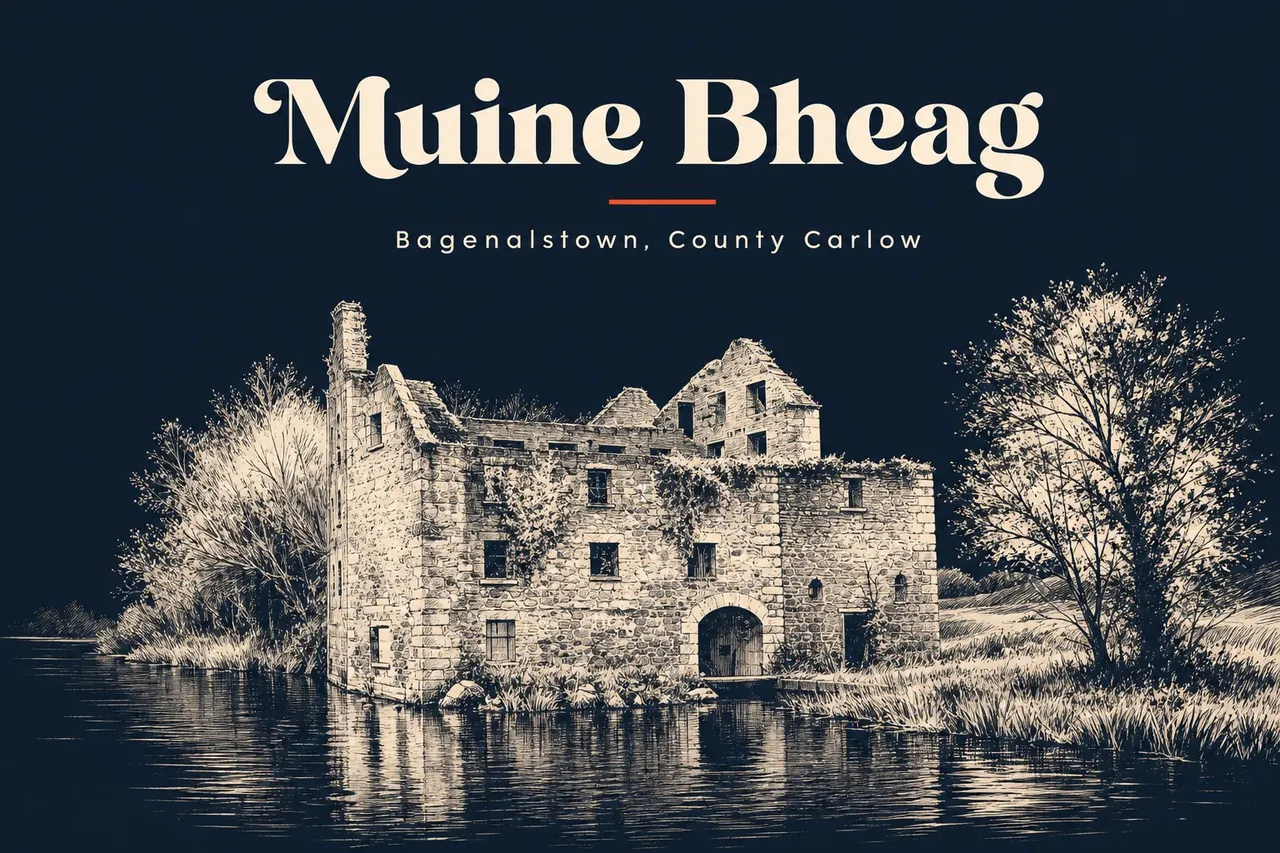
Muine Bheag

The Ireland's Ancient East
STOP 08 / 08
Muine Bheag · Co. Carlow

A small Versailles that never was, on a slow bend of the Barrow.

Bagenalstown was meant to be Versailles. In the 1730s Walter Bagenal — landlord, ambition surplus to requirements — decided the small Barrow-side hamlet of Muine Bheag would do as the site of a planned town to mirror the French original. He laid out wide streets, commissioned a Greek-temple courthouse, and waited for the Dublin-to-Waterford coach road to swing through. The coach went by way of Leighlinbridge instead. Bagenal lost interest. The courthouse got built. The rest of Versailles did not.

What survived is a town with the bones of a much grander idea. The streets are wider than the houses on them. The courthouse rises above everything like it's still expecting visitors. The Barrow Navigation came in 1792 and gave the place a real reason to exist; the railway came in 1846 and confirmed it. The mills along the river — Rudkin's, the Lodge — turned grain for Dublin until the railway took the trade and then the trade went elsewhere altogether.

After independence the town tried on its Irish name properly: Muine Bheag, the small thicket. It stuck on the postmark and the station sign and not much else. A 1975 plebiscite said 77% wanted Bagenalstown back. The turnout was too low to count, so the official name stayed Muine Bheag and everyone kept saying Bagenalstown anyway. Both names are correct. The locals will use whichever one suits the sentence.

It's not a tourist town. It's a working market town with a river through it, a half-finished 18th-century dream of grandeur, and the Barrow Way passing through on its way to better-known places. Stop for an hour. Walk the towpath to the lock. Look up at the courthouse. Have a pint. Get the train.
Population
~2,950
Walk score
Twenty minutes top-to-bottom, river to courthouse
Founded
1730s, by Walter Bagenal
Coords
52.7010° N, 6.9570° W
01 / 08

At a glance.

Three things every local will eventually mention. Read these and you've already understood more than most day-trippers do.

02 / 08

The pubs.

None of these are themed Irish pubs, because they don't need to be. A few that earn the trip:

The Pint Depot

Family-run, all-day
Sports gastro pub

Award-collecting family pub. Food from nine in the morning till seven (six on Sundays), which makes it the default for anyone passing through who needs feeding outside dinner-only hours. The match is usually on.

Jim D's

Locals, evening
Bar & lounge, Regent St

A proper town pub on Regent Street. No frills, no menu, the regulars know each other. Walk in, order a pint, sit down. That's the trip.

Matty's

Crossroads local
Pub with rooms, Royal Oak

Two minutes out the road in Royal Oak village across the Barrow. Beer garden, self-catering apartments above, the sort of place travellers used to stop and still do. Worth the short drive if the town pubs feel quiet.

03 / 08

Where to eat.

PlaceTypeLocal note
The Pint Depot Gastropub kitchen €€ The town's reliable plate. Open from breakfast through to early evening seven days. The carvery does what a carvery should do.
Goodly Barrow Café Café & waterways museum On the restored canal store on the riverbank. Soup, salads, baking, a small museum of the Barrow Navigation attached. The setting does most of the work and the soup finishes the job.
Lord Bagenal Inn Restaurant, Leighlinbridge €€€ Six minutes up the road in Leighlinbridge, on the Barrow. The named Bagenal inn — though the family connection is loose — and the dining room the area sends visitors to when it wants to make an impression.
04 / 08

Stories & lore.

The reason to come back. The things every local will eventually tell you about, usually after the second pint.

A planned town that wasn't

Walter Bagenal's New Versailles

In the 1730s Walter Bagenal decided the hamlet of Moneybeg would be rebuilt as 'New Versailles' — boulevards, a courthouse, the lot. The plan needed the Dublin-to-Waterford coach road to come through. It didn't. It went by Leighlinbridge instead. Bagenal abandoned the project after building only the courthouse. The wide streets you walk today are the half-built bones of an idea that lost its main artery before it had a chance.

Bagenalstown / Muine Bheag

The two names

After independence the town commissioners adopted Muine Bheag — 'small thicket' — as the official name. It never quite caught. In 1975 a plebiscite voted 77% in favour of going back to Bagenalstown, but the turnout fell short and the result didn't count. The post office still says Muine Bheag. The locals still say Bagenalstown. The road sign coming in tries both. Pick whichever suits the sentence.

A Greek temple over the Barrow

The courthouse on the hill

Bagenal's one completed gesture is a granite Greek-Revival courthouse, 1820s, perched on rising ground above the river. From the road in from Dunleckny the pediment lifts above everything else in town and you can see what he was after. Up close, with the columns and the high garden walls, it's the most ambitious building for miles. It's also pretty much alone in its ambition. Which is the whole story of the place in one image.

Dublin–Waterford, 1846 onwards

The line that saved it

The Bagenalstown plan failed because the road went elsewhere. The town survived because the railway came. The Dublin-to-Waterford line opened through here in 1846 and the Victorian station was the engine of the town for a century. It closed in 1963 with the Beeching cuts of Irish Rail's own. It reopened in 1988 and trains run again, a handful of times a day. Stand on the platform and you're standing on the only reason the town didn't quietly empty out.

05 / 08

Things to do outside.

Wear waterproofs. Bring a sandwich. Tell someone where you're going if it's the mountain.

Barrow Way north — to Leighlinbridge Towpath the whole way. Flat, gravelled, lock gates at intervals. Leighlinbridge is the prize at the top end — a 14th-century bridge, the Lord Bagenal Inn, somewhere to eat. Walk one way and get a taxi back if the legs aren't up to the round trip.
~10 km returndistance
2.5 hourstime
Barrow Way south — to Goresbridge The quieter direction. Long stretches with nothing but the river, the heron, and the occasional lock-keeper's cottage. Goresbridge is in Co. Kilkenny by the time you arrive. The river doesn't care about the county line.
~14 km one-waydistance
3.5 hourstime
The courthouse circuit Up Bachelors Walk, around the courthouse, down through the wide laid-out streets that were meant to carry coaches and mostly carry parked cars. The Versailles ghost-tour, no commentary needed.
2 kmdistance
30 mintime
Dunleckny Lane Out the road north toward the old Bagenal estate at Dunleckny. The view back at the courthouse pediment from this direction is the one Walter Bagenal himself was probably most pleased with.
4 km returndistance
1 hourtime
06 / 08

When to go.

There is no bad time. There are different times.

Spring
Mar–May

The Barrow towpath at its best — light, swallows arriving, hawthorn out. The whole walk to Leighlinbridge becomes a different proposition.

◉ Go
Summer
Jun–Aug

Quiet by Irish-tourism standards. You will not be queuing for anything. The river slows, the trains run on time, the evenings are long.

◉ Go
Autumn
Sep–Oct

The towpath in October is one of the underrated walks in Leinster. Light through beech, no one about, a pint at the end of it.

◉ Go
Winter
Nov–Feb

The Barrow floods. The towpath gets boggy. The pubs are warm and the courthouse looks great in mist, but plan around the weather rather than through it.

◐ Mind yourself
07 / 08

What to skip.

Honestly? Don't bother.

If a local was sitting beside you, this is the bit where they'd lean in.

×
Looking for the Versailles

There isn't one. There's a courthouse, some unusually wide streets, and the absence of a town that was meant to be there. That absence is the point. Don't expect boulevards.

×
A weekend just for Bagenalstown

It's a half-day stop, honestly. Pair it with Leighlinbridge, Borris and the Barrow Way as a two- or three-day Carlow river trip and the place fits properly into context.

×
Driving when the train works

Dublin Heuston to Muine Bheag is a clean 90-minute run. You arrive at the Victorian station two minutes from the river. You don't need the car for what's here.

×
Sunday-evening anything

Plenty of small Carlow towns wind down hard on a Sunday night. Eat early, drink early, train out early. Or stay in Borris where there's more going on after dark.

+

Getting there.

By car

Dublin to Bagenalstown is 1h 30m via the M9, exit at Leighlinbridge. Carlow town is 20 minutes north. Kilkenny is 30 minutes south-west.

By bus

Bus Éireann and JJ Kavanagh run Dublin–Waterford services that stop at Carlow town; from there a local bus or taxi covers the last 15km.

By train

Iarnród Éireann Dublin Heuston–Waterford line stops at Muine Bheag station. About 90 minutes from Heuston. Several trains a day in both directions.

By air

Dublin Airport is 2 hours by road. Waterford is closer but barely served. Cork and Shannon are both 2.5 hours.