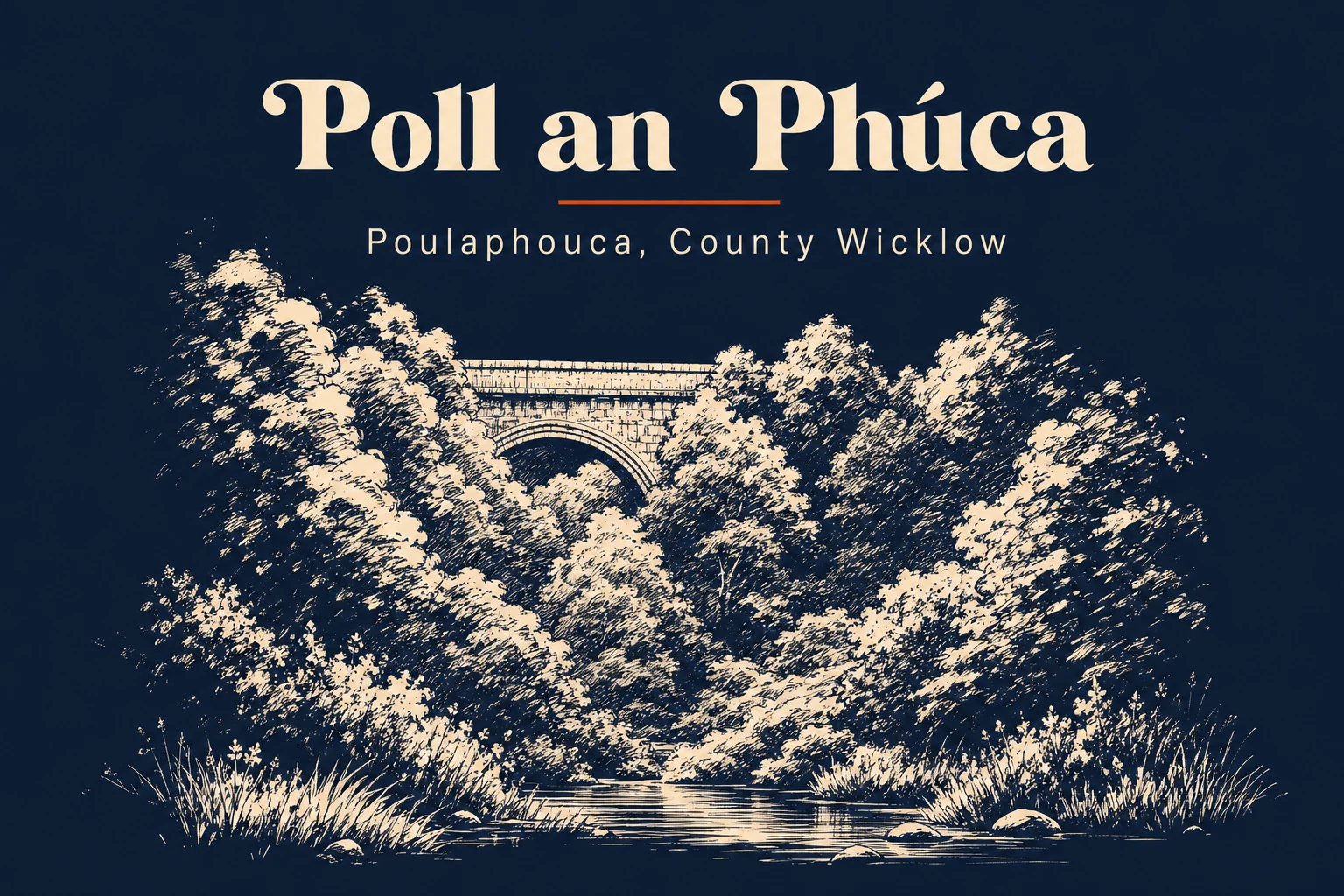
Poll an Phúca · Co. Wicklow
A drowned waterfall, a Gothic bridge over a 150-foot chasm, and the dam that made the largest reservoir in Leinster. The Púca's pool gave the place its name before the ESB raised the water over it.
Poulaphouca is not really a village. There is no main street, no square, no church on a corner. What there is, is a name - Poll an Phúca, the pool of the Púca, the water-sprite that shifts shape and leads travellers astray - attached to a waterfall, a bridge, and a dam, on the spot where the River Liffey drops out of the west Wicklow hills. For two hundred years that meant the falls. Since 1940 it has mostly meant the reservoir.
The waterfall was the draw. From the 18th century onward, visitors came to see the Liffey fall roughly 150 feet in three stages through a chasm only 40 feet wide, lined with sheer greywacke rock, the water spinning in a circular basin at the bottom. It was famous enough that James Joyce gave Leopold Bloom a childhood memory of the place in Ulysses. In 1822 the engineer Alexander Nimmo threw a single Gothic arch across the gorge, 65 feet of span with the keystone 150 feet above the river bed. The bridge is still there, carrying the N81. The falls are still there too, but the ESB took most of their water.
In the late 1930s the State dammed the Liffey at Poulaphouca for its second hydroelectric scheme, after Ardnacrusha on the Shannon. The water began rising on 3 March 1940. Seventy-six houses in the valley above had already been demolished and the bridges at Humphreystown, Baltyboys and Burgage blown up; the village of Ballinahown went under, along with thousands of acres of farmland and a 12th-century cross that was lifted out and moved to a Blessington cemetery before the water reached it. The reservoir that formed - the Blessington Lakes - covers about 22 square kilometres, holds 166 billion litres, and is the largest artificial lake in Ireland. It still supplies most of Dublin's water and turns two 15 MW Kaplan turbines at the dam.
So treat Poulaphouca as a place you stop at, not a place you stay in. The dam and station are at the southern end of the lake; Blessington is five minutes north at the head of the water; the lakeside roads around the western and eastern shores are good cycling and driving country. The one building with a roof and a welcome is Poulaphouca House & Falls, a family-run events house above the falls. Everything else here is water, hill, and the bridge over the gorge.