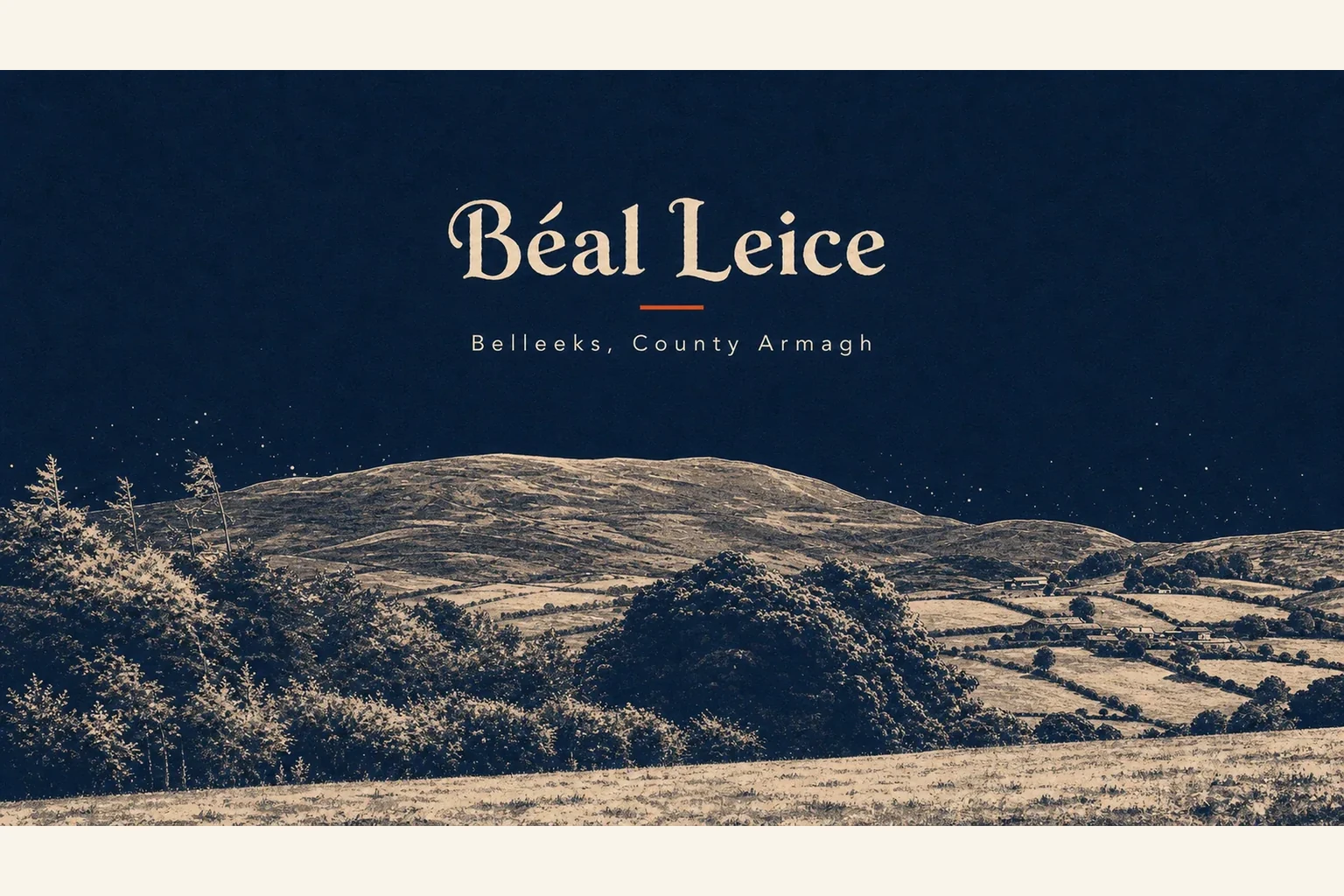
Béal Leice · Co. Armagh
A planned 1790s village in the south Armagh hills, two pubs and a public common. Not the Fermanagh pottery one.
First thing - Belleeks is not Belleek. The pottery place is in Fermanagh, eighty miles west, makes the white china your aunt keeps in the good cabinet. This Belleeks, with the s, is a small Catholic village on the A25, sitting between Camlough to the east and Newtownhamilton to the west, about seven miles from Newry. The Irish is Béal Leice, the ford-mouth of the flagstone. The Armagh people will correct you on the difference before you have finished the question.
An Earl of Gosford laid the village out in the 1790s on the site of an old Tudor garrison, and the street plan has barely moved since. It is south Armagh, so you carry the weight of that - low green hills, small fields, the chapel above the houses, the GAA club running the social calendar. Through the 1800s this was a proper little market centre: people from the outlying townlands brought butter and cheese here to be sold on to Belfast and beyond, and Sir Archibald Acheson held a patent for four fairs a year, the February one surviving until the 1850s.
Do not come expecting a day out. There are two pubs, a shop, a part-time factory and a public common, and that is the village. If you are driving the A25 between Newry and Armagh you will be through it inside a minute. Slow down anyway. There is a story in the ground here, even if there is no coffee shop to read it in.