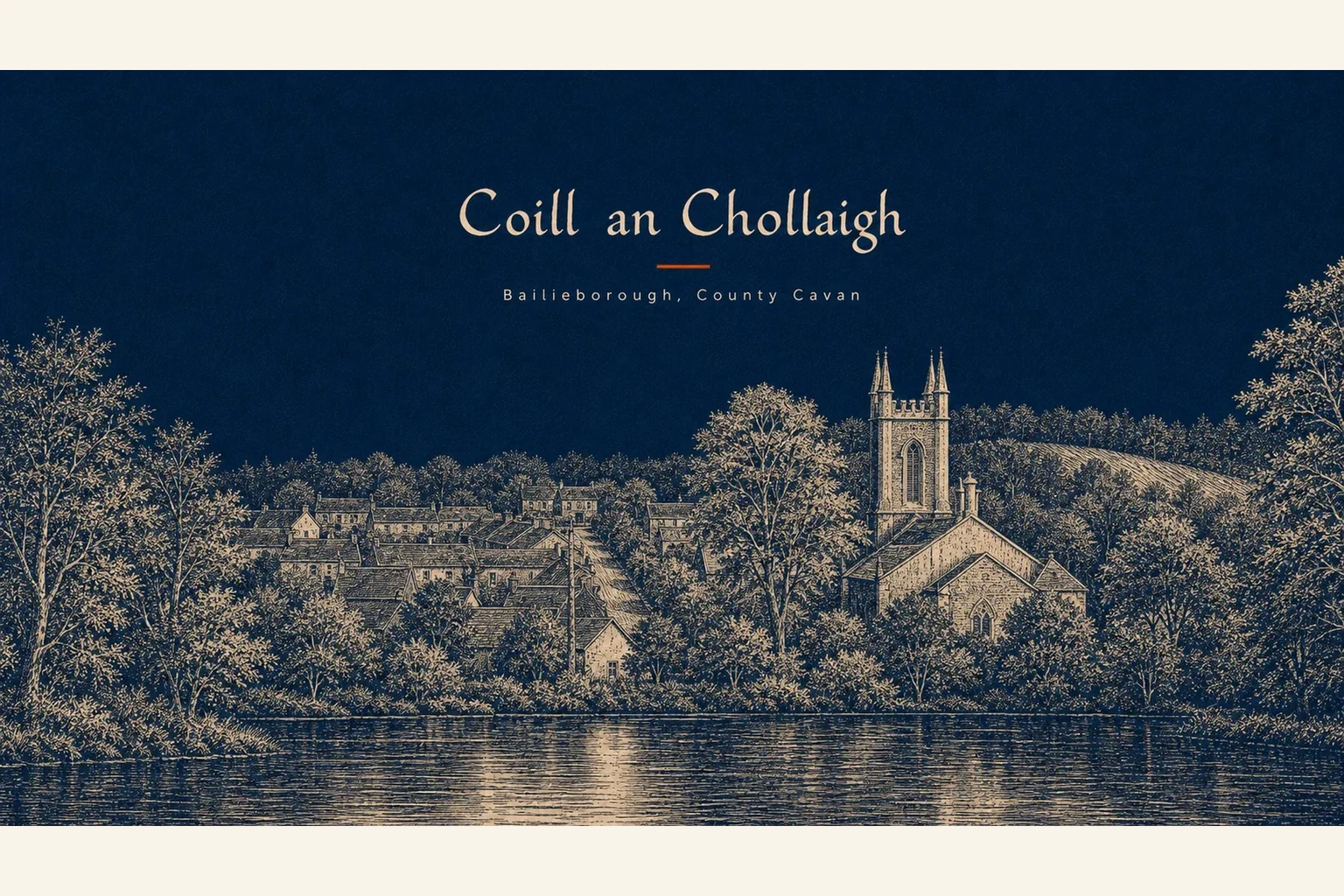
Coill an Chollaigh · Co. Cavan
A Scottish Plantation town with one long tree-lined street and a lake in the woods behind it.
Bailieborough is a Plantation town and it still looks like one. In 1610 a Scottish soldier called William Bailie was given the lands of Killechally by James I, anglicised the name to his own, and laid out a town on a Scots-Ulster grid. Two hundred years later Sir William Young widened the Main Street to its current scale and lined it with trees. Almost nothing about the place is accidental.
What that means today is one long, generous street running gently uphill, with the courthouse and the old Bridewell about halfway up, two churches at either end, and the woods of the old Castle demesne tucked behind it. The town is a working east-Cavan market town first and a commuter town for Dublin second - the N3 will get you there in just over an hour, which has saved Bailieborough from the slow emptying that did for several of its neighbours.
The reason to come is the demesne. The castle is gone - the Marist Brothers, who took it on as a school in the early 1900s, pulled it down in the 1940s when the upkeep beat them - but the lake and the woods and the Rebel Hill memorial are still there, and the loop around the water is a proper hour of walking. Do that, eat in the town, drive ten minutes to Lough an Leagh for the long view, and you have the day.