County Cavan Ireland · Co. Cavan · Ballinagh Save · Share
POSTED FROM
BALLINAGH
CO. CAVAN · IE

Ballinagh
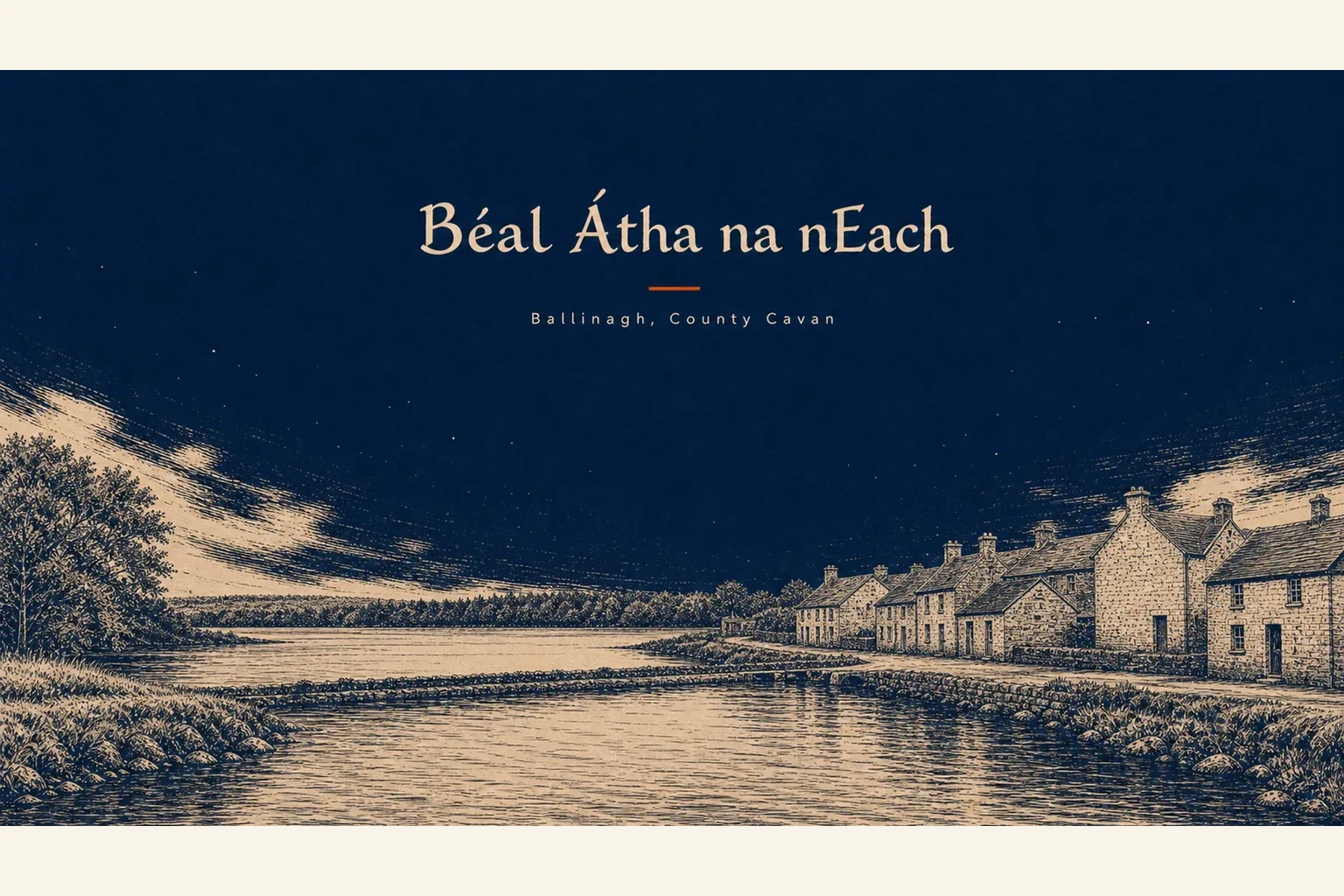
Béal Átha na nEach

The Ireland's Lakelands
STOP 06 / 06
Béal Átha na nEach · Co. Cavan

A horse-ford crossroads on the N55, exactly between Cavan and everywhere else.

Ballinagh sits on the N55 at the midpoint between Cavan town — twelve kilometres east — and Granard in County Longford to the south-west. It is a crossroads village: one road, a scatter of houses, a church, the infrastructure that small-farm parishes grow around when they need somewhere to stand. The 2016 census gave it roughly 700 people across the wider townland area. On the ground that means a modest village with a clear before-and-after to it: the kind of place you arrive in from the drumlin fields and feel the road widen slightly.

The Irish name carries the real history. Béal Átha na nEach — ford-mouth of the horses — names a river crossing where animals and carts passed through shallow water before bridge-builders arrived. South Cavan once ran on these crossings. Horses coming down off the drumlins, drovers reading the water, the ford marking a point on the route west. The river still runs here; the ford is the thing that became a road.

The landscape around Ballinagh is drumlin country all the way to the horizon. Small oval hills, the kind the last ice sheet left behind when it retreated north, sit in every direction, broken by the smaller loughs and streams of the Lough Oughter system. It is a slow, inward-looking landscape — the kind that keeps weather trapped and light interesting. The lough itself, ten kilometres north-west via Crossdoney, is the bigger presence in this part of Cavan: a maze of islands, channels and flooded drumlin tops that shaped how everyone here moved, fished, and thought about water.

Crosserlough GAA is the institution with the most visible life in the parish today. Gaelic football in mid-Cavan is not a casual thing — the club represents the whole parish of Crosserlough, which takes in Ballinagh and several surrounding townlands — and it has been competitive at county level across several generations. That is normal in Cavan, a county that takes its football seriously, but it gives the parish its clearest ongoing organisation and, on match days, its loudest hour.
Population
~700
Coords
53.8983° N, 7.3742° W
01 / 06

At a glance.

Three things every local will eventually mention. Read these and you've already understood more than most day-trippers do.

02 / 06

Stories & lore.

The reason to come back. The things every local will eventually tell you about, usually after the second pint.

What Béal Átha na nEach actually means

The horse ford

The name breaks into three parts: béal (mouth), áth (ford), and na n-each (of the horses). Fords were the logic of pre-bridge Ireland — a point where a river shallowed enough for crossing, and where routes inevitably converged. Ballinagh's ford on the local stream was specific enough to be named after the animals that used it. Drovers moving cattle and horses between the drumlins and the markets at Cavan or Granard would have known the ford by reputation. The N55 follows, more or less, that same line of old movement.

The lake that floods everything

Lough Oughter, nearby

The Lough Oughter system begins properly around Killeshandra and Crossdoney, but its influence runs through the whole of this part of Cavan. The upper Erne and its tributary streams drain the drumlin fields west of Ballinagh into a flooded landscape of over a hundred islands and narrow channels — a Special Area of Conservation and one of the more complex freshwater habitats in Ireland. Ballinagh sits on the edge of that system, on slightly higher ground, which is probably why the ford mattered: the alternative was the lough.

The parish club

Crosserlough GAA

Crosserlough GAA Club — named for the parish, not the village — has competed in the Cavan Senior Football Championship across decades of mid-county football. The parish of Crosserlough covers Ballinagh, Ballintemple and the surrounding townlands. Like most strong rural clubs in Ulster, it has outlasted much of the economic activity it grew alongside. The pitch, the dressing rooms and the club draw the parish together in a way that few other institutions manage in a dispersed agricultural area. Cavan has historically produced football-playing parishes of unusual stubbornness, and Crosserlough is one of them.

Main-street villages and the road that made them

The N55 corridor

Ballinagh follows the pattern of a dozen small Cavan and Longford villages that the N55 links between Cavan town and Athlone: a main-street facing the road, a church set slightly back, the school visible on the approach, a pub or two that has probably served the same route for a century and a half. The N55 itself replaced older roads and drove routes that traced the same logic as the old fords — moving through drumlin country where the gaps allowed. These villages are not scenic in any managed sense. They are functional in the way that all working landscapes are functional: everything is where it is because it had to be.

03 / 06

Things to do outside.

Wear waterproofs. Bring a sandwich. Tell someone where you're going if it's the mountain.

Lough Oughter loop via Crossdoney Head north-west on the R199 through Crossdoney to reach the Lough Oughter shore and Killykeen Forest Park. The forest park has several walking loops from 2.5 km to 5 km, mostly flat and well-marked. You are not walking from Ballinagh — you are driving to the lake and walking there.
Drive 10 km, walk variesdistance
Half daytime
Parish roads on foot The back roads around Ballinagh through the drumlin townlands — towards Ballintemple, Drumcor, or south towards Arva — are quiet on any morning and give a better sense of the landscape than the N55 does. No waymarking. Bring a map or a phone with a signal. The hills are low; the views are long.
Open-endeddistance
1–2 hourstime
04 / 06

When to go.

There is no bad time. There are different times.

Spring
Mar–May

The drumlins green up fast. Light traffic on the back roads, and the lough country to the north-west is at its most accessible before summer canoe season begins.

◉ Go
Summer
Jun–Aug

The surrounding countryside is at full working volume. GAA championship season means local traffic on match days. Killykeen Forest Park nearby is busy but manageable mid-week.

◉ Go
Autumn
Sep–Oct

The best light in drumlin country. The lough water quietens, the summer visitors clear, and the road to Crossdoney is worth the drive just for the sky.

◉ Go
Winter
Nov–Feb

A working village in a cold county. The roads are fine. There is not much to do here in winter unless you are visiting someone.

◐ Mind yourself
05 / 06

What to skip.

Honestly? Don't bother.

If a local was sitting beside you, this is the bit where they'd lean in.

×
Arriving without a plan to go somewhere else

Ballinagh is a junction, not a destination. The interest is in the landscape around it — the drumlins, the loughs, the back roads. Drive through with a reason to stop, not in hope of finding one.

×
The N55 main street as a scenic experience

It is a national primary route through a crossroads village. The scene is functional. The actual landscape is half a kilometre off the road in any direction.

+

Getting there.

By car

Cavan town is 12 km east on the N55 — 12 minutes. Granard, Co. Longford is 20 km south-west, about 20 minutes. Dublin is 1h 30m via the N3 and M3 from Cavan town.

By bus

Bus Éireann route 30 (Dublin–Cavan–Enniskillen) passes through or near the village. Check current timetables — frequency is limited to a few services daily.

By train

No train station. Nearest mainline stations are Longford (30 km south-west) and Drogheda via the Dublin line.

By air

Dublin Airport (DUB) is 2 hours by road. Belfast International is 1h 45m via Cavan town and the A3.