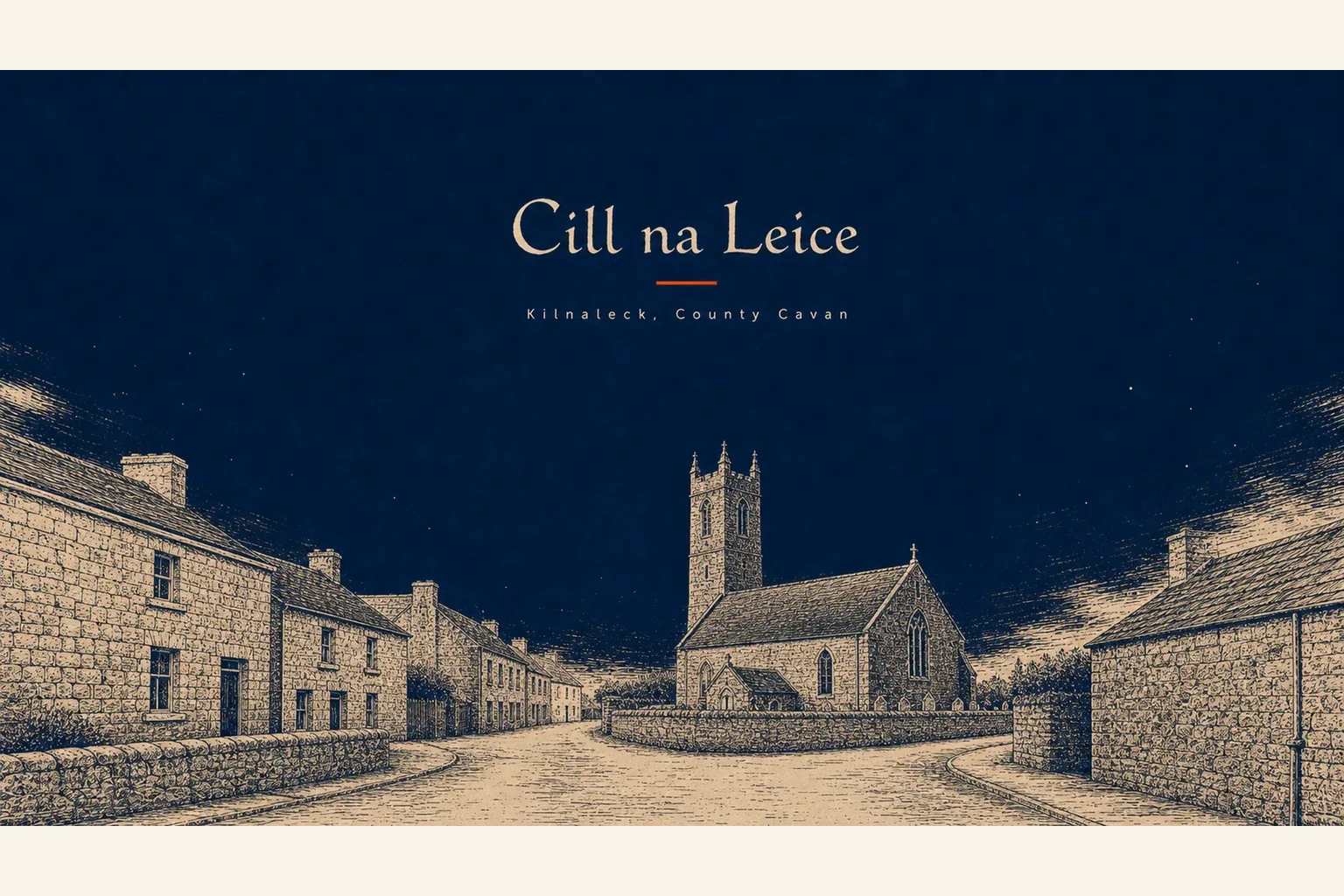
Cill na Leice · Co. Cavan
A flagstone church gave it a name. A failed coalmine and a baseball dynasty gave it a history.
Kilnaleck is a south Cavan village of under five hundred people on the R154, in the civil parish of Crosserlough. It has a church, a school, a Garda station, a GAA club, and the usual small-village infrastructure that means you can get a haircut and a prescription on the same trip. What it does not have is a reason to stop that announces itself from the road. You have to know where to look.
The name is the start of it. Cill na Leice - the church of the flagstone. Some early-medieval ecclesiastical site, a significant stone, a settlement that grew around both and has been here in one form or another for over a thousand years. The stone is not there to inspect. The parish is. St Patrick's church in the village dates from later centuries, but the ground it stands on has been consecrated longer than the building can tell you.
In 1879, a school headmaster and a group of local businessmen sank a shaft into the ground outside the village looking for coal. They found it. The seam was real. The problem was depth - the coal sat too far down to extract at a profit, and the operation closed before it became anything. The shaft is gone. The story survived. It is the kind of thing that happens in the drumlin counties: a flash of something that might have changed everything, and then the fields again.
The family that changed things, in the end, did it from Chicago. John Comiskey was born in the parish of Crosserlough in 1826. He left during the Famine years, landed in New Haven, moved west to Chicago, built a political career as an alderman, and raised a son named Charles. Charles Comiskey became the owner of the Chicago White Sox - one of the founding clubs of American professional baseball. The Old Roman, they called him. His grandfather's ground is ten minutes outside a south Cavan village with no train and one bus route. The Cavan connection is real and almost entirely unmarked.