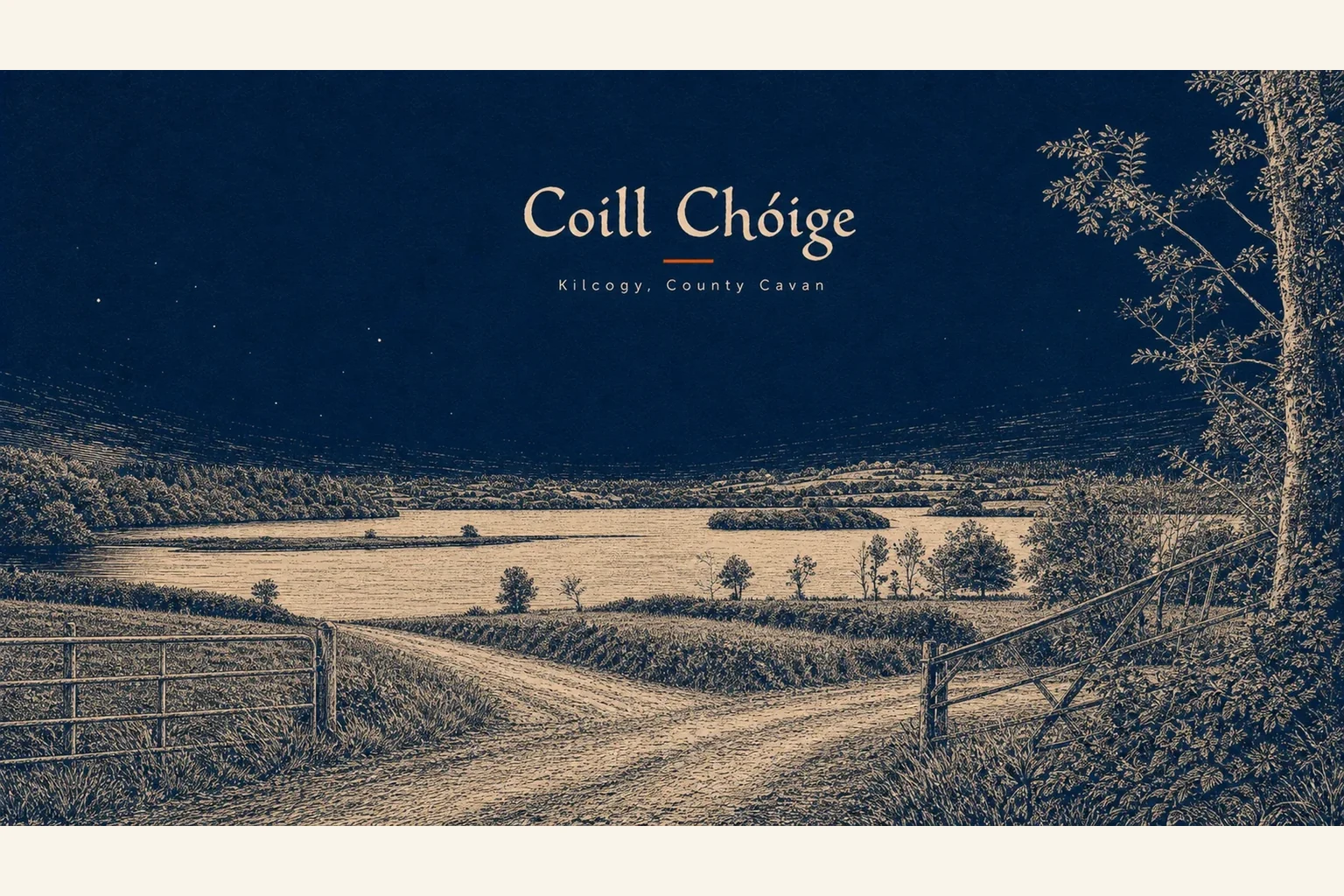
Coill Chóige · Co. Cavan
A farming crossroads with a big lake behind it and a Tánaiste in its past.
Kilcogy sits in the civil parish of Drumlumman in south-western Cavan, on the R394 between Arvagh and the Longford border. About three hundred people live in and around it. The name is recorded as Coill Chóige as far back as 1610 - the Plantation-era cartographers were thorough if nothing else. The village itself is a crossroads: a church, a GAA pitch a mile out, a few houses, agricultural land on every side.
The lake changes things. Lough Gowna is ten minutes west, a long shallow body of water that straddles the Cavan-Longford boundary and connects into the River Erne system. It was formed after the last glaciation, the drumlins creating natural dams and the water filling the gaps between them. The result is a shoreline with more bays and inlets than you can usefully count, most of them accessible only on foot or by small boat. Pike, perch, and bream have been drawing coarse anglers here for generations. The infrastructure for fishing visitors is modest - this is not the tourist-facing end of the Erne.
John Patrick Wilson was born in 1923 on a farm at Callanagh, outside Kilcogy. He won two All-Ireland football medals with Cavan - including the famous 1947 final played at the Polo Grounds in New York - before becoming a secondary school teacher and then, eventually, Tánaiste of Ireland under Charles Haughey from 1990 to 1993. He later chaired the Independent Commission for the Location of Victims' Remains, helping families recover the bodies of those disappeared by paramilitary groups. Not a typical career for a man who grew up in a drumlin field in Cavan. He died in 2007, one day after his eighty-fourth birthday.
Mullahoran GAA - the club that serves this parish - was founded in 1888 and has twelve Cavan Senior Football titles and twenty-six Senior Hurling titles to its name. Their run of twenty-one consecutive hurling championships is a GAA record. The club produced Paul Brady, world handball champion, and Wilson himself. For a small rural parish between two counties, Mullahoran has punched well above its demographic weight for a very long time.