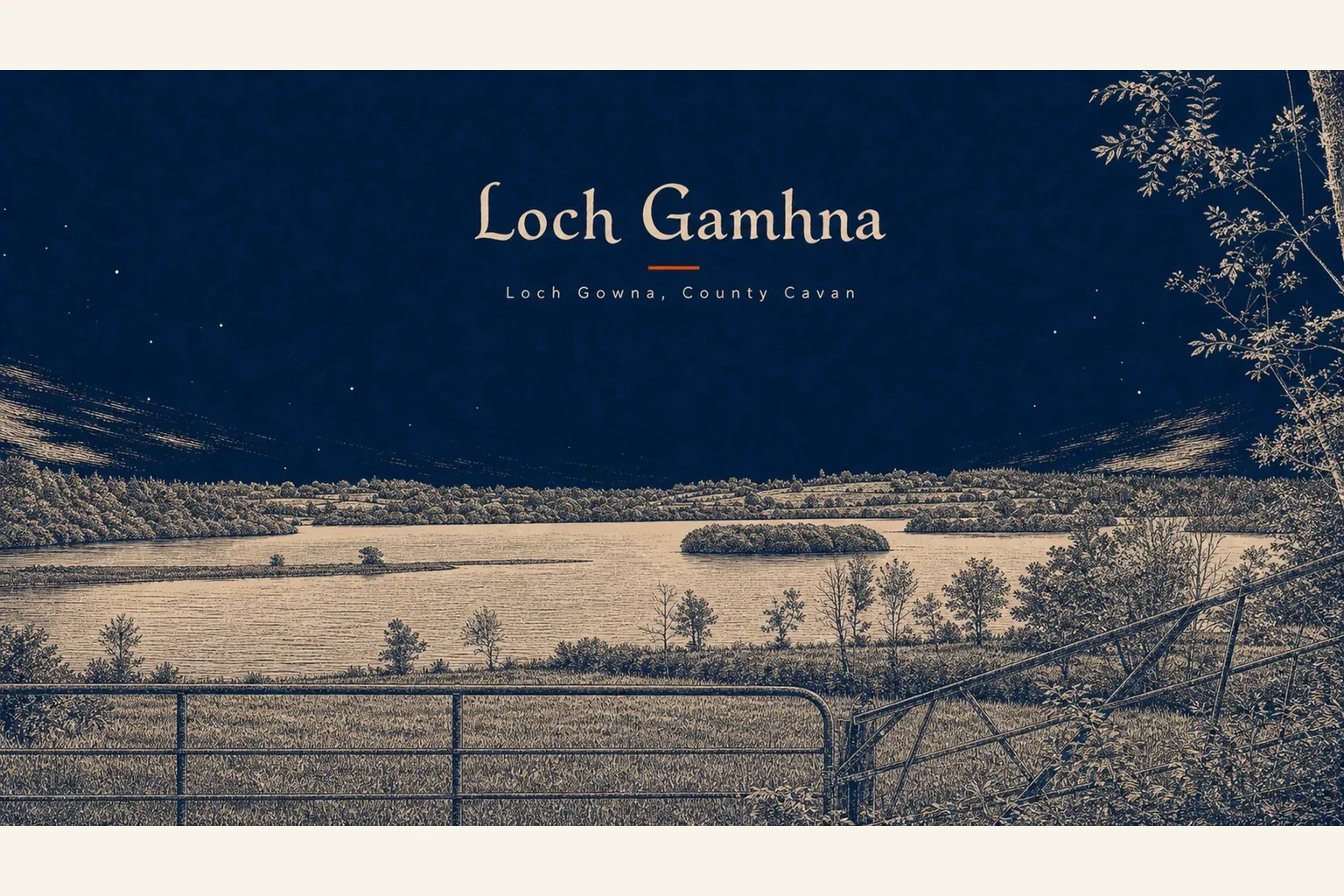
Loch Gamhna · Co. Cavan
A village that changed its name to match the lake, and was right to.
Loch Gowna was called Scrabby until 1950. That year the villagers held a plebiscite and voted to rename the place after the lake it sits beside. It was a reasonable decision - the lake had always been the point. The village is small even by Cavan standards: about 168 people, a handful of streets, a service or two for the fishing crowd and the holiday-home owners who fill the area in summer. The lake is bigger than the village and always has been.
The lake's shape is the drumlin landscape doing what it does - pushing the water into a long, irregular system of bays and inlets connected by narrow channels. That complexity is what makes it good fishing country. There are dozens of places to put a rod in where the bank angles right, the reed margin comes in close, and the pike hold in the shallower water. The coarse angling community has worked these spots out over generations. Lough Gowna is not a secret among people who care about bream.
Out in the middle of the lake, Inchmore Island - Inis Mór, the big island - carried a monastery from the sixth century. It is attributed to Colmcille, who founded enough monasteries in early Ireland to have his name attached to almost any ancient foundation in Ulster and the midlands. The monks on Inchmore were raided by Vikings in 804, survived long enough to adopt Augustinian rules by the twelfth century, and were dissolved by Henry VIII in 1543. A fifteenth-century bell from the monastery was recovered at some point and now hangs in the Catholic church at Aughnacliffe, a few kilometres south over the Longford border. The island is otherwise empty.
The name is older than the monastery. Loch Gamhna means the lake of the calf. The story behind it is that a supernatural calf escaped from a well in the townland of Rathcor and ran north, with water following it out of the ground and flooding the area behind it. Lakes across Ireland have origin legends like this - sacred wells that overflow, animals that lead water somewhere new. The one at Loch Gowna is quieter than most. The calf just ran, and the lake came after.