County Cavan Ireland · Co. Cavan · Mullagh Save · Share
POSTED FROM
MULLAGH
CO. CAVAN · IE

Mullagh
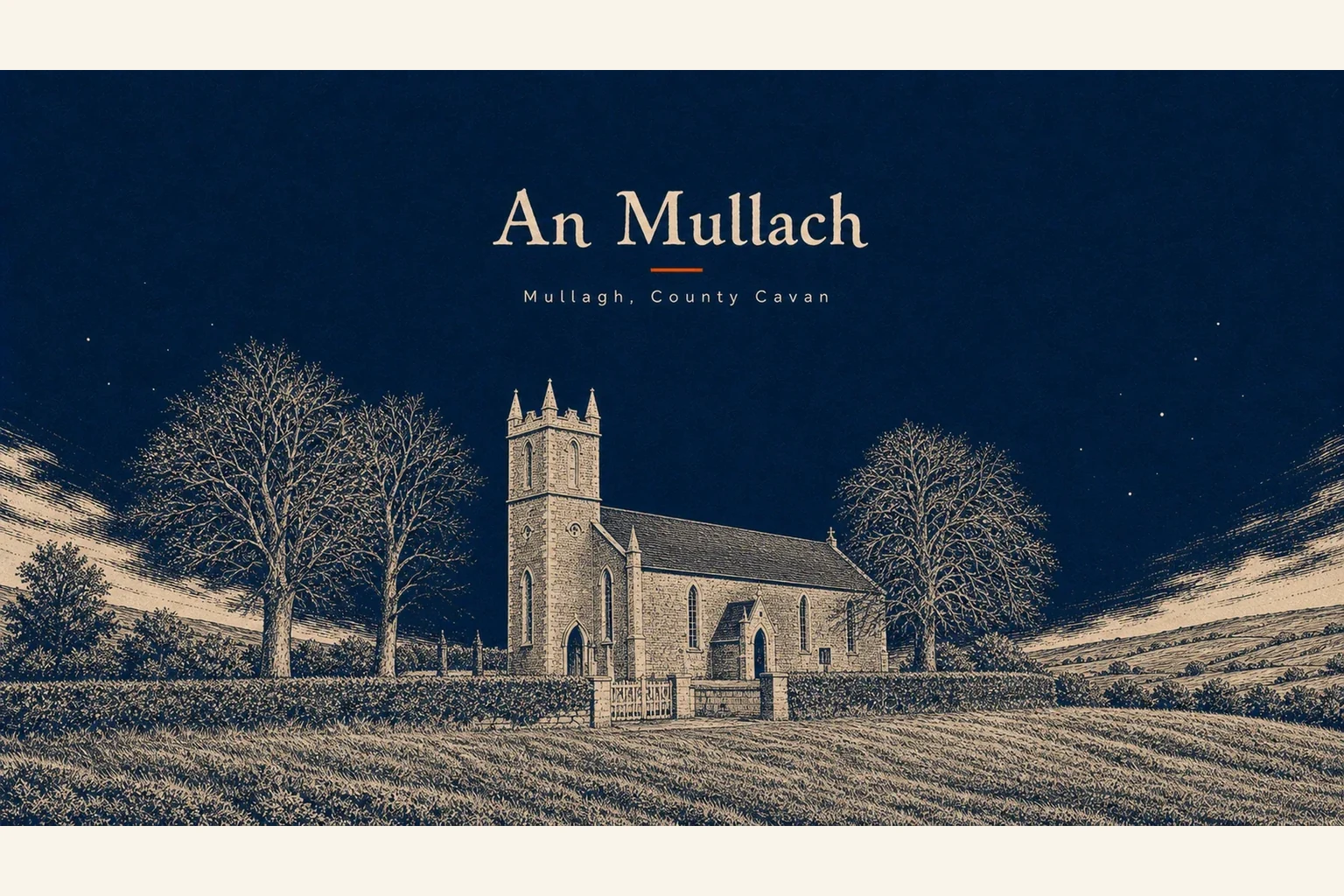
An Mullach

The Ireland's Ancient East
STOP 06 / 06
An Mullach · Co. Cavan

A Cavan village that means more in Bavaria than it does on most Irish maps.

Mullagh is a small village in the southeast of Cavan, close to the Meath border, sitting in the gentle drumlin country that rolls from here all the way to the lake district in the west of the county. It has a lake beside it, a heritage centre in the middle of it, and a connection to southern Germany that has been running, in one form or another, for fourteen hundred years.

The connection is St Killian. He was born here around 640, took holy orders, left Ireland as a young man with eleven companions, and walked east across what is now Germany until he reached Würzburg in Franconia. He converted the local duke — Gozbert — baptised him and his people, and then made the mistake of telling the duke that his marriage to his brother's widow was irregular under church law. Gozbert's wife Geilana had him beheaded on 8 July 689, along with his companions Colman and Totnan, while the duke was away. Killian is now the patron saint of Würzburg and of all Franconia. His feast day is one of the major civic occasions of the Bavarian calendar. His birthplace is a village of 1,400 people in County Cavan.

Würzburg and Mullagh have been formally twinned for decades. Bavarian pilgrims travel here each year for the feast day. The Killian Heritage Centre in the village documents his life, his mission, and the ongoing relationship between two places that have almost nothing in common except this one man. It is one of the more unlikely things in Ireland, and it is entirely true.

Outside the heritage story, Mullagh is quiet, working country. The lake is there for fishing. The roads loop through drum country past small farms. The village has what it needs and not much more. That is not a criticism. It means the one extraordinary thing about the place has room to breathe.
Population
~1,400
Walk score
Village in five minutes; lake in fifteen
Founded
Medieval parish settlement
Coords
53.8167° N, 6.9333° W
01 / 06

At a glance.

Three things every local will eventually mention. Read these and you've already understood more than most day-trippers do.

02 / 06

Stories & lore.

The reason to come back. The things every local will eventually tell you about, usually after the second pint.

How a Cavan monk got to Bavaria

The mission

Killian was born in Mullagh around 640 into a noble Irish family, educated in a monastic school, and ordained. In the tradition of the Irish peregrini — monks who left Ireland as an act of permanent pilgrimage, seeking God in foreign exile — he gathered eleven companions and sailed for the continent around 686. They made their way through France and into Thuringia, and eventually arrived in Würzburg, then the seat of Duke Gozbert. Killian converted Gozbert and his household and won papal authorisation for the mission from Pope Conon in Rome. He was the first bishop of Würzburg and the evangeliser of Franconia. All of that, from a village on the Meath border.

8 July 689

The martyrdom

Killian's death came from a marriage dispute. He told Duke Gozbert that his union with his brother's widow, Geilana, violated church law and must end. Gozbert agreed to consider it and left on a military campaign. While he was gone, Geilana had Killian and his two companions — Colman the priest and Totnan the deacon — killed. Their bodies were buried in the duke's stable and later translated to the cathedral. The date was 8 July 689. It is now a public occasion in Würzburg: the Kiliani Volksfest, one of the largest folk festivals in Bavaria, opens every year on 8 July and runs for ten days. The man who died in a Frankish stable on a summer evening is the reason for all of it.

Mullagh's account of its most famous son

The heritage centre

The Killian Heritage Centre in the village documents the saint's life from his birth in Mullagh through the continental mission and martyrdom to the cult that grew up around him in Würzburg. It covers the Würzburg twinning, the annual German pilgrimages, and the ongoing relationship between Franconia and Cavan. It is a local heritage centre run with genuine care for a story that is, when you sit down with it, genuinely extraordinary. The centre is the reason German visitors — arriving, usually, in small organised groups — make their way to a village in southeast Cavan and stand in the car park looking slightly moved.

Würzburg and Mullagh

The twinning

The formal twinning between Würzburg and Mullagh is one of the more asymmetrical town-twinning arrangements in Europe. Würzburg is a city of 130,000 on the Main River, home to a Residenz palace that is a UNESCO World Heritage Site, a cathedral that took several centuries to finish, and a wine culture going back to Killian's own time. Mullagh is a village of 1,400. What they share is one 7th-century Irishman. The relationship has produced bilateral visits, a plaque, a heritage centre, and a stream of Bavarian pilgrims arriving in Cavan each July having driven the longer half of the journey from Germany. Killian would probably find it all very strange.

03 / 06

Things to do outside.

Wear waterproofs. Bring a sandwich. Tell someone where you're going if it's the mountain.

Mullagh Lake loop Around the lake and back through the village. Flat ground, quiet road sections, the kind of coarse-fishing lake that looks best in low morning light. Tufted duck, coot, and the occasional grey heron lifting off the reeds. No crowds, no signage drama.
4 kmdistance
1 hourtime
Village heritage trail Start at the Killian Heritage Centre and walk the village — the church, the old cross sites, the markers that trace the saint's connection to the place. Brief, flat, and most useful if you have done the heritage centre first. The walk without the context is just a village street.
1.5 kmdistance
30 mintime
04 / 06

When to go.

There is no bad time. There are different times.

Spring
Mar–May

The drumlin country greens up fast. Heritage centre quiet. Good light on the lake in the mornings.

◉ Go
Summer
Jun–Aug

8 July is the feast day of St Killian — if you are here, or anywhere near here, that is the day. German pilgrims may be in the village around that time. The Kiliani Volksfest opens on the same day in Würzburg, 1,700 km away.

◉ Go
Autumn
Sep–Oct

Fishing on Mullagh Lake is at its best in autumn. The village is very quiet. Good if you want the place to yourself and a lake without an audience.

◉ Go
Winter
Nov–Feb

Heritage centre may run reduced hours — check before travelling. The lake in January is bleak in the right way if you like bleak. Not much else is happening.

◐ Mind yourself
05 / 06

What to skip.

Honestly? Don't bother.

If a local was sitting beside you, this is the bit where they'd lean in.

×
Expecting a big heritage attraction

The Killian Heritage Centre is small and earnest, not a Fáilte Ireland flagship. It is a local operation run by people who care, and it works. Do not arrive expecting a visitor complex with a café and a gift shop and an immersive experience. Arrive expecting a well-told story in a small building.

×
Coming for the feast day without checking what is actually happening in Mullagh

The big Killian event on 8 July is in Würzburg, not Mullagh. The German pilgrimage to the village is a real thing, but it varies year to year in scale and timing. Check with the heritage centre before planning a special trip around it.

×
Driving through and deciding there is nothing here

It looks like a crossroads. The heritage centre is not visible from the main road. Stop. Go in. The story of a man who walked from this village to Bavaria in the 7th century, converted a duchy, and got martyred for criticising a duke's marriage is worth twenty minutes of your time.

+

Getting there.

By car

Dublin to Mullagh is about 90 minutes — up the N3 toward Cavan, then east toward the Meath border. Virginia is 15 minutes west. Kells in Meath is about 20 minutes southeast. Ballyjamesduff is ten minutes west.

By bus

No direct Bus Éireann service to Mullagh. The closest stop on regular services is Virginia on the 109 Dublin–Cavan route. A car is the practical option.

By train

No train. Nearest stations are at Drogheda or Dublin Connolly, both about 90 minutes by car.

By air

Dublin Airport (DUB) is the obvious entry point — roughly 80 minutes by car. For German visitors coming to see Killian's birthplace, the route is Frankfurt or Munich to Dublin, then north.