Turlough O'Brien, and four centuries of repairs
The bridge of 1506
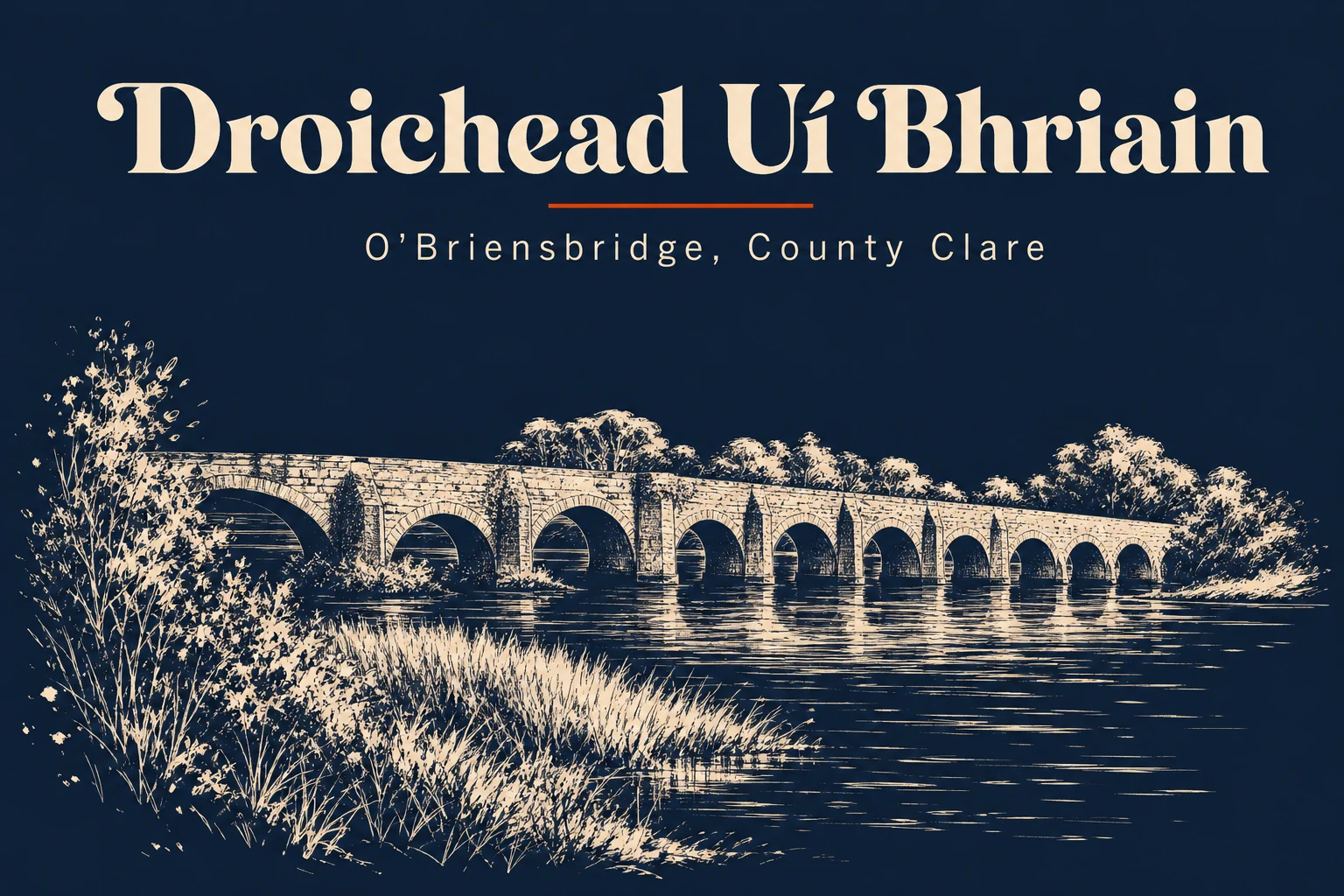
Turlough O'Brien, first Earl of Thomond, and his brother the Bishop of Killaloe built the first bridge across the Shannon here in 1506. It was timber, and Gearoid Mor FitzGerald, eighth Earl of Kildare, burned it in 1510. The O'Briens rebuilt it with two castles, walls twelve feet thick, one on each bank, linked by a seven-arch wooden span that rose fifteen feet above the water. In 1537 Leonard Grey, Henry VIII's Lord Deputy, destroyed that too after a long fight against the rebelling O'Briens. The later stone bridge was built around 1750, partly replaced by the Shannon Commissioners in 1842, and modified with a navigation arch during the Ardnacrusha hydro works of the 1920s. The family name is stamped on the river permanently.
Limerick to Killaloe, one bridge
The only crossing
For all its size, O'Briensbridge has carried serious traffic for five centuries. It provides the only crossing of the Shannon between Limerick city and Killaloe - a span of river roughly twenty-five kilometres long with no other bridge. That is why a fight over a wooden bridge here mattered enough to draw in earls and Lord Deputies, and why the village exists at all. The river was the obstacle; the bridge was the prize.
Horses, towpaths and the old Shannon navigation
The Errina canal and the barge road
Before Ardnacrusha tamed this stretch in the 1920s, the Shannon above O'Briensbridge ran through rapids that boats could not pass. The Errina canal was cut to carry barges around them, and a towpath ran alongside it where horses hauled the boats upriver. The navigation is long gone, but the canal cut and the old barge road survive as the spine of the village's looped walks. It is now being redeveloped as a recreational route for walkers and anglers.