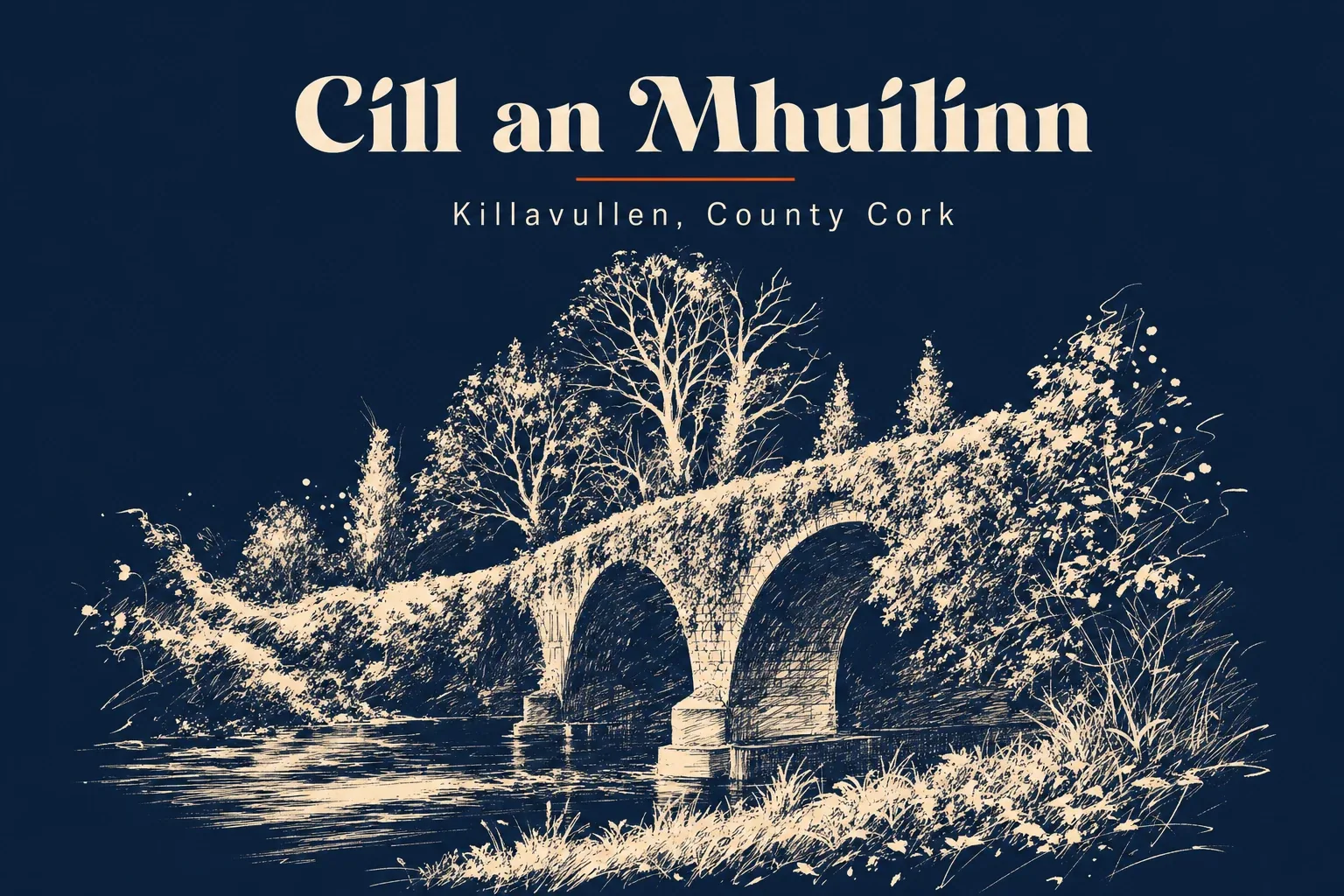
Cill an Mhuilinn · Co. Cork
A small Blackwater village that gave the world Hennessy cognac and Nano Nagle - and has bone caves under the bridge full of bear, wolf and reindeer.
Killavullen is a small place on a bend of the Blackwater between Mallow and Castletownroche, ten kilometres east of Mallow and a little south of the N72. The name is Cill an Mhuilinn - the church of the mill. The village sits astride the river where the water cuts through limestone gorges, and the houses run up the slope above the bridge. Two hundred-odd people. A church, a community centre, a pub.
What is unusual about it is how much history sits on so few people. Richard Hennessy, of the cognac, was born at Ballymacmoy House above the village in 1724 and the family still hold the house. Nano Nagle, who founded the Presentation Sisters and ran an illegal school network for poor children when that was a crime, was born at Ballygriffin just outside the village in 1718. Edmund Burke, the philosopher and parliamentarian, got some of his early schooling in a hedge school here. For a hamlet, that is a remarkable roll-call.
Then there are the caves. Down by the bridge, in the limestone on the south bank, are caves that were lived in within recorded memory and that gave up the bones of bear, wolf, reindeer and Irish elk when they were dug in the 1930s. The animals are long gone from Ireland. The bones came out of the ground here.
You do not come to Killavullen for nightlife or shops. You come because you are following the Blackwater, or the Hennessy story, or Nano Nagle, or you want a long loop walk up into the Nagle Mountains with the river valley laid out below. Mallow is ten minutes west for anything the village does not hold.