County Cork Ireland · Co. Cork · Shanballymore Save · Share
POSTED FROM
SHANBALLYMORE
CO. CORK · IE

Shanballymore
An Seanbhaile Mór, Co. Cork

The North Cork
STOP 09 / 09
An Seanbhaile Mór · Co. Cork

A village of under two hundred people on the north bank of the Awbeg, with one pub, a landmark church built from a soldier's barracks, and the Nagle name written into the fields all round it.

Shanballymore sits on the north bank of the Awbeg, the river Edmund Spenser called the Mulla in The Faerie Queene, on the road that runs from Mallow toward Mitchelstown. It is small. The 2022 census counted 184 people. Locals call it Shanbla and have done for generations, which tells you something about how little fuss the place makes about itself.

The Irish name, An Seanbhaile Mór, means the big old town, and there is more truth in the 'old' than the 'big'. This is Nagle country - the Norman family who held the Awbeg valley from the Middle Ages, who left tower houses in the townlands at Ballinamona and on toward Annakisha and Killavullen, and who produced Nano Nagle, the eighteenth-century foundress of the Presentation Sisters. Children from Shanballymore were schooled by her order in Doneraile, five kilometres west.

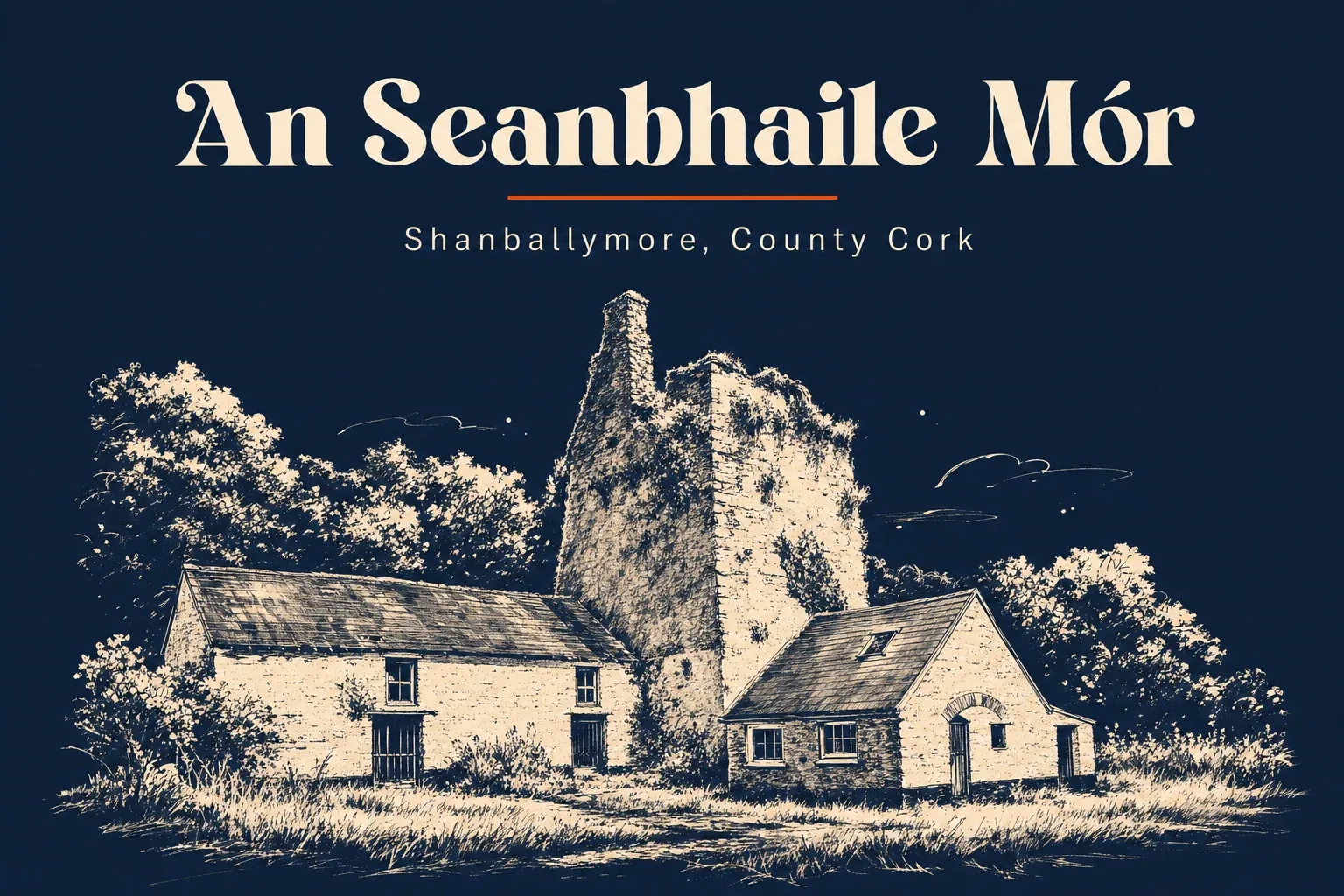
The one building you cannot miss is the Church of Christ the King, up on the high ground in the middle of the village. It was built in 1933 out of cut limestone salvaged from the chapel of the army barracks in Buttevant - good stone given a second life. There is a pub, the Corner House, a national school, and the GAA club, and that is about the size of the village proper. An older bar, O'Farrell's, closed in 2005 and is gone now.

Do not come expecting a destination. Shanballymore is a quiet farming village you pass through between better-known stops - Doneraile and its deer park to the west, Castletownroche and Anne's Grove gardens to the south, Kildorrery to the east. Come for the church, the river, the Nagle history in the surrounding fields, and the particular pleasure of a place that is exactly what it looks like and no more. Mallow, with the restaurants and the train, is fifteen minutes away.
Population
~184 (2022)
Coords
52.2200° N, 8.4700° W
01 / 09

At a glance.

Three things every local will eventually mention. Read these and you've already understood more than most day-trippers do.

02 / 09

The pubs.

None of these are themed Irish pubs, because they don't need to be. A few that earn the trip:

The Corner House

Local, plain, the one bar in the village
Village pub

Shanballymore's pub, and effectively the only one since O'Farrell's on the main street closed in 2005. It is a small village bar that does what a village bar does - a pint, the day's talk, the GAA on the television. Not a destination, and it would not claim to be. If you want a real night out with food and choice, Mallow is fifteen minutes off.

03 / 09

Where to eat.

PlaceTypeLocal note
Shanballymore village Very limited There is no restaurant scene here. A village of under two hundred people keeps a pub and not much more in the way of eating out. Plan your meal somewhere else and treat Shanballymore as a stop rather than a sitting.
Mallow (15 minutes) Proper restaurants €€ The straight answer for a real meal. Mallow, fifteen minutes west, carries the restaurants, the shops and the choice that a market town of its size holds. Doneraile, five minutes the other way, has its pub kitchen if you only want something basic.
04 / 09

Where to sleep.

PlaceTypeLocal note
The Awbeg valley villages B&Bs and guesthouses Shanballymore itself has little to no formal accommodation. There are scattered B&B and guesthouse rooms in the surrounding villages - Doneraile and Castletownroche among them - but they are small and limited, so book ahead rather than arrive hoping.
Mallow (15 minutes) Hotels For a proper hotel and real choice, Mallow is the base for this corner of North Cork. Shanballymore is somewhere you pass through, not somewhere most people stay the night.
05 / 09

Stories & lore.

The reason to come back. The things every local will eventually tell you about, usually after the second pint.

Christ the King, 1933

The church built from a barracks

The Church of Christ the King was built in 1933 on an elevated site that makes it the landmark of the village. Its quiet distinction is in the stone: the builders reused fine cut limestone from the nineteenth-century chapel of the military barracks in Buttevant, a few miles off. It is a cruciform church, snecked squared limestone walls, a four-bay nave, pointed-arch windows with stained glass, and a concrete bellcote with a metal cross. A cast-iron railing salvaged from the earlier village church was set at the entrance. The whole thing is a piece of recycling on a parish scale - an army chapel taken down and stood back up to serve the people who never wore a uniform.

A Norman family and the woman who taught the poor

Nano Nagle and the Nagle castles

The Nagles were a Norman family who held this stretch of the Awbeg valley from the Middle Ages, strong almost from the day they arrived. The townlands around Shanballymore carry the remains of their tower houses - Ballinamona among them - and the family held castles on toward Annakisha and Killavullen as well. Sir Richard Nagle of Clogher rose to be Solicitor General for Ireland under James II. But the Nagle who matters most is Nano Nagle, the eighteenth-century woman who founded the Presentation Sisters and built a network of schools for the poor Catholic children of Cork when teaching them was barely legal. Children from Shanballymore were educated by her order at the Presentation convent in Doneraile. The castles are mostly low ruins in fields now; her work outlasted the stone.

Sonnach Gobunn, Templeroan, Shanballymore

Three names for one village

Few villages this small have changed their name twice and kept all three in use. The earliest, Sonnach Gobunn, appears in the Críchad an Chaoilli around 1100 and in the Papal Taxation of 1291. The second, Templeroan, arrives around 1400 and survives as the name of the civil and Church of Ireland parish. The third and most recent, Shanballymore - the big old town - is the name of the Roman Catholic parish and of the village on the signpost. Locals cut through all of it and just say Shanbla.

06 / 09

Things to do outside.

Wear waterproofs. Bring a sandwich. Tell someone where you're going if it's the mountain.

Church of Christ the King Up on the high ground in the centre of the village. Walk the exterior for the snecked limestone and the bellcote, and note the cast-iron railing carried over from the older church. The reused Buttevant barracks stone is the thing to look at. A landmark you can see before you reach the village.
In the villagedistance
20-30 mintime
The Awbeg riverbank Spenser's Mulla, the same river that runs past Doneraile and Castletownroche. Nothing here is signposted or sold - the water just runs quiet through farmland on the north edge of the village. Good for a slow half hour if you like a river that does not perform.
Variabledistance
As long as you liketime
Wallstown Castle (toward Castletownroche) A ruined four-storey tower house that takes its name from the Norman Wall family, captured by Lord Inchiquin in 1642 during the Confederate Wars. It stands in farmland between Shanballymore and Castletownroche. Unmarked and uninterpreted - ruins in a field rather than a visitor site. Respect any boundaries and ask locally about access.
Short drive west of the villagedistance
30 mintime
07 / 09

When to go.

There is no bad time. There are different times.

Spring
Mar-May

Quiet, green, the Awbeg valley at its best and the church stone taking the light. There are never crowds here, in any season.

◉ Go
Summer
Jun-Aug

The easiest weather for the river walk and for the short drives out to Doneraile and Castletownroche. Long evenings, empty roads.

◉ Go
Autumn
Sep-Oct

Low afternoon light on the limestone of the church and on the castle ruins in the fields. A good time for the photographs you came for.

◉ Go
Winter
Nov-Feb

Short days and North Cork wet. The church and the pub keep going, but there is little to hold you here in poor weather. Bring boots and low expectations of the sky.

◐ Mind yourself
08 / 09

What to skip.

Honestly? Don't bother.

If a local was sitting beside you, this is the bit where they'd lean in.

×
Expecting a village that fills a day

Shanballymore is under two hundred people, one pub, a church and a school. You can see the church, walk a stretch of the Awbeg and be on your way inside an hour. That is not a fault - it is simply the scale of the place.

×
Looking for restaurants or a hotel in the village

There are none to speak of. For a real meal or a hotel bed, Mallow is fifteen minutes west. Plan accordingly rather than arrive hungry or tired.

×
Hunting for grand standing Nagle castles

The Nagle tower houses around the parish are mostly low ruins in private fields now, unmarked and uninterpreted. The better-preserved Nagle and Roche castles are downriver toward Killavullen and Castletownroche. If you need a castle to walk into, this is the wrong stop.

×
Asking for O'Farrell's bar

It was a well-known main-street pub, but it closed in 2005 and is no longer licensed. The Corner House is the village's pub now. Do not go looking for a bar that shut two decades ago.

+

Getting there.

By car

Shanballymore sits off the N73 Mallow to Mitchelstown road, on the north bank of the Awbeg. From Cork city it is about an hour via the N20 to Mallow and then east. Mallow is roughly fifteen minutes west, Doneraile five minutes, Castletownroche and Kildorrery a short drive either side.

By bus

There is no useful scheduled town bus through the village itself. Local Link covers the rural roads of North Cork on a limited timetable - check before relying on it. The nearest real bus and transport hub is Mallow.

By train

The nearest station is Mallow, about fifteen minutes west, on the Dublin to Cork main line with frequent services in both directions. There is no station at Shanballymore.

By air

Cork Airport (ORK) is about an hour south. Shannon (SNN) is around 90 minutes north. Cork is the more frequent option for most visitors.