County Derry Ireland · Co. Derry · Macosquin Save · Share
POSTED FROM
MACOSQUIN
CO. DERRY · IE

Macosquin
Maigh Choscáin

The Causeway Coast and Glens
STOP 05 / 05
Maigh Choscáin · Co. Derry

A Plantation village built on top of a Cistercian abbey, four miles south of Coleraine.

Macosquin is a small village four miles south-west of Coleraine, on the road to Limavady. Six hundred people, a Plantation grid laid down in the early 1600s, and a parish church on a hill that is older than any of it.

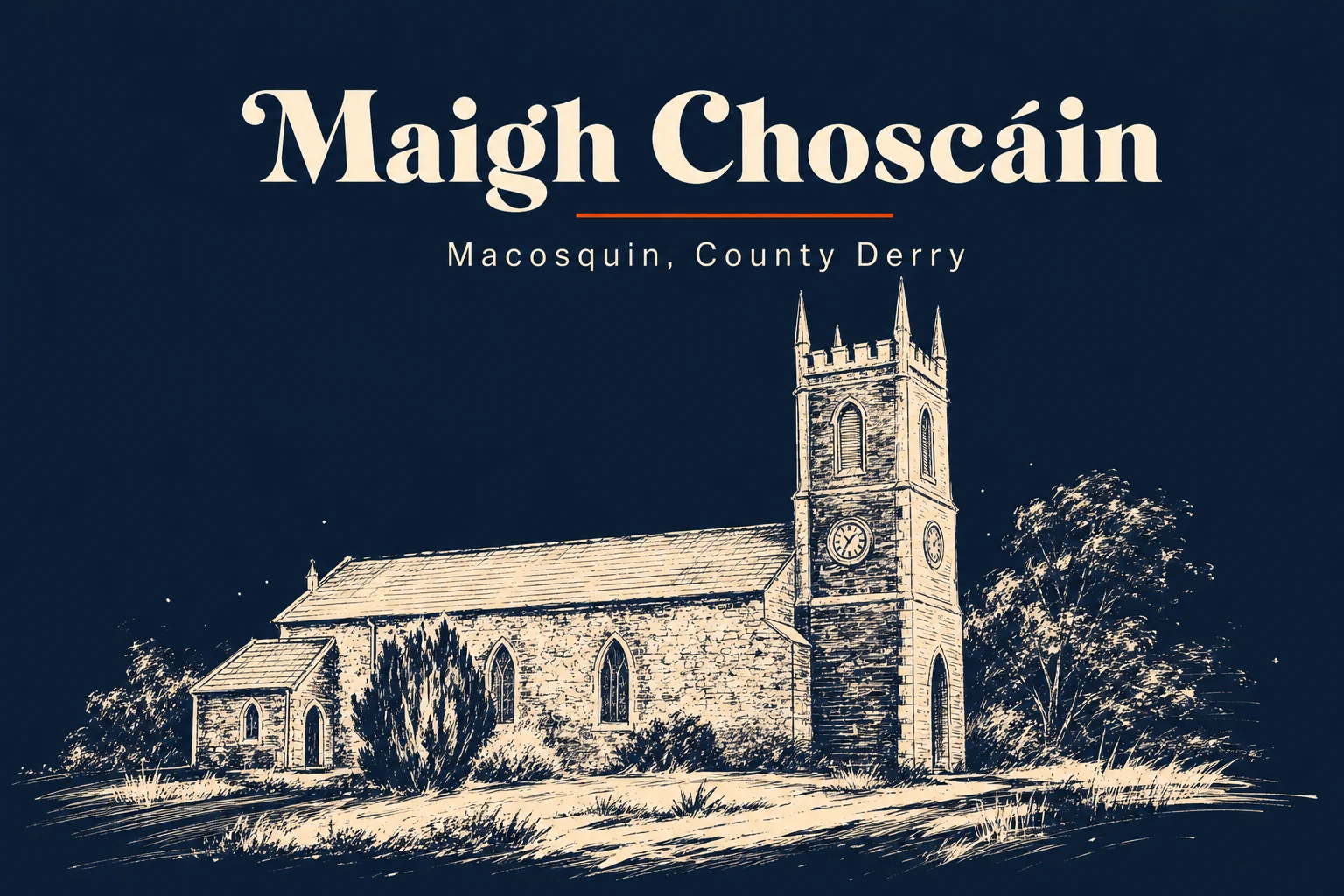
The angle here is the Cistercian abbey. Monks from Morimond in France founded a house called Clarus Fons — the Clear Spring — on this spot in 1217. The Order of the London Merchant Taylors got the land at Plantation in the early 17th century, and the parish church of St Mary's was raised on the abbey's footprint in 1616, reusing a 13th-century lancet window in the north wall. Half the medieval church is under the present graveyard. Stand at the east end of the chancel and you're standing on the line of the old presbytery.

Two miles off, on a bend in the Bann at Castleroe, sits Camus — the older site. A monastery attributed to St Comgall of Bangor, sixth century. The remnant is the stock of a sandstone high cross carved with scenes from Genesis and the baptism of Christ. It was broken in the 1700s and the surviving lower portion now sits in the graveyard. The village proper has none of this — you have to drive down to find it. Worth the drive.
Population
604 (2021)
Walk score
Plantation grid, ten minutes end to end
Founded
Cistercian abbey founded 1217
Coords
55.1136° N, 6.7239° W
01 / 05

At a glance.

Three things every local will eventually mention. Read these and you've already understood more than most day-trippers do.

02 / 05

Stories & lore.

The reason to come back. The things every local will eventually tell you about, usually after the second pint.

The Cistercian abbey, 1217

Clarus Fons

Monks from Morimond — a daughter house of Cîteaux in Champagne — colonised Macosquin in 1217, dedicating their new house to Our Lady of the Clear Spring. The site is the rise above the village. By 1539 the place had fallen into disrepair. At Plantation the lands were granted to the London Guild of Merchant Taylors and the parish church was built into the abbey shell in 1616. The 13th-century lancet window in the north wall of St Mary's is the surviving piece of stone. Everything else is foundations under the grass.

An older monastery on the river

Camus-juxta-Bann

Two miles east of the village, at Castleroe on a bend of the Bann, lies Camus — Camas-Comgaill in older spellings. A monastery attributed to St Comgall of Bangor in the sixth century. The site overlooks what was a known ford on the river. The parish name 'Camus-juxta-Bann' — Camus next to the Bann — kept the link alive in the church records for centuries. What's left is the graveyard and the broken sandstone high cross.

Used as a gatepost

The high cross stock

The Camus high cross stood in the graveyard until the mid-1700s, when it was broken — accident, lightning or vandalism, no one's sure. The remaining stub was reused as a gatepost into the churchyard for a stretch before anyone realised what they'd done. It's sandstone, carved with the Ark, the murder of Abel, and the baptism of Christ. It's still there. Park at the gate on Curragh Road and walk in.

How the village got its grid

The Merchant Taylors' Plantation

The Plantation of Ulster carved Derry up among the London livery companies. Macosquin and its lands fell to the Worshipful Company of Merchant Taylors. The grid you walk today — the church on the rise, the main street running off it, the lanes laid out at right angles — is theirs. The abbey was already a ruin by 1609 when James I handed it across. The Merchant Taylors took the stone, kept the church, and built a village around what was left.

03 / 05

When to go.

There is no bad time. There are different times.

Spring
Mar–May

Daffodils up the churchyard wall. The Bann salmon are running by April. Drive down to Camus while the hedges are still bare and you can see the river through the trees.

◉ Go
Summer
Jun–Aug

Long evenings, dry walking. Coleraine's busy. Macosquin isn't.

◉ Go
Autumn
Sep–Oct

Quiet. The good light. The churchyard is the kind of place autumn is invented for.

◉ Go
Winter
Nov–Feb

The village shuts in on itself. If you're driving down to Camus, the lanes can be greasy after rain. Boots, not trainers.

◐ Mind yourself
04 / 05

What to skip.

Honestly? Don't bother.

If a local was sitting beside you, this is the bit where they'd lean in.

×
Looking for the abbey ruins on the surface

There's barely anything above ground. The interest is the church the abbey is buried under, and the lancet window in the north wall. Read the plaque, look up.

×
Driving past Camus on the way to Coleraine

It's a two-mile detour and the older, stranger of the two sites. The high cross stub is what you actually came for.

×
Expecting pubs and food

There are none worth naming in the village. Coleraine is ten minutes north. Plan accordingly.

+

Getting there.

By car

Coleraine to Macosquin is 10 minutes south-west on the B201 (Macosquin Road). From Limavady, 20 minutes north on the same road in reverse. Camus graveyard is on Curragh Road, two miles east — sign-posted, just.

By bus

Translink Ulsterbus 234 (Coleraine–Limavady) stops at Macosquin a few times a day. Check NI Translink before you commit.

By train

Nearest station is Coleraine on the Belfast–Derry line. Then bus or a six-pound taxi.

By air

City of Derry Airport (LDY) is 30 minutes. Belfast International is 75 minutes.