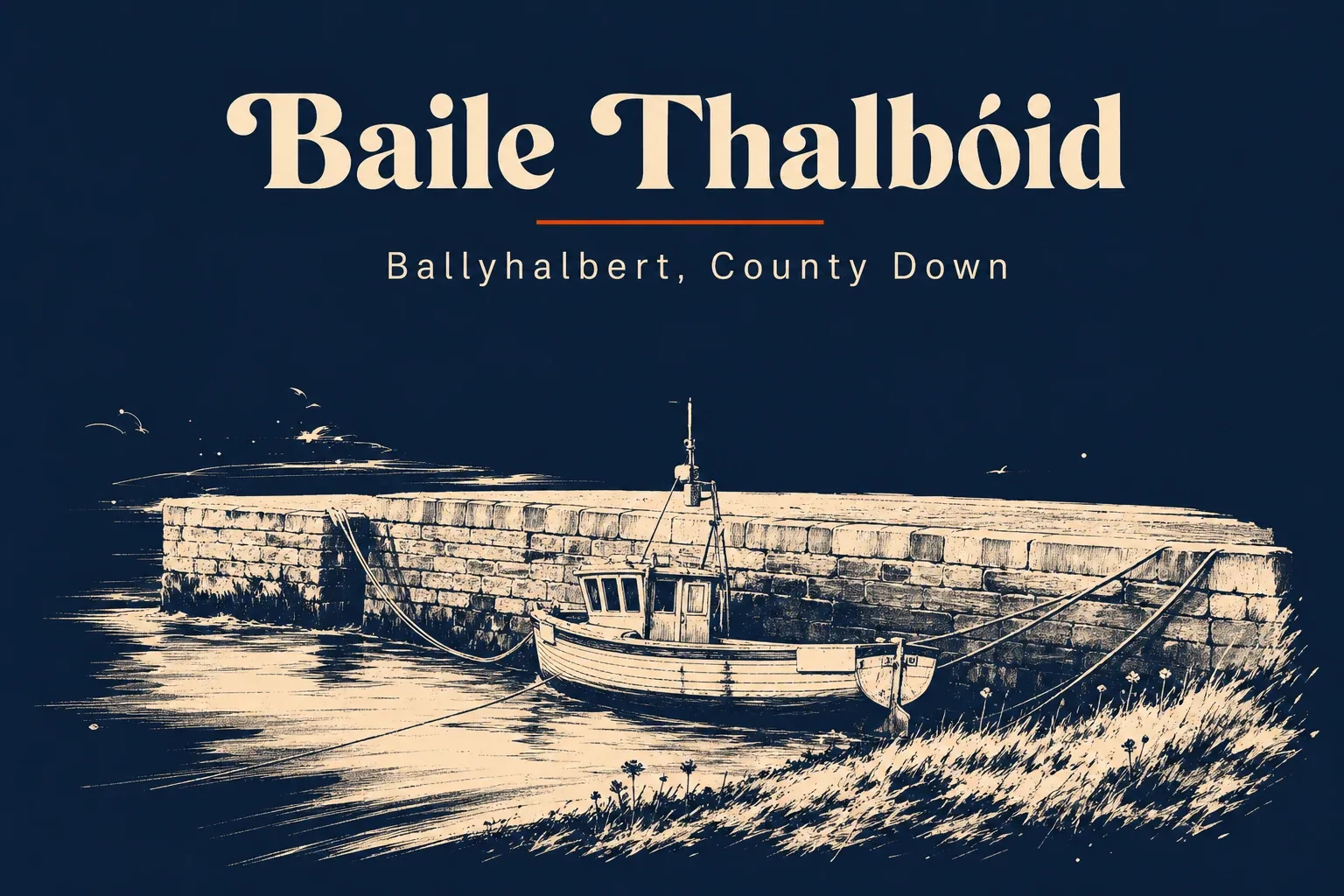
Baile Thalbóid · Co. Down
Ireland's easternmost village. A small harbour, a big caravan park, a vanished airfield.
Ballyhalbert is a single street of houses, a tidal harbour, and the largest caravan park in the north sitting on the footprint of a wartime airfield. The village proper has a population of around 1,266. The caravan park, in season, has many times that. Most visitors don't notice the village at all - they come in off the A2, turn through the gates of Ballyhalbert Holiday Park, and don't come out again until they leave.
The reason to stop is south of all that. Burr Point is the most easterly point on the island of Ireland. The steel letter-E sculpture by Ned Jackson Smyth stands back in Ballyhalbert harbour, marking the easternmost direction. It is two kilometres of quiet coast walk from the harbour, with Burial Island - a tern colony with a Viking burial legend attached - sitting a stone's throw offshore. There is no car park at the point itself; the access road is residents-only. You walk in.
The other reason is the past. RAF Ballyhalbert opened on the 28th of June 1941 with the brief of defending Belfast from the east. By 1943 the Polish Air Force had moved in: 315 'City of Deblin' Squadron from July to November, then 303 'Kosciuszko' Squadron from November through to the following April. General Sosnkowski flew in on the 14th of August 1943 to pin Virtuti Militari crosses on four of the pilots. The Poles called it Belfast-the-quiet-posting. The airfield closed in 1945. The caravans arrived after.
There is no pub in the village. There is a chipper, a SPAR with a coffee bar, the holiday park's clubhouse, and ten minutes' drive in either direction to a proper bar. That is the deal. Come for Burr Point, the airfield ghost, and a long flat walk along the east coast. Leave when the tide does.