The sinking tower
Kirkistown Castle
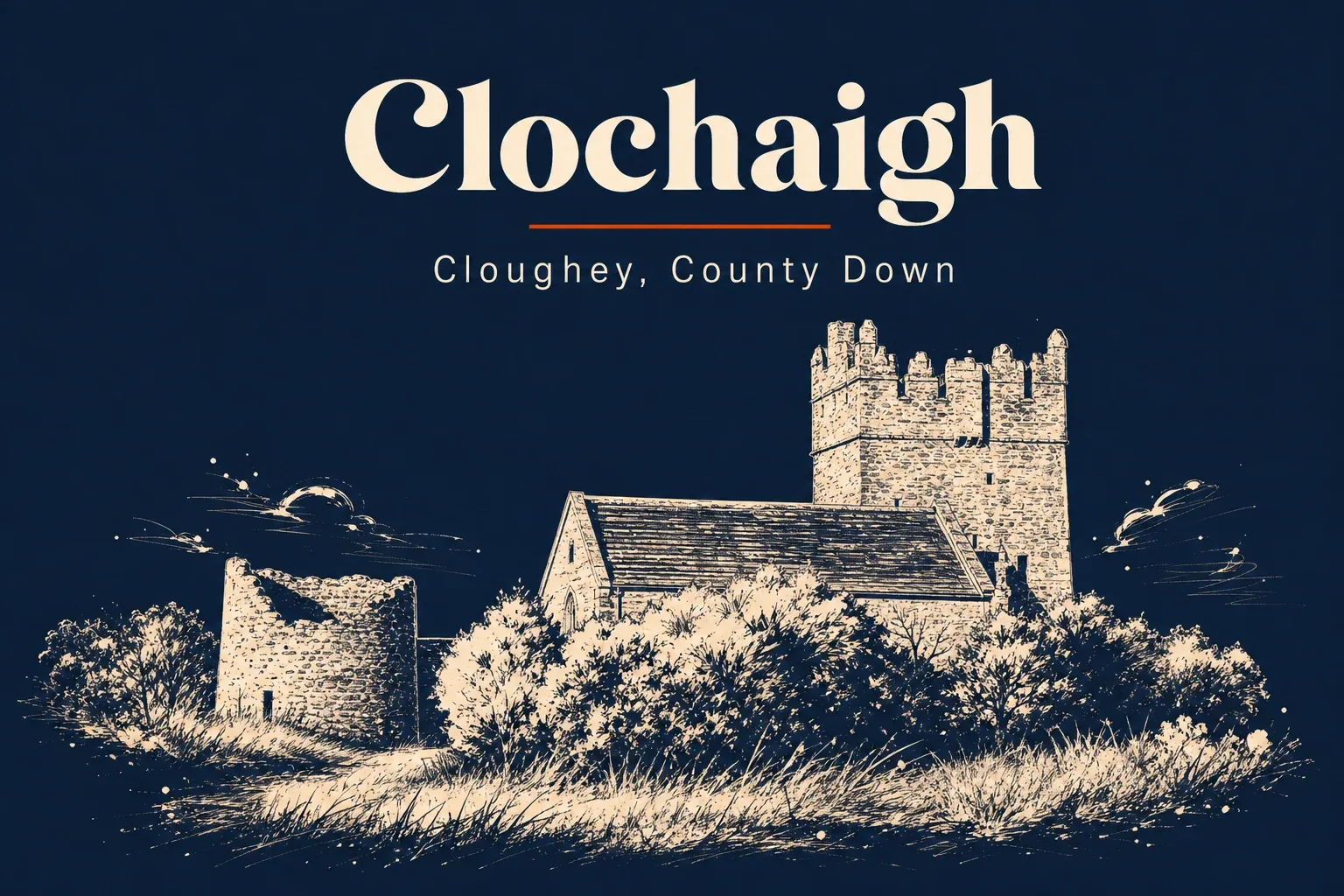
Built around 1622 by Roland Savage of Ballygalget, possibly reusing an earlier site. Three storeys, the remains of a bawn around it, a barn added later. The Savages were a Norman family who had held the south Ards since the 13th century and the castle was the seat of one branch. The ground underneath is marshy and the tower has been settling almost since it was built. In the late 19th century someone finally bolted iron braces across the walls and threw buttresses up the sides to stop the whole thing leaning into the sea. It is still there. It is still leaning, gently.
Before the Savages
The Knights of St John
Before the tower house there was a commandery — a religious-military outpost — of the Knights of the Order of St John of Jerusalem, the Knights Hospitaller. They held land along the Ards in the medieval period. A reference in 1744 to 'the late monastery of St John of Jerusalem' is one of the last mentions; by then the foundation was long gone. The Savages took the site and built the tower house on top. The parish graveyard sits inside an older rath — a ringfort from the first millennium — with the ruins of a medieval church inside it, believed to be the Church of Ardmacossce mentioned in the Taxation of Pope Nicholas in 1306.
Kirkistown Castle Golf Club, 1934
James Braid laid out the course
The golf club was founded on 3 September 1902, with Major General W E Montgomery leasing the Sandgrass Farm at Cloughey for the purpose. The course was extended to 18 holes in 1929. In 1934 the legendary James Braid — five-time Open champion, designer of Carnoustie and Gleneagles — came over for a day, walked the ground, and laid out the present course. He spent the morning marking out the tees and greens and the afternoon shaping the bunkers. The dip in front of the first tee, and the depression behind the third green, are both there because sand was dug out of the course in 1941 to build the runways at Kirkistown and Ballyhalbert aerodromes.
RAF Kirkistown to club-owned track
The airfield and the circuit
RAF Kirkistown opened in July 1941 as a satellite for RAF Ballyhalbert, three concrete runways laid down on flat ground a mile inland from the beach. Late in the war the Navy took it over and renamed it HMS Corncrake II, the standard Navy fiction of treating shore bases as ships. After the war the runways went quiet. In 1953 the 500 Motor Racing Club of Ireland turned up, marked out a course with straw bales on the old east–west runway and the northern perimeter road, and ran race control out of a parked double-decker bus. Le Mans winner Ivor Bueb won the 500cc Championship of Ireland here in 1957 a fortnight after his Le Mans victory. The club leased the land until the 1970s, then bought it outright — making Kirkistown the only club-owned and operated permanent motor racing circuit in the British Isles.
Before the road came
Coal under sail
Before the coast road was improved, the village's coal came in by sea from Scotland. Two-masted schooners would sail into Cloughey Bay at full tide and drop anchor. As the tide ran out, horses and carts would go down the strand and unload the cargo straight off the deck onto the wet sand. The schooner refloated on the next tide and sailed away. It is hard to picture from the modern beach; the dunes have moved, the boardwalk is new, the boats are gone. But the bay is shallow and gentle enough that it worked, for a couple of centuries, as a working port that wasn't really a port.