County Down Ireland · Co. Down · Portavogie Save · Share
POSTED FROM
PORTAVOGIE
CO. DOWN · IE

Portavogie
Port an Bhogaigh

The Ards Peninsula
STOP 08 / 08
Port an Bhogaigh · Co. Down

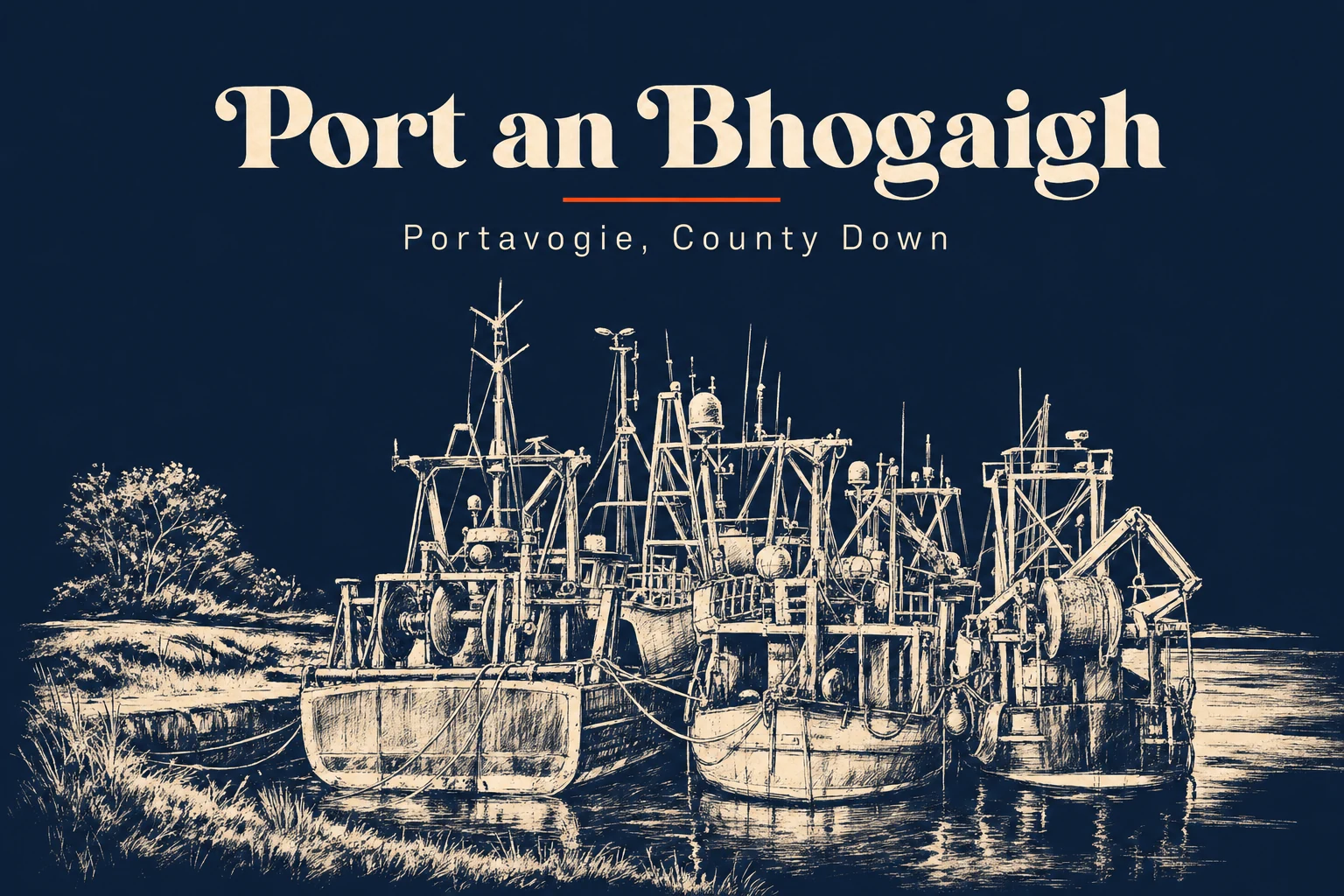
A working prawn port on the east coast of the Ards. The harbour is the whole story.

Portavogie is a working fishing port on the east shore of the Ards Peninsula. Not a heritage trail with a working harbour bolted on — the actual port, with the actual fleet, with the actual auctions on the quay most evenings of the week. The catch is nephrops, mostly: the local prawns that go out as scampi to half the lounge bars in the north.

The village itself is small and blunt. A line of houses up the hill behind the harbour, a Presbyterian church looking down on it, a primary school with three murals of the fishing fleet painted on the outside wall. The people are descended in good part from Scottish Covenanters who fled persecution in the 1600s, and from a wave of fishing families who came across from Maidens in Ayrshire around 1750 and built the place into what it is. The Ulster-Scots in the village is closer to Lowland Scots than to anything you'll hear in Belfast.

There's no real tourist apparatus. One pub-restaurant down by the quay that's been billed for years as the easternmost pub in Ireland. A long flat beach at East Shore. A coastal road that runs north to Ballyhalbert and Burr Point — the actual easternmost spot on the island — and south to Cloughey's two miles of white sand. Come down for an afternoon. Eat prawns. Watch a boat tie up. That's the deal.
Population
2,269 (2021)
Walk score
Harbour-to-harbour in fifteen minutes
Founded
Harbour completed 1904; Scottish fishing families from 1750
Coords
54.4636° N, 5.4486° W
01 / 08

At a glance.

Three things every local will eventually mention. Read these and you've already understood more than most day-trippers do.

02 / 08

The pubs.

None of these are themed Irish pubs, because they don't need to be. A few that earn the trip:

The New Quays

Easternmost pub on the island
Pub & seafood restaurant

Sits at 81 New Harbour Road, less than a hundred yards from the quayside, and gets the prawns walked up from the boat. The Mediterranean-feeling split-level dining room is doing real things with scallops and Portavogie haddock. The bar is a small east-coast local with the harbour out the window.

03 / 08

Where to eat.

PlaceTypeLocal note
The New Quays seafood kitchen Seafood restaurant €€ The headline. Pan-fried scallops with black pudding, hand-shelled Portavogie prawns, Dover sole and turbot when the season delivers. The fish moves about fifty yards from boat to pan. Book at weekends.
Portavogie scampi, anywhere A regional thing Order it in any decent bar from here to Belfast and the prawns are likely off a boat tied up at the Portavogie quay that morning. It is not posh and it is not pretending to be. It is the thing.
The Saltwater Brig (Kircubbin/Portaferry road) Pub & seafood, 15 min drive €€ Not in Portavogie — sits between Kircubbin and Portaferry on the Strangford side — but it's where you go for hand-shelled Portavogie prawns done properly, in a place that's been pulling pints since 1765.
04 / 08

Stories & lore.

The reason to come back. The things every local will eventually tell you about, usually after the second pint.

Ayrshire to the Ards, 1750

The Maidens families

Portavogie was a few cottages and not much else until the middle of the 18th century. Around 1750 a community of Scottish fishing families crossed from Maidens, a small port on the Ayrshire coast, and settled here. They brought the boats, the techniques, and a strong strand of Lowland Scots that you can still hear on the quay. By 1880 there were almost three hundred houses; by 1904 the new harbour was finished. A village built by immigration, on purpose.

Why the church is Presbyterian

Covenanters on the coast

Many of the earlier settlers were Covenanters — Scottish Presbyterian dissenters fleeing persecution in the late 1600s. The Ards Peninsula was a soft landing: empty coast, sympathetic landlords, sea to the east. The Presbyterian church above the harbour and the Reformed Presbyterian tradition that's still strong in the village both trace back to that wave. The Ulster-Scots identity here is not a recent revival; it's continuous.

The fleet, painted

Three murals on the school wall

The exterior of the local primary school carries three murals of the fishing fleet — the boats, the catch, the harbour as it has been for a century. It is the only outdoor gallery in the village, and the kids walk past it every day. There are not many places where the way the parents earn a living is painted twelve foot high on the way to class.

And the modern fleet

The 1904 harbour

The harbour as you see it was completed in 1904, expanded several times since, and now houses one of only three working fishing ports left in Northern Ireland — the other two are Kilkeel down on the Mournes coast and Ardglass on the other side of the Lecale. The boats are trawlers, the catch is mainly nephrops with herring as a second string, and most evenings between five and seven there is a fish auction on the quay. It is open to anyone with the sense to keep out of the way.

05 / 08

Things to do outside.

Wear waterproofs. Bring a sandwich. Tell someone where you're going if it's the mountain.

Harbour and East Shore Out from the village along New Harbour Road, around the working quays, then down onto East Shore beach for a flat walk along the sand. Best done in the late afternoon when the boats are coming back in.
2 kmdistance
30–40 mintime
Portavogie to Burr Point (via Ballyhalbert) Walk or drive north along the coast road to Ballyhalbert, then on a kilometre or so to Burr Point — the actual easternmost point on the island of Ireland, marked by a sculpture of the letter E by Ned Jackson Smyth. No turnstile, no car park, just the marker and the sea.
7 km returndistance
2 hourstime
Cloughey Bay beach Drive five minutes south to Cloughey for a mile and a half of firm white sand backed by dunes. A boardwalk keeps your feet off the protected flora. The bay arcs round to the ruins of Kirkistown Castle behind.
2.5 km of sanddistance
However long you havetime
06 / 08

When to go.

There is no bad time. There are different times.

Spring
Mar–May

Quiet, bright, the fleet getting back into a serious rhythm after winter. The coastal road is at its best in clear April light.

◉ Go
Summer
Jun–Aug

The Tide and Turf / Seafood Festival falls late summer or early autumn (it has moved around in the calendar in recent years — check before you travel). Long evenings on the quay; beaches at Cloughey and East Shore busy but not mobbed.

◉ Go
Autumn
Sep–Nov

The seafood festival has lately landed in September as part of the Ards and North Down 'Taste Autumn' programme. Good catch, big skies, the village at its working best.

◉ Go
Winter
Dec–Feb

Hard weather off the Irish Sea. The fleet works through it but the village goes quiet. Come for the wind and the prawn supper, not for a holiday.

◐ Mind yourself
07 / 08

What to skip.

Honestly? Don't bother.

If a local was sitting beside you, this is the bit where they'd lean in.

×
Looking for a town centre

There isn't one in the way you mean. Portavogie is a harbour, a school, a church, and a line of houses. The point is the working port, not a square with cafés.

×
Claiming you have been to the easternmost point in Ireland after a pint at the New Quays

The pub is the easternmost pub on the island, fair enough. The easternmost point itself is Burr Point, two kilometres south of Ballyhalbert. Drive the extra ten minutes.

×
Treating it as a stop on a coach tour

Coaches stop at Mount Stewart, Greyabbey, Portaferry. Portavogie is a working town that's not playing dress-up. Park, walk, eat, leave. Don't try to make a half-day of sightseeing of it.

×
Sunday lunch with no booking

The one serious restaurant in the village gets the Sunday trade from half the peninsula. Phone ahead or eat a sandwich on East Shore beach instead.

+

Getting there.

By car

Belfast to Portavogie is about an hour via Newtownards and the A20 down the peninsula. From Newtownards itself, allow 35 minutes on the A2/B173. The Portaferry car ferry across Strangford Lough is the scenic approach from the Lecale side.

By bus

Translink Ulsterbus route 9/10 runs Belfast to Portaferry via Newtownards, Greyabbey, Ballywalter and Portavogie — roughly hourly Monday to Saturday, sparser on Sundays. The bus stops at the harbour.

By train

No train. Bangor (line from Belfast) is the nearest station, then bus or 30 minutes by car.

By air

Belfast City (BHD) is about 45 minutes by car; Belfast International (BFS) about an hour and a quarter; Dublin is two hours and a quarter on a good run.