County Down Ireland · Co. Down · Ballynahinch Save · Share
POSTED FROM
BALLYNAHINCH
CO. DOWN · IE

Ballynahinch
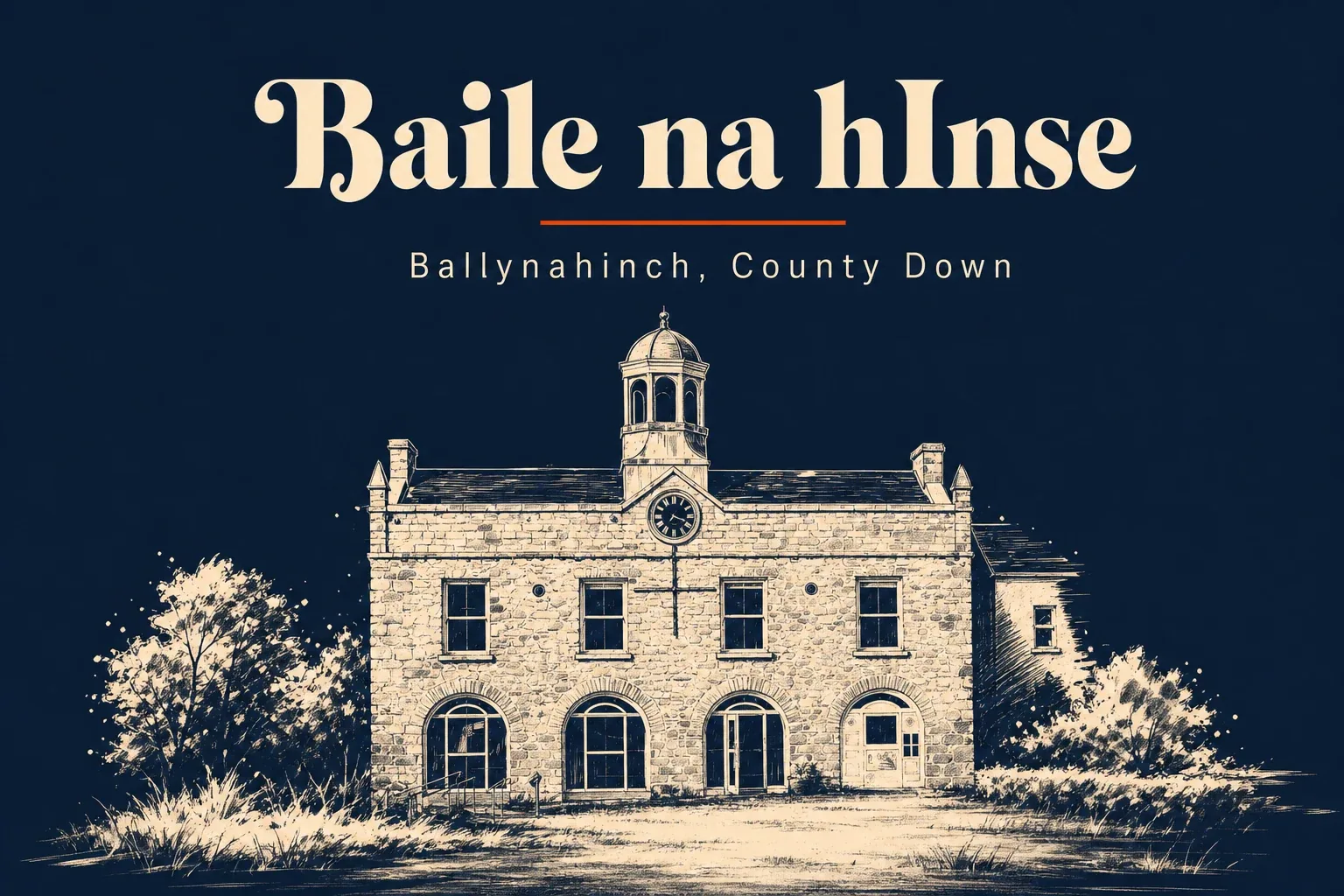
Baile na hInse

The Ireland's Ancient East
STOP 09 / 09
Baile na hInse · Co. Down

Mid-Down market town with a 1798 battlefield in its back garden.

Ballynahinch is a working market town in mid-Down, fifteen miles south of Belfast on the road to Newcastle. The Market House at the centre dates to 1795 — commissioned by the first Earl of Moira, finished three years before his estate at Montalto became a rebel camp. That is the texture of the place. It looks like a quiet country town, and it is, mostly. The history underneath is not.

The 1798 battle is the thing. The United Irishmen of Down — four thousand of them under Henry Munro, a linen draper from Lisburn — camped at Montalto on the night of the 12th of June and were broken by sunrise on the 13th. The town was burned. Munro was hanged. Betsy Gray, who rode with the rebels, was killed at Ballycreen and buried where she fell. A memorial put up in 1896 was smashed by a unionist mob two years later, on the eve of the centenary. The grave is unmarked again. That story still sits in the local air.

Today the draw is Montalto Estate — gardens, woodland trails, the same demesne the rebels camped in, now run as a paid visitor attraction by the Wilson family. Beyond that, Ballynahinch is a commuter town for Belfast and a stop on the way to the Mournes. The Primrose has been on Main Street since 1935. Café Rossi does the breakfasts. The traffic on the A24 is its own permanent feature. Come for Montalto, the battle, and a pint after.
Population
~6,200 (2021 census)
Walk score
Main Street to Market Square in five minutes
Founded
Late 17th century — Sir George Rawdon
Coords
54.4025° N, 5.8958° W
01 / 09

At a glance.

Three things every local will eventually mention. Read these and you've already understood more than most day-trippers do.

02 / 09

The pubs.

None of these are themed Irish pubs, because they don't need to be. A few that earn the trip:

The Primrose Bar & Restaurant

Family-run, steady
Pub & bistro, established 1935

Main Street institution, on the go for over ninety years. Formerly Gabbies. The prawn open sandwich is the dish people order without looking at the menu.

03 / 09

Where to eat.

PlaceTypeLocal note
Café Rossi Café & bistro €€ One Main Street. Brunch, lunch, dinner, the breakfasts get the most love. Open seven days, late on Thursday, Friday, and Saturday.
The Gilmore Restaurant Hotel restaurant (Millbrook Lodge) €€€ In-house at Millbrook Lodge on Drumaness Road. The Maguire family have had the hotel four decades and the restaurant carries the load.
The Primrose Bar & Restaurant Pub bistro €€ Same Primrose as the pub list. The food is the reason most locals are in there at seven on a Wednesday.
04 / 09

Where to sleep.

PlaceTypeLocal note
Millbrook Lodge Hotel Country house hotel Sixteen rooms in a Victorian house on Drumaness Road, just outside town. Family-run by the Maguires. The Gilmore restaurant downstairs, function suites for the wedding trade, and twenty minutes to the Mournes if that is the trip.
Montalto Estate Self-catering accommodation The estate itself rents the gate lodges and a couple of cottages on the demesne. You wake up inside the eight kilometres of trails and have the gardens to yourself before the day visitors arrive.
05 / 09

Stories & lore.

The reason to come back. The things every local will eventually tell you about, usually after the second pint.

June 1798

The Battle of Ballynahinch

The rebels of County Down rose on 9 June 1798 and gathered, four thousand strong, at Ednavady Hill on the edge of Sir John Rawdon's Montalto estate. They elected Henry Munro of Lisburn — a Presbyterian linen draper, no soldier — as their general. On the night of 12 June, General George Nugent's loyalist force dislodged a rebel outpost on Windmill Hill above the town and set up there. The fighting ran through the night and the morning of the 13th. The rebels broke. Three to four hundred were killed. The town was burned. Munro was captured at a farmhouse two days later and hanged in front of his own house in Lisburn on the 16th.

And the broken memorial

Betsy Gray

Elizabeth Gray of Gransha rode with the rebels at Ballynahinch — by tradition, on a white horse, with a green flag, alongside her brother George and her sweetheart William Boal. All three were killed at Ballycreen as they tried to escape, and buried where they fell. The grave became a quiet pilgrimage site through the 19th century. In 1896 a proper memorial stone was paid for by James Gray of London, a grandnephew. On a Sunday in June 1898 — the eve of the rebellion's centenary — a crowd of local unionists, inflamed that a Catholic and Home Rule committee was organising the commemoration, smashed the memorial to pieces. The grave at Ballycreen has been unmarked ever since.

The estate that watched it happen

Montalto

Sir George Rawdon bought the townland in 1657 after the previous owner, Patrick McCartan, lost it for joining the 1641 Rebellion. His great-grandson the 1st Earl of Moira built the Georgian house in the 1760s. By 1798 the Earl was off in Britain and his Montalto woods were full of United Irishmen. The Rawdons sold up in 1802 to David Ker, who spotted the rising fashion for medicinal spa wells and developed the springs two miles outside town. The estate is privately owned still, but it opened the gates as a paid visitor attraction in 2018 — the trails, the walled garden, the Lost Garden glasshouse remains. The History Trail goes over the ground the rebels camped on.

Foundation stone laid by the masonic lodge

The 1795 Market House

The Market House in the centre of town was commissioned by John Rawdon, 1st Earl of Moira, as a covered market — arcaded ground floor for the corn and flax dealers, assembly room above for the polite end of town. The foundation stone was laid by the local masonic lodge on 2 July 1792. The building was finished in 1795. By the end of that decade the market was grossing around £300 a week and the town was prospering. Three years after that, Munro and his rebels camped a kilometre down the road.

06 / 09

Things to do outside.

Wear waterproofs. Bring a sandwich. Tell someone where you're going if it's the mountain.

Montalto Estate trails The main outdoor reason to be in Ballynahinch. History Trail takes in the 1798 battlefield ground. Lost Garden Trail goes past the ruined Victorian glasshouses. Lake Walk for the autumn maples. Ticketed entry. Closed some weekdays in winter — check.
8 km networkdistance
Half a daytime
Walled Garden loop (Montalto) A short loop inside the estate that takes in the formal walled garden, herbaceous borders, fountain and cascade pool. Best in late spring through summer.
1 kmdistance
30 mintime
Windmill Hill walk-up Up the lane to the hill where Nugent dug in on 12 June 1798. The actual windmill is long gone. The view back over the town is the same one Nugent had when he decided to walk in.
2 km returndistance
45 mintime
07 / 09

When to go.

There is no bad time. There are different times.

Spring
Mar–May

Montalto comes back to life. Walled garden borders going. Quiet enough to have the trails to yourself on a Tuesday morning.

◉ Go
Summer
Jun–Aug

The estate is at its peak. June is also when the 1798 anniversary commemorations happen — small affairs, but the local history societies put events on. Long evenings.

◉ Go
Autumn
Sep–Oct

Best season on the estate — Japanese maples on the Lake Walk go red. Cooler air for the longer woodland trails.

◉ Go
Winter
Nov–Feb

Montalto runs reduced hours and shuts on some weekdays. The town is quiet and the A24 traffic is the soundtrack. Check estate opening before you make the trip.

◐ Mind yourself
08 / 09

What to skip.

Honestly? Don't bother.

If a local was sitting beside you, this is the bit where they'd lean in.

×
Driving through on a weekday rush hour

The A24 funnels Belfast commuters straight down Main Street. Fifteen thousand vehicles a day and no bypass. If you can come on a Sunday or arrive after 10am, do.

×
Looking for the Betsy Gray memorial

It is not there. The 1896 stone was smashed in 1898 and never replaced. The grave at Ballycreen is unmarked. The story is the memorial now.

×
Expecting a 1798 visitor centre

There isn't one. The battle is told inside Montalto Estate on the History Trail and via local history society pamphlets. The Market Square has no plaque to speak of. It is a town that remembers in private.

+

Getting there.

By car

Belfast to Ballynahinch is 35 minutes on the A24 (23 km). Newcastle is 25 minutes further south on the same road. Downpatrick is 20 minutes east on the B2. Expect a slow crawl through the town centre on weekday mornings and evenings.

By bus

Translink Goldline 215 (Belfast–Newcastle) stops in the town centre every 30 minutes most of the day. Ulsterbus 17 connects to Downpatrick.

By train

No train. Nearest station is Belfast Lanyon Place, then the 215 bus.

By air

Belfast International (BFS) is an hour. Belfast City (BHD) is 40 minutes. Dublin Airport is 2 hours.