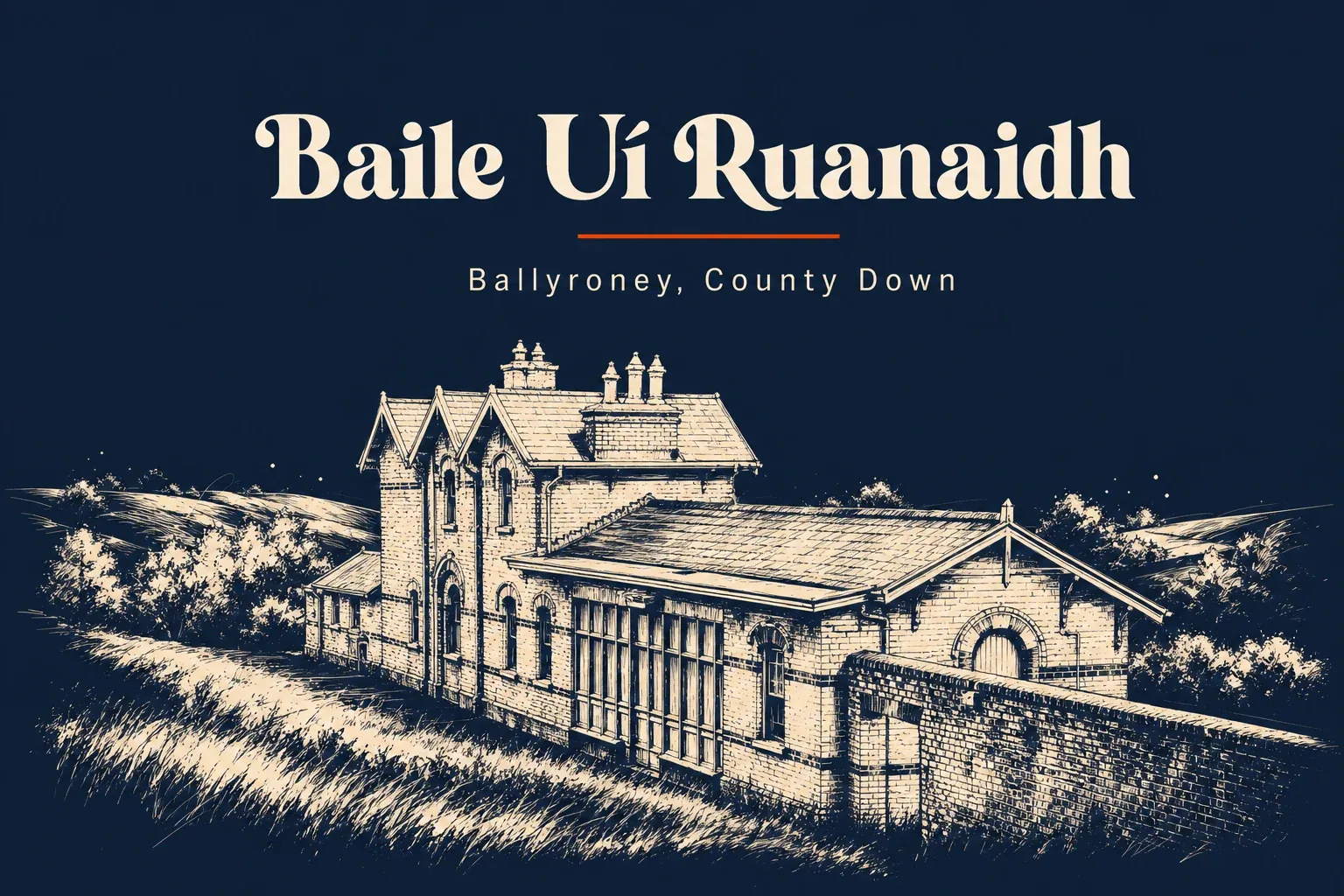
Baile Uí Ruanaidh · Co. Down
A crossroads on the upper Bann that fathered Kate McKay and trained Patrick Bronte.
Ballyroney is a small village on the upper River Bann, between Rathfriland and Dromara, on the B7. The crossroads, the chapel, a few houses, the lake out the road - that is the village. The wider parish of Drumballyroney stretches further, taking in the back lanes that drop south toward Rathfriland and the Mourne foothills. Population for the village and the immediate townlands sits around three hundred. It is a place you arrive at by accident on the way somewhere else, and a place you remember the name of afterwards.
The reason you remember the name is the Brontes. Drumballyroney parish - Ballyroney is the village core of it - is where Patrick Bronte preached his first sermon in 1806, in the church on Church Hill Road, after he came home from St John's College, Cambridge. Before Cambridge he had taught at the parish school next door as a young man. The church and the schoolhouse are restored, and the schoolhouse is now the Bronte Homeland Interpretative Centre. The signed Bronte Homeland Drive starts at the church door and loops out through Emdale, where Patrick was born, and Glascar Hill, where he had his first teaching post. His three daughters in Yorkshire - Charlotte, Emily, Anne - wrote the books. The County Down half of the story stayed in the parish of Drumballyroney, and a fair share of the visitor traffic ends up at the Ballyroney end of it.
The other story the place gives you, if you ask, is Kate McKay. Kate was born in Ballyroney in 1691. By the middle of the eighteenth century she was running the boarding house where the workmen building the new stone bridge over the Bann a few miles upstream lodged. They named the bridge after her. The hamlet that grew up around it took the bridge's name. Kate's name is now the name of the next village down the road, and her own village is not on the road signs. That is the shape of the thing.
Don't come for a day out. Come for half an hour with a reason. Walk the church and schoolhouse yard at Drumballyroney, look at the motte where the Norman castle was, drive the lanes out to Emdale, and push on to Rathfriland for lunch or Katesbridge for a pint at the Anglers Rest. Ballyroney is the country, not the visitor centre. The visitor centre is the church.