County Down Ireland · Co. Down · Dromara Save · Share
POSTED FROM
DROMARA
CO. DOWN · IE

Dromara
Droim Bearach

STOP 08 / 08
Droim Bearach · Co. Down

A mill village under Slieve Croob, where the Lagan starts as a spring.

Dromara is a one-street village ten kilometres south-west of Ballynahinch, in the lap of Slieve Croob. The River Lagan — the one that ends up in Belfast Lough — starts as a spring on the hill above the village and runs straight through the middle of it. That is the whole geography in a sentence: hill behind, river through, road on.

There has been a church here since at least 1306. The present St John's, on the Banbridge Road, was rebuilt by Bishop Thomas Percy in 1811 after centuries of ruin, and got its chancel and transepts in 1896. The street pattern is older than the buildings, and the buildings are mostly early 19th century, which tells you what kind of place this is — a mill village that quietly outlived its mills and kept the road and the river and the hill.

Nobody comes to Dromara for Dromara. They come for the hill, or the dolmen, or both. Slieve Croob is the easy one — a tarmac road most of the way and a view from the summit that takes in the Mournes, Strangford, and on a clear day half of Down. Legananny Dolmen sits on the south-western flank of the same hill, in a farmer's field, with the Mournes lined up behind it like a backdrop somebody arranged. Park at the village, drive ten minutes out, walk the last bit, and you have done the thing.

Stay long enough for a pint at the Laganview, or a plate at Squareone, and the village fills in around the visit. It is not a destination. It is a base camp with a chimney.
Population
1,118 (2021)
Walk score
A street, a bridge, a hill behind it
Founded
Church recorded 1306
Coords
54.3489° N, 6.0181° W
01 / 08

At a glance.

Three things every local will eventually mention. Read these and you've already understood more than most day-trippers do.

02 / 08

The pubs.

None of these are themed Irish pubs, because they don't need to be. A few that earn the trip:

Laganview Arms

Local, steady
Village pub

The pub on the bridge over the Lagan, named for the river it sits on. A pint, a fire, the kind of place where the football is on but turned down. Not a session pub — a village pub.

Squareone Dromara Bar & Bistro

Food-led
Bar & bistro

Open 10am to 8pm most days. Food the whole time. The closest thing the village has to a kitchen with ambition, and on a wet day after Slieve Croob it earns every star.

03 / 08

Where to eat.

PlaceTypeLocal note
Squareone Dromara Bar & Bistro Bar & bistro €€ Daytime food and into the early evening. Pub plates, soups, the kind of menu a village this size shouldn't quite be able to support and somehow does.
Laganview Arms Pub food €€ Standard pub kitchen on the bridge. Reliable rather than ambitious. Goes well with the pint that comes before it.
04 / 08

Stories & lore.

The reason to come back. The things every local will eventually tell you about, usually after the second pint.

A spring on a hillside

The source of the Lagan

Slieve Croob rises to 534 metres directly behind the village. On its northern slopes, in a bit of bog you would walk past without noticing, a spring rises. That spring is the River Lagan. It comes down through Dromara, through Dromore, through Lisburn, and finally through Belfast into the Lough. Stand at the source on a wet afternoon and the river is barely a trickle through the rushes. By Belfast it is carrying half the city. The whole journey starts here.

A coffin held high for 5,000 years

Legananny Dolmen

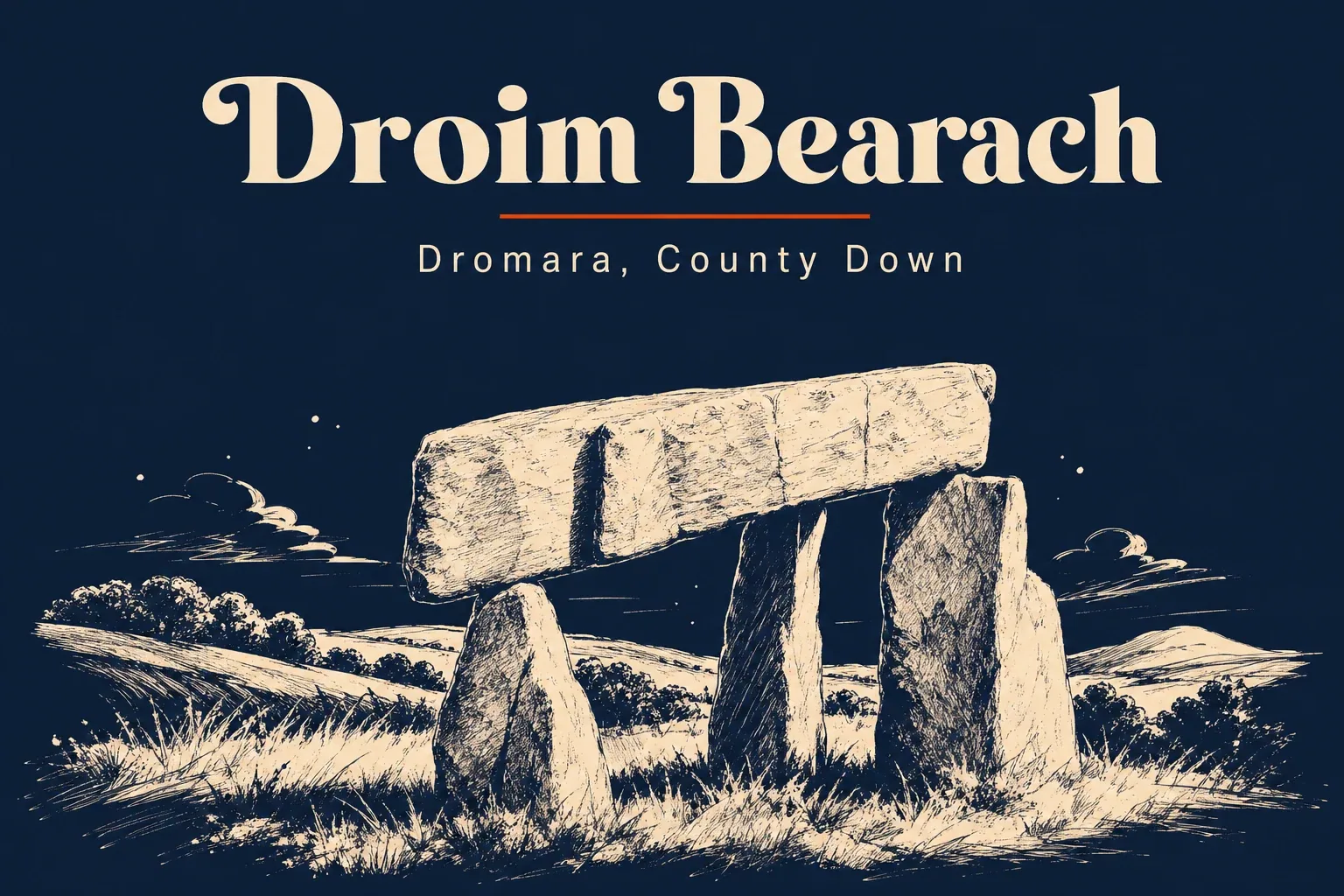
On the south-western slopes of Slieve Croob, in a field down a side road, three uprights hold up a long capstone. The capstone is ten feet by four feet by two feet. The legs are seven and a half feet tall. The whole thing has been balanced that way since the Neolithic — roughly five thousand years. It is a portal tomb, of the rare tripod kind, and it has been called a coffin held aloft by pallbearers ever since the first photographer arrived with a glass plate. The Department for Communities looks after it now. There is no visitor centre, no turnstile, and no fee. There is a sign and a footpath. That is the etiquette.

The climb that came back

Blaeberry Sunday

Slieve Croob was a Lughnasa hill — one of the high places climbed on the Celtic harvest festival in late July or early August. On the way up, locals picked blaeberries (bilberries) on the slopes, which is where the local name came from: Blaeberry Sunday, or Cairn Sunday for the stones carried up to add to the summit pile. The tradition went quiet in the 1950s and almost died. Community groups have brought it back in recent years with an organised annual walk. The bilberries grow on the same slopes they always did.

1306, 1641, 1811, 1896

The church on the ridge

Dromara — Droim Bearach, the ridge of heifers — has had a church recorded since 1306, when it appeared in the ecclesiastical taxation rolls as the Church of Drumberra. It was burned in the rising of 1641 and stood as a ruin for fifty years. Bishop Thomas Percy, the English antiquary turned Bishop of Dromore, rebuilt it in 1811. The chancel and transepts were added in 1896. St John's still sits on the Banbridge Road, paired with Garvaghy down the road, a working parish in a quiet diocese.

05 / 08

Things to do outside.

Wear waterproofs. Bring a sandwich. Tell someone where you're going if it's the mountain.

Slieve Croob — Twelve Cairns Park at the Dree Hill car park. Follow the tarmac transmitter road most of the way up. The summit has a Bronze Age cairn and a view that takes in the Mournes, Strangford Lough, and on a good day the Belfast hills. The local name — the Twelve Cairns — comes from a much larger cairn complex that once stood here.
4.35 km returndistance
1h 30time
Legananny Dolmen Drive to Legananny Road on the south-western side of the hill. A signed footpath crosses a farmer's field. The dolmen is there. So is the view of the Mournes, lined up behind the stones like the gods arranged it. Bring a camera.
A field and a footpathdistance
20 minutes including parkingtime
Dromara Bridleways A network of quiet lanes and tracks west of the village, signposted from Finnis. Mostly tarmac, no scrambling. Good for an hour after lunch when the hill is in cloud and the dolmen has been done.
5–8 km loopsdistance
1–2 hourstime
06 / 08

When to go.

There is no bad time. There are different times.

Spring
Mar–May

Lambs on the slopes, gorse in flower, the hill drying out. The clearest views of the year are often in April.

◉ Go
Summer
Jun–Aug

Long evenings on Slieve Croob. The last Sunday of July is Blaeberry Sunday — climb it then if you can.

◉ Go
Autumn
Sep–Oct

The hill in heather, the Mournes from Legananny in low autumn light. Quiet on the paths.

◉ Go
Winter
Nov–Feb

The transmitter road can be icy. The dolmen field gets boggy. Both still doable on a clear cold day — just check the forecast.

◐ Mind yourself
07 / 08

What to skip.

Honestly? Don't bother.

If a local was sitting beside you, this is the bit where they'd lean in.

×
Driving up to within sight of the summit and not getting out

The last bit on foot is what makes it. The car park at Dree Hill is the start of the walk, not the end.

×
Going to Legananny without checking the field gate

It's an active farm. The gate is to be closed behind you. Dogs on leads. The stones don't care; the farmer does.

×
Expecting a session

This is not a music village. Two pubs, both quiet ones. If you want trad, you're going to Newcastle or Ballynahinch.

+

Getting there.

By car

Belfast to Dromara is about 35 minutes via the A1 and Hillsborough. Ballynahinch is 10 minutes east on the B7. Banbridge is 15 minutes south-west.

By bus

Translink Ulsterbus 26 runs Lisburn to Dromara. Route 27 connects Ballynahinch to Dromara. Limited service — check timetables before relying on either.

By train

No station. Nearest is Lisburn, then bus or taxi.

By air

Belfast International (BFS) is 45 minutes. Belfast City (BHD) is 40.