County Galway Ireland · Co. Galway · Ardrahan Save · Share
POSTED FROM
ARDRAHAN
CO. GALWAY · IE

Ardrahan
Ard Raithin

STOP 05 / 05
Ard Raithin · Co. Galway

Home of a playwright-activist who shaped Irish independence. Small village, large legacy.

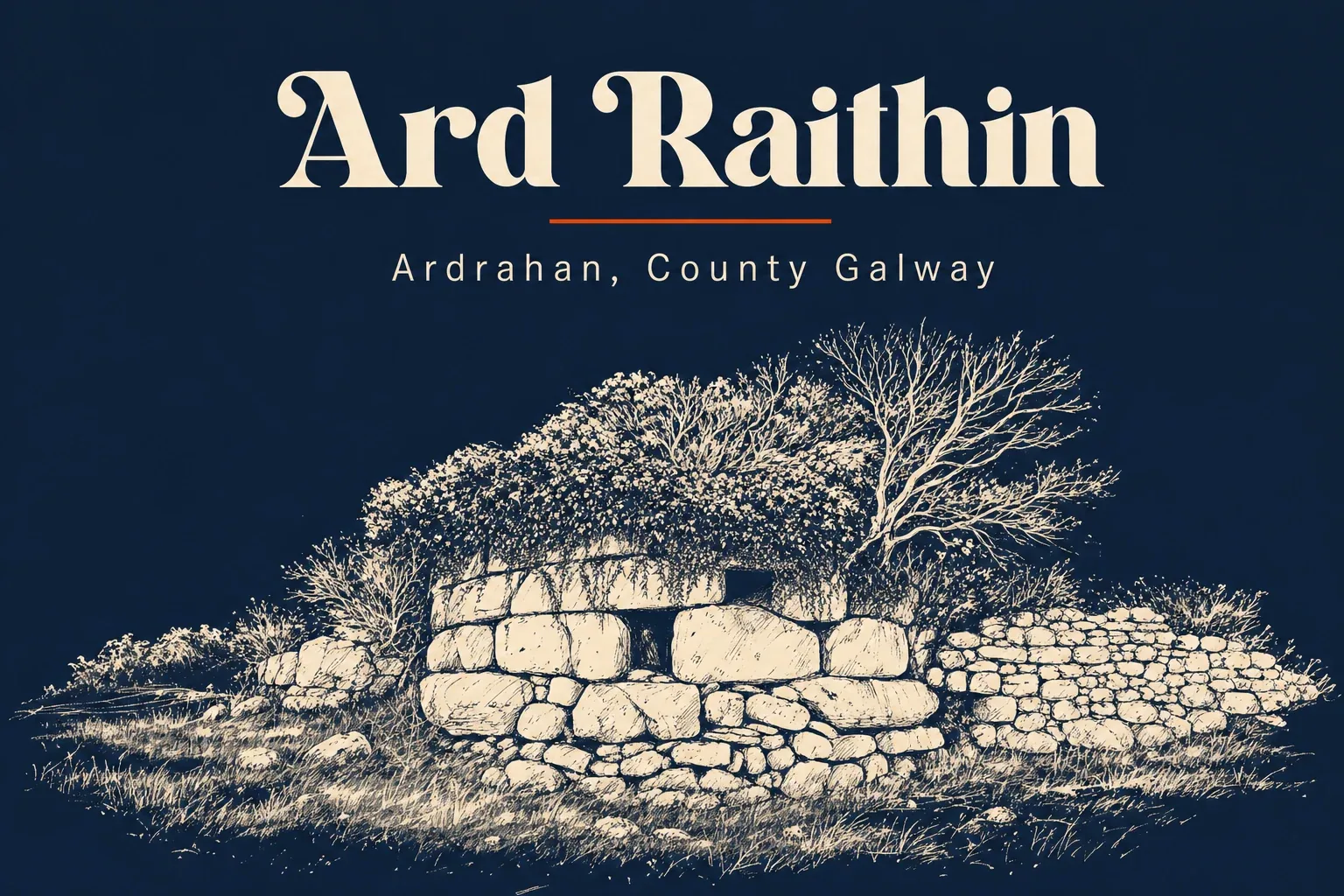
Ardrahan is a village in south Galway, near the Clare border. The name means 'high ringfort' in Irish. What it is known for is Edward Martyn — playwright, independence activist, first president of Sinn Féin (1905–1908), and his family seat at Tulira Castle. Martyn was descended from Richard Óge Martyn, a leading Irish Confederate in the 1640s. He inherited the castle in 1860 and lived there until his death in 1923.

Martyn was not a soldier. He was a patron. He founded the Palestrina Choir. He funded the Irish Theatre. He co-founded the Irish Literary Theatre with Yeats and Lady Gregory and paid for the first three seasons. He sponsored stained glass, music, plays. He famously refused to allow 'God Save The Queen' to be sung at a dinner party at Tullira — a quiet act of republicanism that cost him. The village itself has deeper roots: the churchyard contains the remains of a round tower, suggesting a monastic community predated the castle.

Come here if Martyn interests you. Come if you follow Irish theatre or early twentieth-century independence politics. Come for the hurling — Ardrahan GAA won its first Galway Senior title in 1894 and has won 11 since. The village is small and working. The castle is not generally open to the public (it was sold in 2015 to a private owner). But the landscape is quiet and the connections run deep.

Population
540
Founded
Medieval (monastic roots)
Coords
53.1575° N, 8.8058° W
01 / 05

At a glance.

Three things every local will eventually mention. Read these and you've already understood more than most day-trippers do.

02 / 05

Stories & lore.

The reason to come back. The things every local will eventually tell you about, usually after the second pint.

Edward Martyn (1859–1923)

The playwright who changed nothing onstage and everything else

Martyn's own plays were not a success. What made him extraordinary was his generosity and ear for culture. He founded the Palestrina Choir in 1903 (still the resident choir at Dublin's Pro-Cathedral). He co-founded the Irish Literary Theatre with Yeats and Lady Gregory in 1896 and covered the costs of the first three seasons — this was crucial to the theatre's survival and to the eventual founding of the Abbey. He funded the Irish Theatre in Dublin. He sponsored An Túr Gloine, Ireland's first stained-glass workshop. He was a musician himself, playing organ at Tullira. Lady Gregory called him 'a good neighbour' and described his death in December 1923 as leaving her 'a loneliness'. His final act: he donated his body to medical science. He is buried at Glasnevin and the Palestrina Choir sang at his graveside.

Monastic roots

The round tower in the churchyard

The remains of a round tower stand in the churchyard at Labane, near Ardrahan. This suggests that a monastic community occupied the site before the castle was built. A church at Labane contains stained glass windows by Alfred E. Child and Michael Healy — artists Martyn would have known. The tower is a reminder that Ardrahan has older layers. Medieval lords and modern patriots overlay something older still.

Ardrahan hurling

The GAA club that won in 1894 and kept winning

Ardrahan GAA won its first Galway Senior Hurling Championship in 1894 — 130 years ago. Since then, the club has won 11 titles and contested 18 county finals. Only Castlegar has more titles in Galway hurling. The village has also produced a camogie club that has won Féile finals and reached All-Ireland semi-finals. Hurling is the parish sport. The land is limestone and small fields — good hurling country.

The House on the Borderland

A ghost story in a novel

William Hope Hodgson mentioned Ardrahan in his 1907 weird-fiction novel The House on the Borderland. He referenced it as the nearest greater village to a fictional place called Kraighten. It is a small thing, but it means Ardrahan has appeared in published fiction — perhaps the only such mention of this quiet village in the international literary record.

03 / 05

When to go.

There is no bad time. There are different times.

Spring
Mar–May

Quiet. Good for walking the grounds around the village and visiting the monastic site. Lambs in the fields.

◉ Go
Summer
Jun–Aug

Warmer. No particular summer season here — it is not a tourist village. But the landscape is green.

◐ Mind yourself
Autumn
Sep–Oct

The locals' time. Good light. The hurling season is in swing. The landscape is at its quietest.

◉ Go
Winter
Nov–Feb

Cold and damp. Little to do. But you will have the place to yourself and the connection to Martyn feels real.

◐ Mind yourself
04 / 05

What to skip.

Honestly? Don't bother.

If a local was sitting beside you, this is the bit where they'd lean in.

×
Trying to tour Tulira Castle

It is private and not open to visitors. You can see the gates and the demesne from the road, but that is all.

×
Coming here without reading any Martyn

His plays are not well known now. But his cultural work was real. Read about him first, or the village means less.

×
Coming on a day with no hurling or community event

Ardrahan is very small. There is no tourist infrastructure. It exists for the people who live here. Respect that.

+

Getting there.

By car

From Galway city: south on the M6/N18 toward Gort (40km, 45 minutes). Ardrahan is on the R458 between Gort and Gort in south Galway. From Athenry (20km), take the R446 south. Parking is easy.

By bus

Bus services are limited. Check Bus Éireann or GoBus for routes through the area. Local services are irregular.

By train

The old railway station (opened 1869, closed 1983) has been replaced by a new station as part of the Western Rail Corridor reopening. Check current status of the Ennis–Athenry service.

By air

Shannon Airport is 90km (1.5 hours). Cork is similar.