An Tobar · Co. Galway
A village split down the county line - half in Galway, half in Clare - on the quiet eastern edge of the Burren.
Tubber - An Tobar, "the well" - is one of those Irish places that does not quite agree with itself about which county it is in. The community straddles the Galway/Clare border on the eastern fringe of the Burren, and the line runs straight through it. The Galway side lies in the parish of Beagh, in the Diocese of Kilmacduagh, about twelve kilometres south of Gort. A 2001 travelogue caught it best: "a place a mile long with a pub at either end - one part of it appeared to be in Clare, the other in Galway." The pubs are down to one now.
This is limestone country, the flat lowland Burren rather than the dramatic coastal version. The fields are small and bounded by dry stone walls grey with lichen, the soil thin over white rock, the drainage underground. Turloughs - seasonal lakes that fill and empty with the water table - dot the surrounding land. There is no real village centre on the Galway side; the houses are scattered across the townlands, and what gathering there is happens around the pub and the church. The name comes from a holy well, the original reason anyone settled on ground this bare.
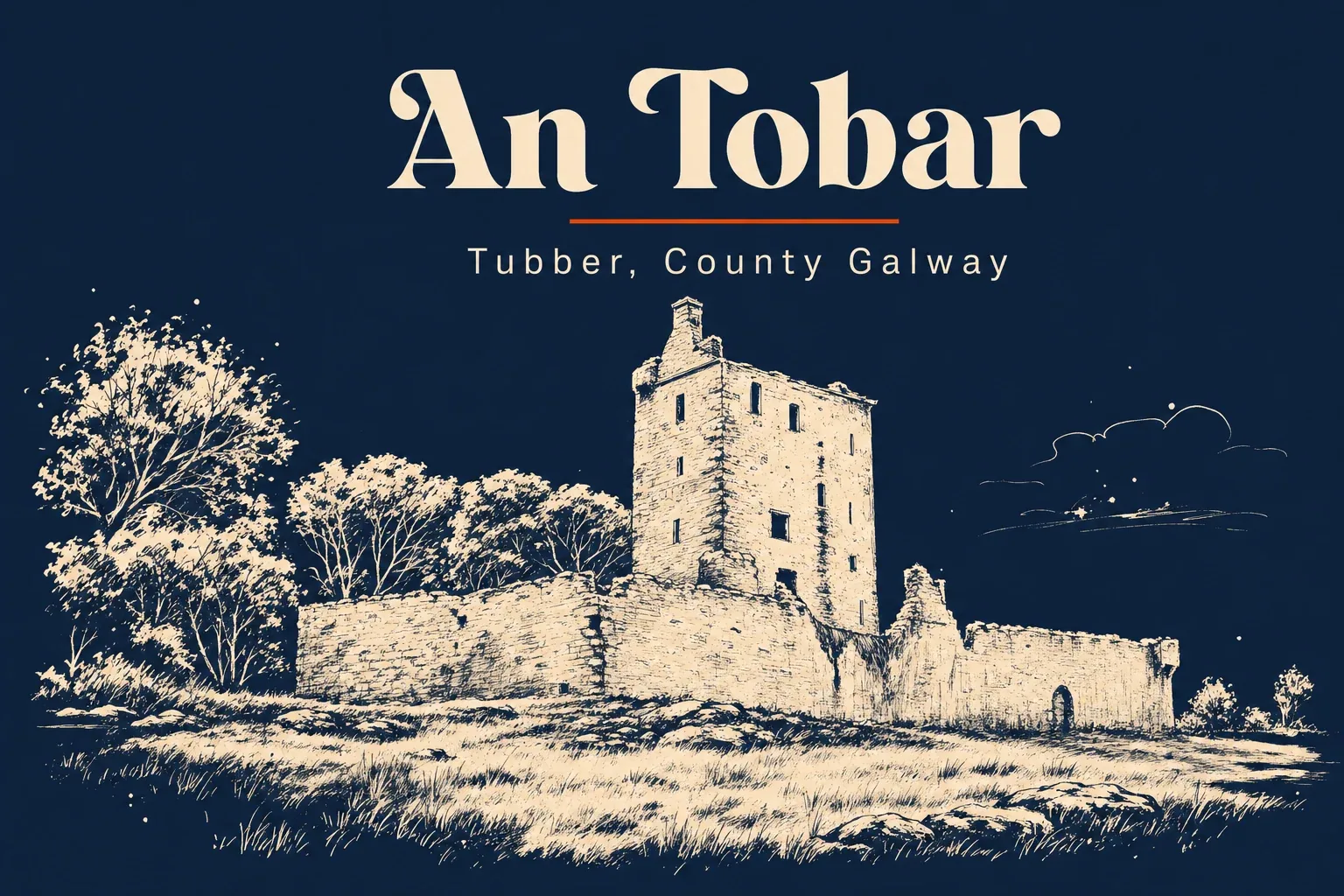
Come here for the quiet and for one genuinely good ruin. Fiddaun Castle, an O'Shaughnessy tower house of 1574, stands a short way off between two small lakes, on the Galway side of the line. It is the reason a curious traveller turns off the Gort road. If you want shops, hotels and a tourist machine, this is not it - Gort is up the road for that. If you want the eastern Burren with almost nobody in it and a real castle in a field, Tubber is honest about what it is.