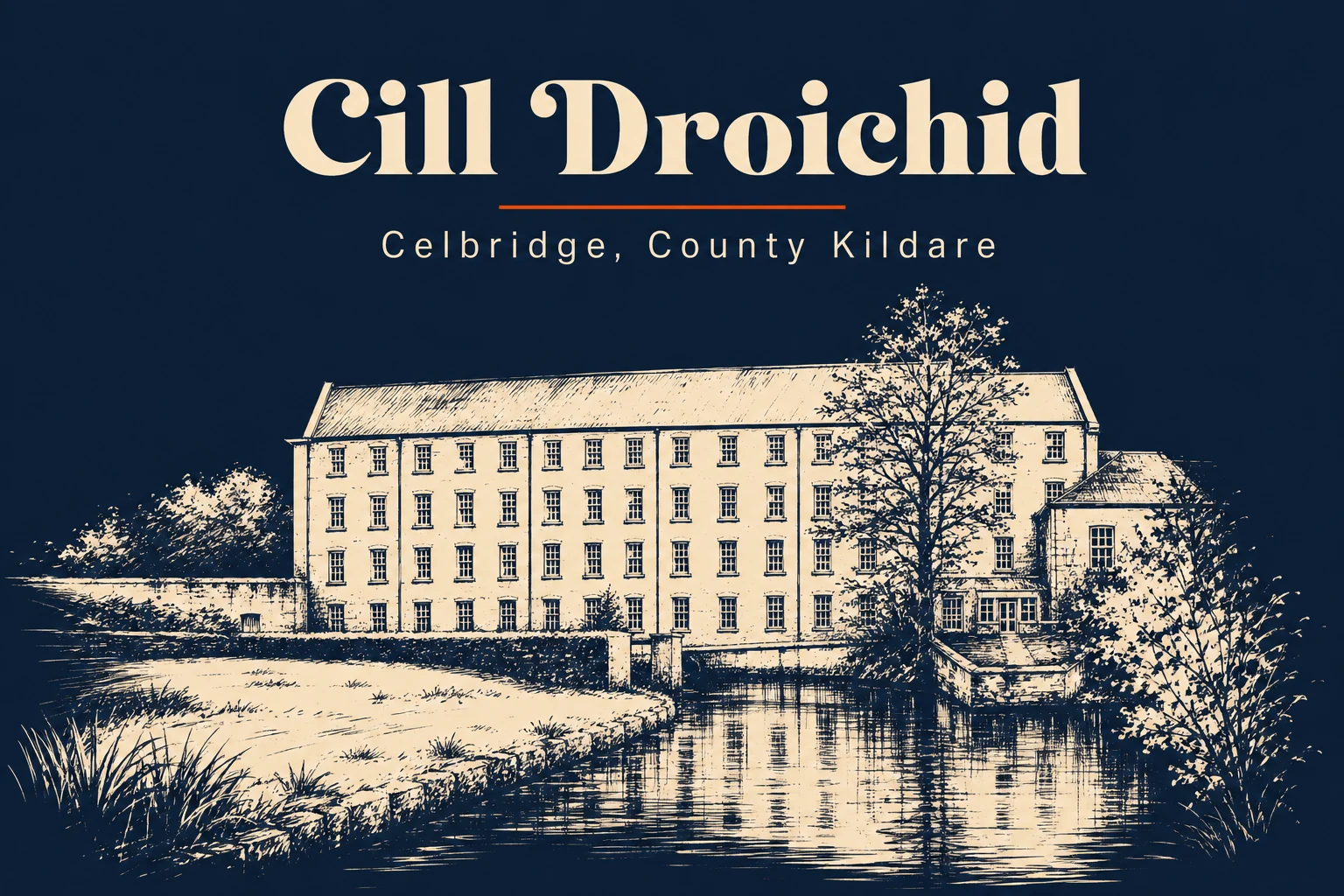
Cill Droichid · Co. Kildare
Ireland's greatest Palladian house, one road from a retail park.
Celbridge is two towns in one skin, and only one of them is what you came for. There is the heritage core - Castletown House, the Liffey bank, Celbridge Abbey, the slow curves of the demesne - and there is everything built around it in the last forty years: the estates, the roundabouts, the retail park on the bypass, the commuter population of 25,000 that mainly goes to Dublin for work. Walk fifteen minutes in the wrong direction and you could be anywhere. Walk fifteen minutes in the right direction and you are in the forecourt of the finest Palladian country house in Ireland.
Castletown is the reason to come. Speaker William Conolly - son of a Donegal innkeeper who got rich through property speculation after the Williamite Wars, then became the wealthiest man in the country - built it between 1722 and 1729 as a statement that the new Protestant ascendancy could match anything in Europe. Alessandro Galilei drew the original plans in Rome. Edward Lovett Pearce adapted them for Kildare. The result is 52,529 square feet of Portland stone and classical proportion, with 800 acres of parkland running down to the Liffey. The Irish State manages it now. Entry is free. On a Tuesday in March, you may have the Long Gallery to yourself.
Two other stories are woven into the same landscape. Esther Vanhomrigh, the woman Jonathan Swift called Vanessa, lived at Celbridge Abbey by the river from 1714 until she died in 1723, age 35, never having received from Swift the public acknowledgement she spent her adult life waiting for. Arthur Guinness was born on what is now Main Street in 1725, the son of the man Archbishop Arthur Price employed to manage his Celbridge estate. He stayed thirty years before going to Dublin and signing a 9,000-year lease on a brewery. Neither of these stories is incidental. They happened here, on this stretch of river, in the same short decades. That concentration of biography in one small town is unusual by any measure.
The honest version: most of Celbridge is a large Dublin commuter suburb that grew fast and without much architectural argument. The heritage core is real and it is worth your time. But don't expect a Georgian village that has held its form. Expect one great house, two great stories, a river walk, and a retail park you will need to drive around to get out of.