County Kildare Ireland · Co. Kildare · Leixlip Save · Share
POSTED FROM
LEIXLIP
CO. KILDARE · IE

Leixlip
Léim an Bhradáin

The Ireland's Ancient East
STOP 02 / 06
Léim an Bhradáin · Co. Kildare

A Norse name, a Norman castle, and five thousand Intel engineers.

Leixlip sits where the River Liffey meets the Rye Water, eighteen kilometres west of Dublin, and it has been important for exactly as long as that sounds. The Vikings called it 'lax hlaup' — salmon leap — for the five-metre waterfall where salmon ran upstream in their thousands. The Norse name stuck. The waterfall did not: the ESB dammed it in 1945 to build a hydroelectric scheme, and the salmon leap became a reservoir. If you come expecting the waterfall that named the town, you will be looking at a dam.

What remains is stranger and more interesting. A Norman castle built in 1172 that predates Dublin Castle, continuously lived-in, currently occupied by the Guinness family. A corkscrew-staircase folly on the Castletown demesne, built in 1743 as famine relief employment, that looks like something from a different country altogether. And up the hill on the Maynooth Road, one of Intel's two major global chip-manufacturing campuses, which has been here since 1990 and has shaped everything about the modern town — its population, its commuter flows, its school rolls, its traffic.

The duality is real and unresolved. Leixlip is genuinely a medieval settlement — the street pattern, the castle, the Church of Ireland on Main Street — and it is genuinely a tech-era commuter town. These two things do not sit neatly together. The town centre feels like a town centre. The Intel campus feels like it landed from somewhere else. The Wonderful Barn stands in a field between them and refuses to help either side make sense of the other.

Two train stations — Leixlip Confey and Leixlip Louisa Bridge — put the town on the Dublin-Maynooth commuter line, which means it functions, day-to-day, as outer Dublin as much as it functions as County Kildare. Most people who live here work in Dublin or at Intel. Most people who visit come from Dublin and are surprised by what they find.
Population
~18,000
Walk score
Town core walkable; Intel campus and Wonderful Barn need a car
Founded
9th century Norse outpost; castle 1172
Coords
53.3632° N, 6.4972° W
01 / 10

At a glance.

Three things every local will eventually mention. Read these and you've already understood more than most day-trippers do.

02 / 10

The pubs.

None of these are themed Irish pubs, because they don't need to be. A few that earn the trip:

The Salmon Leap Inn

Local, food-led
Pub & restaurant

Named for the thing that is no longer there — the waterfall, not the dam. Solid pub food, local crowd, no particular pretension. The name is the oldest thing about it.

Louisa Bridge Bar

Neighbourhood local
Pub

Down by the train station of the same name. The kind of place where you sit at the bar and the barman knows the regulars by drink. Does what a local pub should do.

Town Leixlip

Sports, loud, weekend
Bar & restaurant

Sixteen HD screens, live DJ Friday and Saturday nights, bottomless prosecco brunch. This is not the quiet pint. But it is what a good chunk of Leixlip does on a Friday, and it does it without apology.

Johnnie Fox's — Leixlip

Casual, mixed crowd
Pub

The Leixlip outpost of the famous Glencullen pub. Less dramatic setting than the original, more reliable parking. Decent pint of Guinness, which feels right given the address.

03 / 10

Where to eat.

PlaceTypeLocal note
The Salmon Leap Inn Pub food, Irish €€ Local and seasonal produce is the stated aim, and they mostly pull it off. The kind of menu that changes with the week rather than the decade. Reliable.
Da Vinci's Italian restaurant €€ On Main Street, evenings only. Proper Italian rather than Italianish — the pasta is made in-house and the wine list does not embarrass itself. Book on a Friday.
Gastro 101 Modern Irish, fire cooking €€ Cooking over fire — not a gimmick here, an actual method. Wood-grilled meats, good sides, the kind of place where you leave smelling of woodsmoke. Operated across two Kildare locations.
Springfield Hotel restaurant Hotel carvery & restaurant €€ The carvery has a genuine local following — Sunday lunch here is an institution. The evening restaurant is quieter and more considered. Both are worth knowing about.
04 / 10

Where to sleep.

PlaceTypeLocal note
Springfield Hotel Hotel 56 rooms, one minute off the M4 at junction 5, fifteen kilometres from Dublin. It is not glamorous but it is well-run, the breakfast is substantial, and the carvery has kept the locals coming back for years.
Leixlip Manor and Gardens Manor house B&B 1798 manor house with mountain and garden views. Quieter than the hotels, more character than most B&Bs. Book ahead — it runs on limited rooms.
Celbridge or Maynooth Wider area Both are ten minutes away and have more accommodation options if Leixlip is full. Maynooth in particular is a university town and has more range at the budget end.
05 / 10

Stories & lore.

The reason to come back. The things every local will eventually tell you about, usually after the second pint.

Léim an Bhradáin, 9th century to 1945

The salmon leap that isn't

The Vikings who pushed their longships as far west as the Liffey would allow named this place for the thing they found there: a five-metre waterfall where Atlantic salmon jumped upstream in numbers. 'Lax hlaup' — salmon leap. The Irish already called it 'Léim an Bhradáin,' the same thing in a different language. Both names survived for over a thousand years. Then in 1945 the ESB built a hydroelectric dam and the waterfall went under. The reservoir is there now, the name is still there, and the salmon — if you fish St. Catherine's Park below the dam — are still there. The waterfall is not.

Leixlip Castle, 1958 onwards

Desmond Guinness and the castle

Leixlip Castle was built in 1172 by Adam de Hereford, a Norman soldier who arrived with Strongbow. It is one of Ireland's oldest continuously inhabited fortifications — it predates Dublin Castle by thirty years and has been lived-in without serious interruption ever since. In 1316 it held off a four-day siege by Edward Bruce's army. In 1958 Desmond Guinness bought it. Desmond was an Irish Georgian Society co-founder and a tireless campaigner for the preservation of Ireland's Anglo-Irish architecture. He lived in Leixlip Castle for decades, restored it, opened its grounds on occasion, and used it as a base for the work that saved buildings like Castletown House down the road. The castle remains private. The grounds open occasionally for charity events. The tower and Georgian Gothic additions are visible from the road.

1990 — the year the hill changed

Intel arrives

In 1990 Intel chose Leixlip for its first European manufacturing facility. The site on the Collinstown Industrial Estate, north of the town on the Maynooth Road, grew over the following three decades into one of Intel's two main global chip-manufacturing campuses. By the 2020s it employed over five thousand people and had accumulated more than thirty billion euros in capital investment. What that means on the ground: Leixlip's population nearly tripled between 1990 and 2022. The schools filled up. The roads — particularly the M4 and the approach roads from Maynooth — became the commuting corridors they are now. The town that had been a quiet Dublin satellite became something else: a place with its own gravitational pull, drawing workers from across Leinster to a semiconductor factory that happens to sit beside an 850-year-old castle.

1743 — Katherine Conolly's answer to a famine

The Wonderful Barn

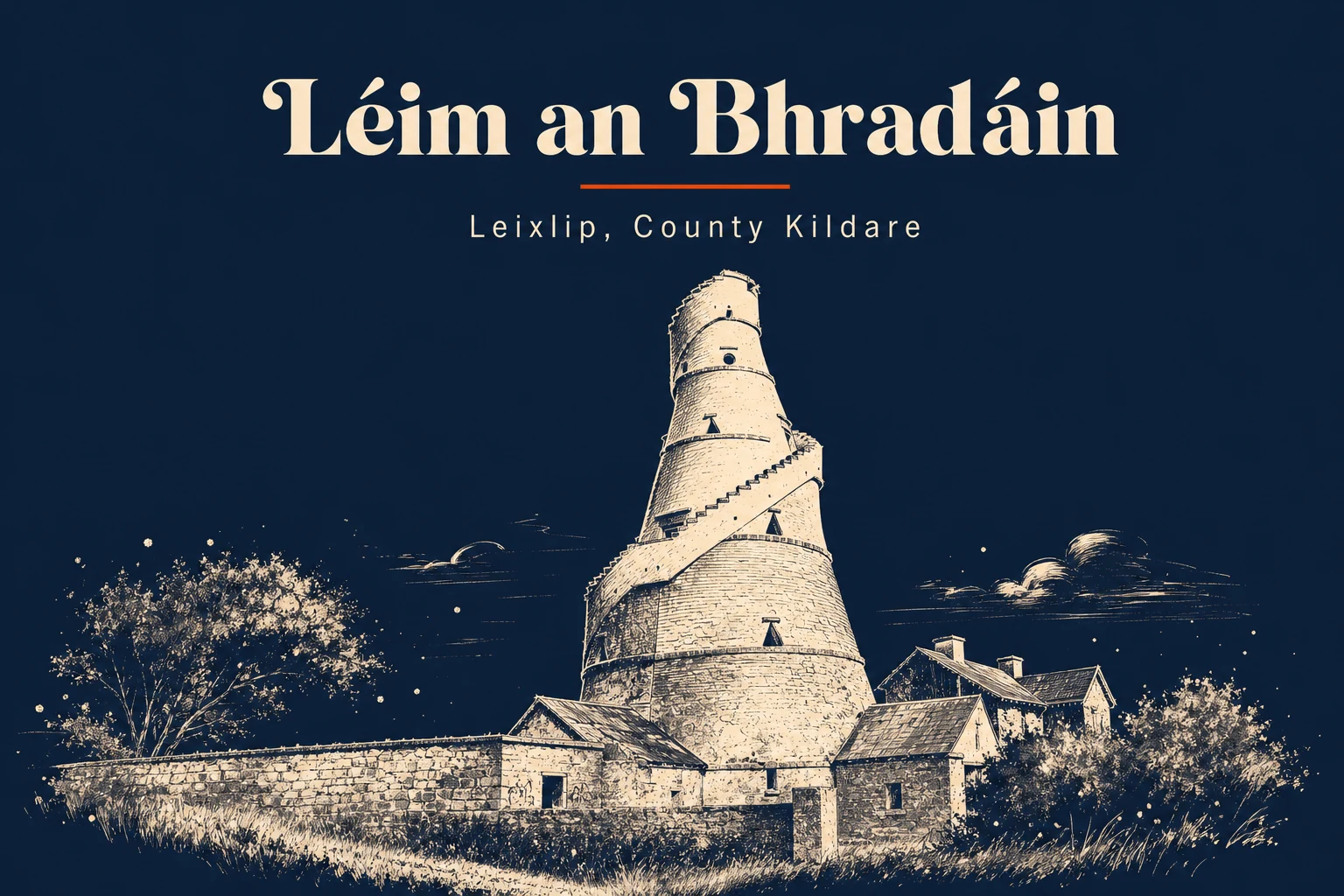
The famine of 1740-41 — 'Bliain an Áir,' the year of the slaughter — killed somewhere between two and four hundred thousand people across Ireland, proportionally more devastating than An Gorta Mór a century later. Katherine Conolly, widow of Speaker William Conolly and administrator of the Castletown estate, responded by commissioning a building. The Wonderful Barn is a conical six-storey tower with an external corkscrew staircase winding around its exterior, built to provide employment and to store grain for distribution. It is 73 feet tall, it looks like nothing else in Ireland, and it still stands in a field off the Celbridge road, beside two smaller circular outbuildings. It is not easily accessible — you can see it from the road. You can also walk the Castletown estate from Celbridge, where a footpath brings you within reasonable viewing distance. It is worth the detour.

06 / 10

Music, by day of the week.

Schedules drift. This is roughly right. The real answer is "ask in the first pub you find."

Fri
Town Leixlip — DJ from 9pm
Louisa Bridge Bar — live music most Fridays
Sat
Town Leixlip — DJ from 9pm
The Salmon Leap Inn — occasional live
Sun
Springfield Hotel bar — afternoon sessions in summer
07 / 10

Things to do outside.

Wear waterproofs. Bring a sandwich. Tell someone where you're going if it's the mountain.

St. Catherine's Park — Liffey walk The park runs along the Liffey between Leixlip and Celbridge. Flat riverside walking, mixed woodland, the river audible throughout. This is where you get closest to understanding what 'salmon leap' actually meant — you are walking below where the waterfall was. Salmon still run the river below the dam. Good for fishing if you have a permit.
4–6 km depending on routedistance
1–2 hourstime
Wonderful Barn and Castletown demesne The easiest way to see the Wonderful Barn properly is to walk the Castletown estate from Celbridge. Castletown House (OPW, free entry) is the anchor. The walk through the demesne brings you toward the Barn on the boundary of the estate. Check sight lines — the Barn is on private land but is visible. The Castletown parkland alone is worth the walk.
5 km loop from Celbridgedistance
1.5 hourstime
Leixlip town loop Main Street to the castle gate, down to the Liffey at Louisa Bridge, along the river path, and back through the town. This is the medieval Leixlip: the castle tower, the Church of Ireland on Main Street, the confluence of the Liffey and the Rye Water below the bridge. Not dramatic walking. Useful for getting your bearings.
3 kmdistance
45 mintime
Rye Water Linear Park The Rye Water flows south from Maynooth into the Liffey at Leixlip. The linear park follows a section of it through light woodland and open farmland. Quiet, mostly flat, and almost entirely unknown to visitors. Good for birdwatching in autumn.
6 km one waydistance
1.5 hours one waytime
08 / 10

When to go.

There is no bad time. There are different times.

Spring
Mar–May

St. Catherine's Park is best from April when the river is running and the woodland is opening up. The Castletown estate walks are good in all but the worst weather.

◉ Go
Summer
Jun–Aug

Long evenings are good for the Liffey walk. The town is busy but not overwhelmed — this is a commuter town, not a tourist destination, so summer crowds are local rather than international.

◉ Go
Autumn
Sep–Oct

Salmon run in the Liffey below the dam in autumn. The Rye Water park is excellent in October. The Wonderful Barn and Castletown have their best light.

◉ Go
Winter
Nov–Feb

The town keeps running year-round — it is not a seasonal place. But the riverside walks are muddy and the short days don't help. Fine if you know what you are coming for.

◐ Mind yourself
09 / 10

What to skip.

Honestly? Don't bother.

If a local was sitting beside you, this is the bit where they'd lean in.

×
Driving to see the salmon leap waterfall

It was submerged by the hydroelectric dam in 1945. What you will find is a reservoir and a dam. The name survives; the waterfall does not. The story of why it is gone is more interesting than the waterfall would have been.

×
Expecting to visit Leixlip Castle

It is privately owned and occupied. The grounds open occasionally for charity events. You can see the tower from the road on Main Street. That is generally all you will see. Worth checking in advance if there is an open day scheduled.

×
Treating Leixlip as a day trip from Dublin without a plan

The town core is compact and takes less than an hour to walk. The Wonderful Barn and St. Catherine's Park are the real reasons to come. Come with a plan that includes at least one of those — otherwise you are driving twenty minutes for a high street that Dublin has more of.

×
Going to see the Intel campus

It is a working semiconductor manufacturing facility behind a security perimeter. There is nothing to see from the road except the plant buildings and the car parks. The Intel story is interesting. The campus is not a visitor attraction.

+

Getting there.

By car

M4 westbound from Dublin, exit at junction 5 (Leixlip). Twenty minutes from the M50 in normal traffic. Parking in the town centre is generally fine. The Intel campus and Wonderful Barn area are a further five to ten minutes north of the town.

By bus

Dublin Bus routes 66, 66A, 66B, and 66X run from Dublin city centre (Merrion Square / College Street area) to Leixlip every 15 minutes at peak. Journey time roughly 40–55 minutes depending on traffic. Route 120 connects Leixlip to Maynooth.

By train

Two stations on the Dublin-Maynooth commuter line: Leixlip Confey (for the western end of town and the Intel campus approach) and Leixlip Louisa Bridge (for the town centre and castle end). Both are about 30 minutes from Dublin Connolly. Trains run regularly throughout the day.