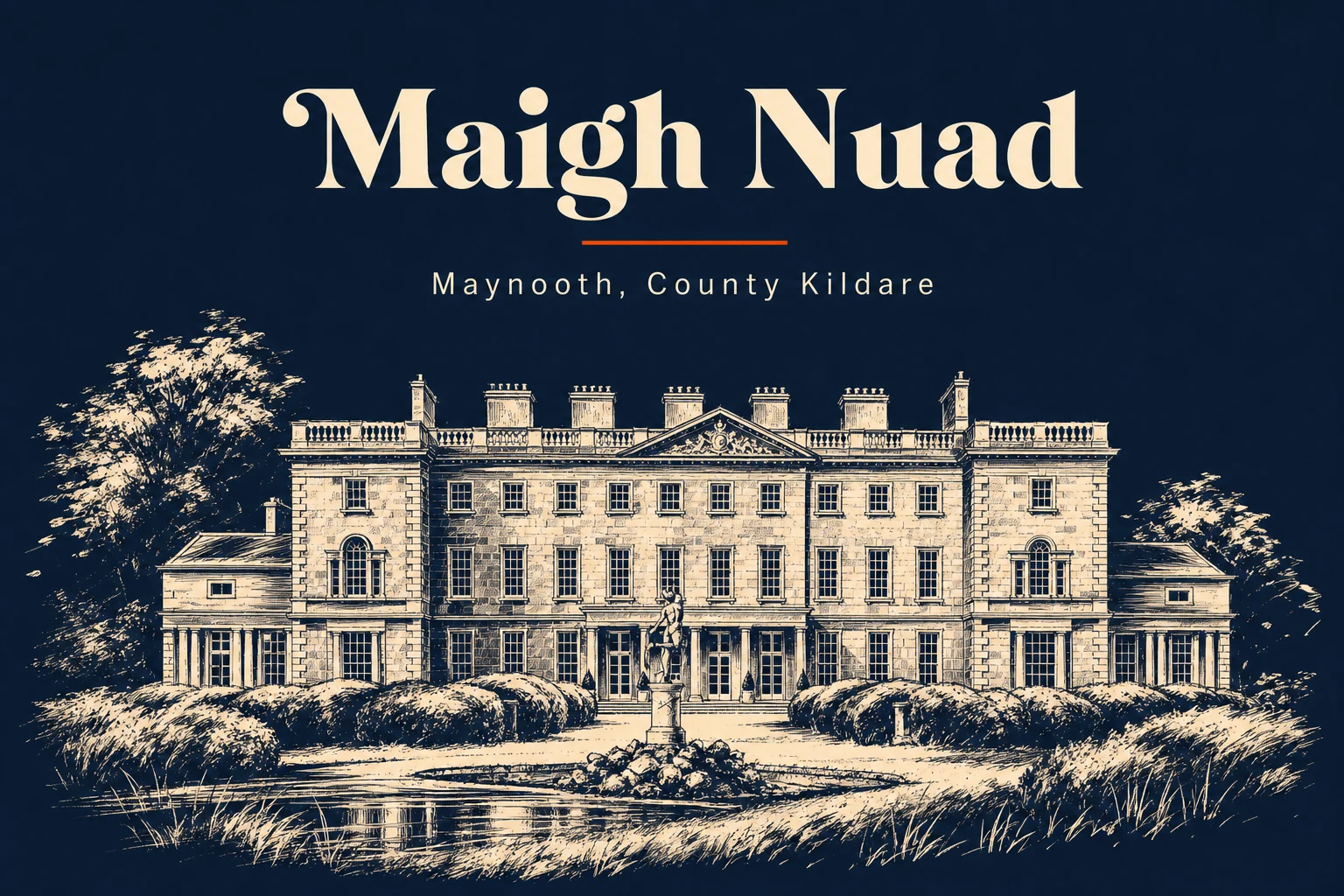
Maigh Nuad · Co. Kildare
Seminary, university, FitzGerald ruin - and loud on Fridays.
Maynooth is not one town. It is four things that happen to share a postcode: a ruined FitzGerald castle, a 230-year-old Catholic seminary, a university with 14,000 students, and a Palladian country house that is now a Fairmont hotel. On a Tuesday morning, you can stand on the main street and look at all four within a single turn of the head. On a Friday night, three of those four things are irrelevant - the students have taken over and the pubs are at capacity.
St Patrick's College Maynooth, the original 1795 foundation, is a separate institution from the university: a pontifical college that still trains Catholic priests for Ireland and beyond. Augustus Pugin designed several of its Victorian Gothic buildings in the 1840s and 50s - the same Pugin who did the interiors of the Palace of Westminster. Walking the south campus on a quiet afternoon, past the great dining hall and the Russell Library, feels like a different century. It is, in fact, several different centuries stacked on top of each other. The college's history and the history of Catholic Ireland since Emancipation are the same story told from the same place.
Carton House sits a kilometre outside the town boundary, through a gate on the Celbridge road, and deserves more than the glance most people give it from the car window. The grounds are 1,100 acres. Richard Cassels built the house around 1740 for the earl who would become Ireland's first Duke of Leinster. Lady Emily Lennox, who married into the title in 1747, created the famous Shell Cottage and had 23 children here, one of whom - Lord Edward FitzGerald - would die on the wrong side of the 1798 rebellion. The 7th Duke sold the lot to pay gambling debts of £67,500. The Fairmont group runs it now. The golf is expensive; the grounds walk is not.
The castle predates everything. Maurice FitzGerald, ancestor of the later Earls of Kildare, built the original keep around 1176 and for three centuries it was the most powerful FitzGerald seat in Ireland. In 1535, Henry VIII's lord deputy William Skeffington bombarded it for ten days with artillery, took the surrender of the garrison, and executed them in front of the gate. This became known as the Maynooth Pardon, which is an Irish joke about English promises. Silken Thomas was captured shortly after and hanged at Tyburn in 1537 with his five uncles. The ruins have been free to visit ever since. The OPW put a small visitor centre in the keep. The town grew up around the gap in the wall.