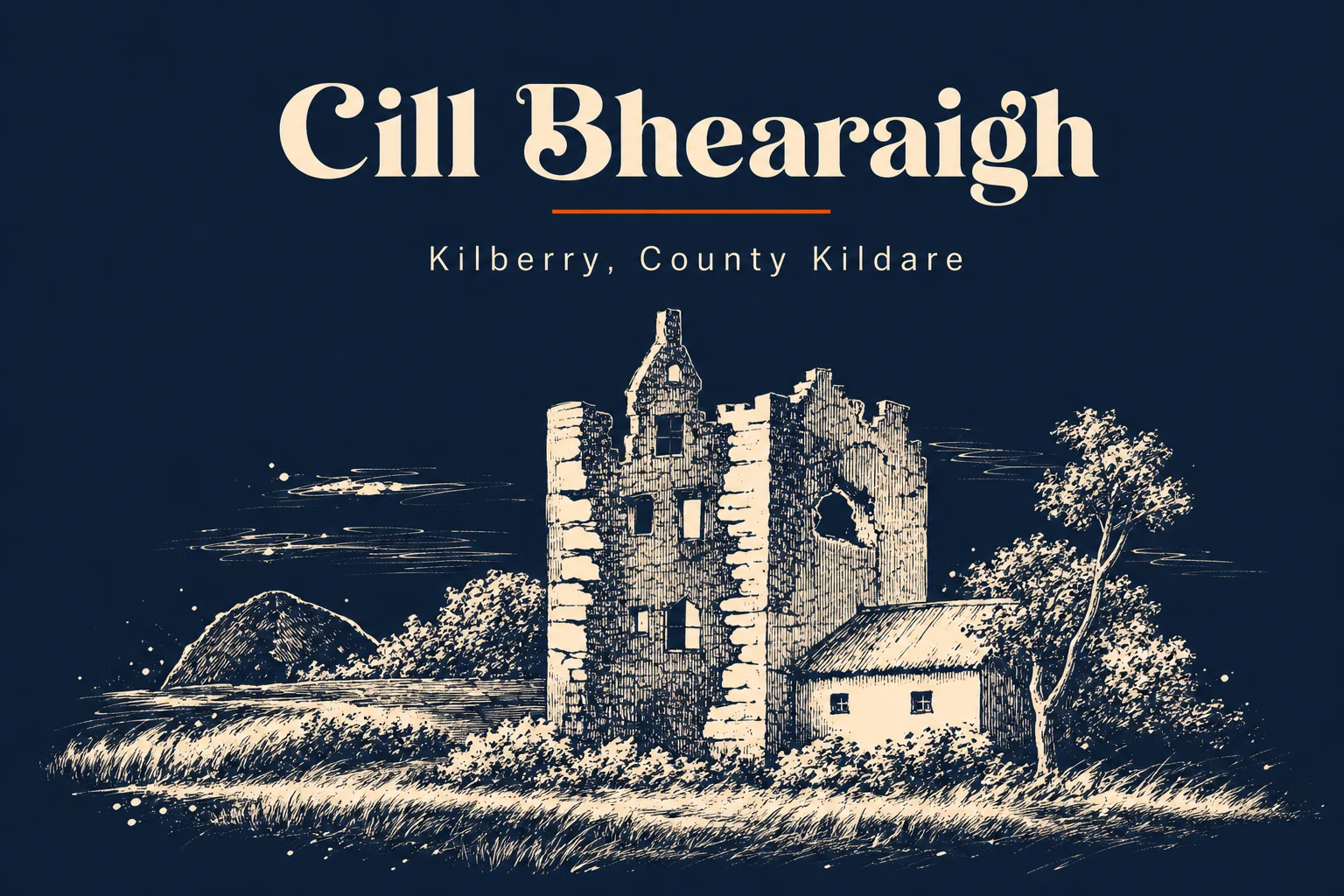
Cill Bhearaigh · Co. Kildare
A scattered Barrow-valley parish on the R417 north of Athy, where the name carries a lost saint and two ruined castles sit in the fields.
Kilberry is a scattered parish in south County Kildare, 4 km north of Athy on the R417, in the valley of the River Barrow. Cill Bhearaigh - the church of St Baire - is named for a saint who has all but vanished from the record. Like a lot of rural Kildare, it is more a townland with a church than a village with a centre: a Church of Ireland church on the road, a graveyard with a medieval ruin in it, farmhouses, and the flat green country of the Barrow lowlands running out to the river.
The history is in the fields rather than on a street. There were once an abbey, a nunnery and two castles in this small parish, and the names still cling to the farms - Abbey Farm, Kilberry Castle, Castlereedy. The Church of Ireland church beside the road, built in 1833, is a small, well-kept Gothic Revival building that is a record in stone of a once-prosperous Protestant population in the locality. The bigger Norman ruin, Rheban Castle, stands a short way west across the Barrow.
There is no pub, no shop, no cafe here, and the census flags Kilberry as one of the peripheral parts of the county that keeps losing people. None of that is a criticism. Kilberry is a quiet farming parish that supports itself on the land and has no reason to put on a show for travellers. Come for the church history, the two castle ruins, and the flat Barrow country, or use Athy down the road as your base and treat this as a half-hour detour. There is nothing wrong with deciding it is not worth the turn off the main road.