County Kildare Ireland · Co. Kildare · Kildangan Save · Share
POSTED FROM
KILDANGAN
CO. KILDARE · IE

Kildangan
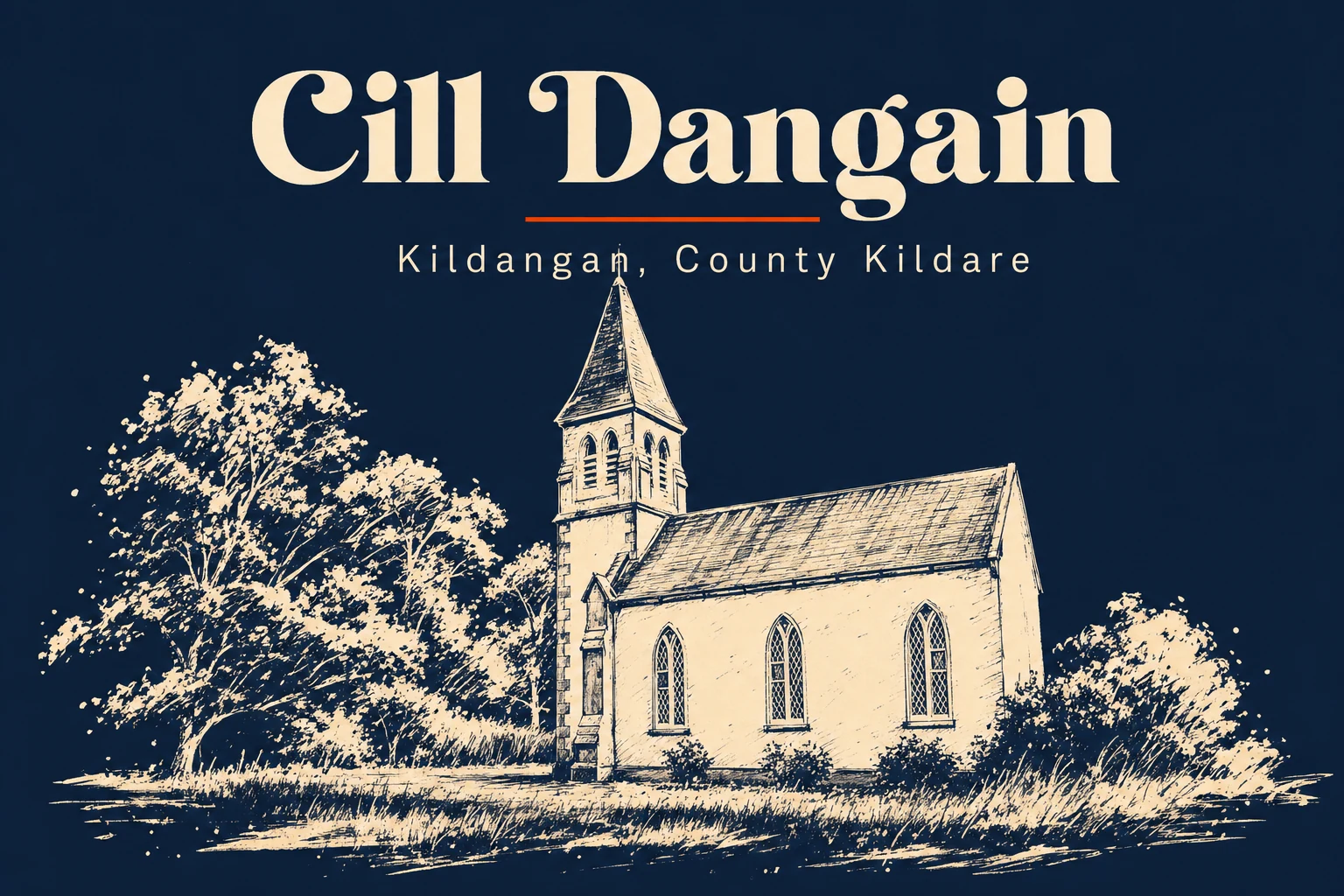
Cill Dangain

The Ireland's Ancient East
STOP 04 / 04
Cill Dangain · Co. Kildare

A small south Kildare village that breeds Epsom Derby winners.

Kildangan sits on the R417 between Monasterevin and Athy — a crossroads village of 317 people surrounded by flat Kildare farmland and the flood plain of the River Barrow. You could drive through it in under a minute. You would miss the point entirely.

The point is Kildangan Stud. Sheikh Mohammed bin Rashid Al Maktoum bought the property in 1986 from the More O'Ferrall family, who had worked it since the late 18th century — first as estate, then as training yard, then as stud from 1946. Sheikh Mohammed expanded what he found into a 1,500-acre operation. Over 400 horses. Around 250 employees. The main house stands on the site of a Norman castle that was dynamited in 1882, its stone reused for the Victorian building that replaced it. The stud's foaling unit — Whitefield Yard — has produced Epsom Derby winners Shaamit and High-Rise, and Group 1 champions including Cape Cross and Singspiel. It is one node in the Darley network that spans England, Kentucky and Australia.

The village itself is modest. One pub, a Gala forecourt that doubles as a convenience store since the post office closed in 2004, a GAA club with a complicated history of foundings and re-foundings. The Local Link bus runs three times daily to Athy and Kildare town. The railway station closed in 1963. What the village has — and what draws people who know horses — is context. The studs of south Kildare sit in a horse-country corridor that has no real equivalent in Europe. The limestone grass, the mild winters, the proximity to the Curragh. Kildangan Stud did not end up here by accident.
Population
~317
Founded
Church and fort, Anglo-Norman period
Coords
53.0850° N, 6.9620° W
01 / 04

The pubs.

None of these are themed Irish pubs, because they don't need to be. A few that earn the trip:

Crosskeys

Local, no-frills
Village pub

The one pub in Kildangan. A village social hub in the straightforward sense — where 317 people's social lives, to whatever extent they converge, converge here. No performance, no tourist trade. Just the pub.

02 / 04

Stories & lore.

The reason to come back. The things every local will eventually tell you about, usually after the second pint.

From Norman castle to 1,500 acres

Kildangan Stud

The More O'Ferrall family had owned the land for the better part of two centuries when Sheikh Mohammed al-Maktoum bought it in 1986. Roderic More O'Ferrall had opened a training stable in 1926 — winning five Irish classics before converting to stud operations in 1946. The Sheikh's purchase ended that era and began another. Today the operation houses over 400 horses, employs around 250 people, and has produced winners of the highest races in the calendar. The main house stands where a 12th-century castle stood until 1882, when it was taken down stone by stone to build what replaced it.

Sheikh Mohammed's global network

Godolphin and Darley

Kildangan Stud operates under Darley — the breeding arm of Sheikh Mohammed's Godolphin operation, one of the largest thoroughbred organisations in the world. Darley runs farms on four continents: Dalham Hall in Newmarket, Jonabell Farm in Kentucky, operations in Australia, and Kildangan here in Kildare. The horses bred at Kildangan compete under the Godolphin blue silks on every major track. Cape Cross, sire of Sea The Stars, was a Kildangan stallion. So was Singspiel, winner of the Japan Cup and Dubai World Cup. The Irish address is not a satellite office — it is a foundation.

Shaamit, High-Rise, and what the limestone grass produces

Derby winners from Whitefield Yard

Epsom Derby winners Shaamit (1996) and High-Rise (1998) were both foaled in Kildangan's Whitefield Yard — purpose-built for foaling. They are two of the more famous horses that began their lives in south Kildare, but the operation's output runs much wider than those two names. Mark of Esteem won the 2,000 Guineas. Swain won the King George VI and Queen Elizabeth Stakes twice. The grassland here — mineral-rich, well-drained, typical of the Kildare limestone belt — is as responsible for what the horses become as anything done by human hands.

Cill Dangain and the Norman fort

The castle that became a house

The Irish name means 'church of the fort' — an Anglo-Norman settlement that combined a castle built by the Fitzgeralds with a church, placed near the River Barrow as part of a defensive line running from Carlow to Portarlington. The castle stood until 1882, when it was demolished and its stone used to build the Victorian Jacobean house that now serves as the stud's main house. By 1837 the original church was already in ruins; a Catholic chapel was built in the 19th century by the O'Reilly family, who also provided land for a schoolhouse. The 1986 purchase by Sheikh Mohammed placed an international racing operation on top of a medieval Irish fortification. Not many places can say that.

03 / 04

When to go.

There is no bad time. There are different times.

Spring
Mar–May

Foaling season. The fields around the stud are full. Kildare horse country is at its best in spring light.

◉ Go
Summer
Jun–Aug

Race meetings at the Curragh (20 minutes away) run through summer. Combine a Kildangan stop with a day at the races.

◉ Go
Autumn
Sep–Oct

Yearling sales season across Kildare. The horse world is busy. The flat roads make for good cycling.

◉ Go
Winter
Nov–Feb

A quiet village gets quieter. The River Barrow plain is prone to flooding. Not much reason to visit specifically.

◐ Mind yourself
+

Getting there.

By car

Kildangan is on the R417 between Monasterevin (8km west) and Athy (10km east). From Dublin, take the M7 to junction 14 (Monasterevin) and follow the R417 south-east. About 60km from the city centre, under an hour.

By bus

Local Link runs three daily services connecting Kildangan to Athy, Kildare town and Newbridge. Route 888 (launched June 2024) links to Athy and Allenwood. Not frequent, but it works.

By train

The nearest stations are Monasterevin and Kildare town, both on the Dublin-Cork mainline. The station in Kildangan itself closed in 1963.