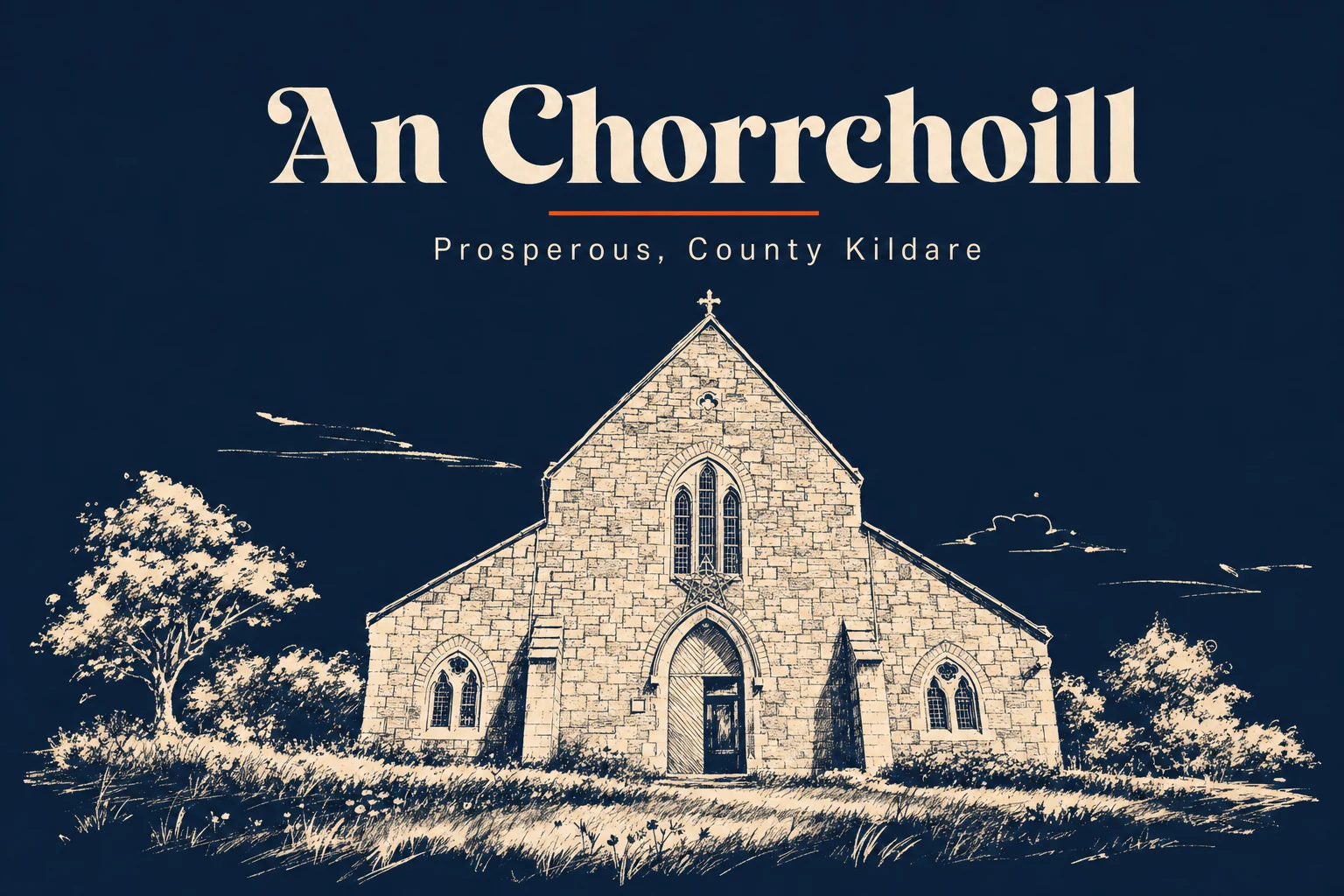
An Chorrchoill · Co. Kildare
Named in hope. The mill failed. Then came the massacre.
The name is ironic now, which was not the intention. Robert Brooke, a County Cavan gentleman with no experience in textiles, received £25,000 from the Irish Parliament in the 1770s to build an Irish Manchester on the north Kildare bogland. He built 200 houses, a cotton factory, a printing works for linen and cotton goods, and named the settlement Prosperous with optimism so complete it bordered on prophecy. Within a decade the money was gone, the machinery was idle, and a contemporary observer noted that Brooke "had no knowledge of the business; he committed it to the care of others; of course every thing went to ruin."
What followed the failed mill is the thing people actually remember. On the night of 23-24 May 1798, United Irishmen under John Esmonde scaled the walls of the garrison in the dark, killed the sentries, opened the gates, and set the barracks on fire. Captain Richard Swayne of the City of Cork Militia - who had spent the previous four days pitcapping locals and desecrating the chapel - was shot and piked in his bed. Around forty soldiers died. The rebels held the town for nearly a month. It was the opening action of the 1798 rebellion in Kildare, and the news of it spread fast.
The village Brooke built is still legible. The Georgian two-square streetplan along Main Street is intact, the proportions deliberate, the scale human. You can read the ambition in the width of the street - this was meant to be a proper industrial town, not a crossroads. What it became instead was a commuter village for north Kildare and Dublin, population somewhere around 4,000, with a Grand Canal branch a few kilometres away and the Bog of Allen for a back garden.
There is one more thing. In 1972, Christy Moore came to Prosperous and recorded an album in the basement of a house called Downings. Andy Irvine was there. Liam Óg O'Flynn. Dónal Lunny. The sessions produced the album that launched the Tara Records label and, shortly after, Planxty. It is one of the founding moments of the modern Irish trad revival. The house is a private residence. The album is still worth finding.