County Kildare Ireland · Co. Kildare · Staplestown Save · Share
POSTED FROM
STAPLESTOWN
CO. KILDARE · IE

Staplestown
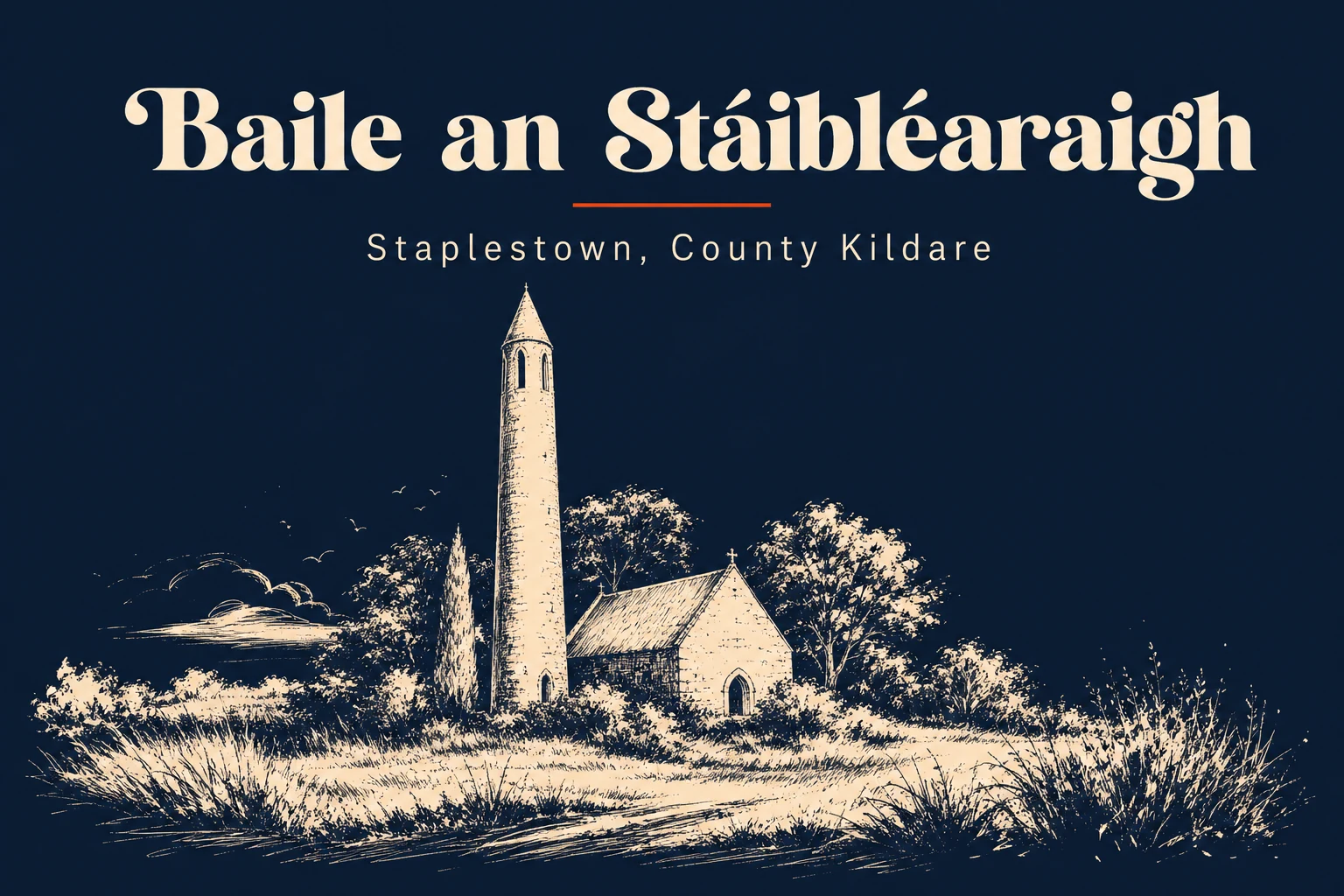
Baile an Stáibléaraigh

The Ireland's Ancient East
STOP 02 / 02
Baile an Stáibléaraigh · Co. Kildare

A medieval staple market reborn from 1798 ashes.

Staplestown is a small village in north Kildare, forty kilometres west of Dublin. The name comes from Baile an Stáibléaraigh — "the Town of the Stapler" — a medieval market designation that gave the place official rights to trade in agricultural produce and livestock. For a small settlement in the flat Kildare countryside, that privilege was significant. It meant merchants, drovers, and travelling traders passed through. It meant infrastructure and hospitality and a permanent community built around commerce rather than farming alone.

The village burned during the 1798 Rebellion. British troops torched the thatched church that stood before — reprisal for the rebel attack on Prosperous barracks eight kilometres west, where sixty United Irishmen killed sixty British soldiers. The community rebuilt. St. Benignus Church, completed around 1840, is the result — a T-plan church with three galleries and a slate roof, one of the oldest in the Kildare and Leighlin diocese. The architectural ambition of that rebuilding is visible still.

Scoil Naomh Mhuire — the national school — was founded in 1833 by Reverend Maurice Kearney "for the Education of the Poor Children in the Parish of Staplestown." St. Kevin\'s GAA Club follows from 1945, playing from Jack Casey Memorial Park. A statue of Christ the King stands opposite the church on the school wall. None of this is complicated or grand. It is honest infrastructure, built slowly, for a small community that had weathered destruction and decided to stay.

Population
~300
Founded
Medieval staple market; St. Benignus Church c.1840
Coords
53.2667° N, 6.7500° W
01 / 02

Stories & lore.

The reason to come back. The things every local will eventually tell you about, usually after the second pint.

Medieval commerce and privilege

The Staple Market Right

Staplestown\'s Irish name preserves a medieval designation. A staple was an official market centre where merchants had the right — and the obligation — to buy and sell certain commodities. The Crown granted these rights to strategic locations, controlling both the trade and the taxation. A "Stabler" or "Staple Keeper" was the official who oversaw weights, measures, and fair dealing. For a small settlement on a river valley route between Naas and the western passes, the privilege meant access to merchants and traders who would not otherwise have stopped. It meant hospitality — stables for horses, rooms for travellers, warehouses for goods. The medieval town was built on that single administrative designation. The modern village is built on what happened after.

The rebellion\'s local cost

Church Destruction and Rebuilding, 1798

On 24 May 1798, sixty United Irishmen rebels attacked the British barracks at Prosperous, eight kilometres west. They killed sixty soldiers — one of the few outright rebel victories of the county rebellion. British retaliation was swift. They burned the thatched church at Staplestown. The original building, dating to around 1750, was destroyed. The community that had survived famine and war decided to rebuild. St. Benignus Church, begun in the 1820s and completed around 1840, represents that determination. The T-plan design, the three galleries, the solid slate roof — all of it was ambitious for a village of three hundred people. The architectural quality suggests both community resources and the commitment of clergy who saw the church as an act of resistance to colonial oppression.

Teaching the poor

Scoil Naomh Mhuire and Catholic Education

Reverend Maurice Kearney founded Scoil Naomh Mhuire in 1833, just four years after Catholic Emancipation made such openly Catholic institutions legal. The school was built on the grounds of St. Benignus Church. The purpose, stated explicitly, was "the Education of the Poor Children in the Parish of Staplestown." That was not rhetorical. Post-Emancipation Irish Catholicism invested substantially in education — schools, orphanages, convents — as a way of asserting both spiritual authority and community permanence. The school here operated continuously from 1833 through expansion in 1927 and renovation in 2006. That continuity, across nearly two centuries of Irish history, is remarkable for a village this small.

+

Getting there.

By car

Dublin to Staplestown is 40 km — 50 minutes on the M4 to Junction 5 (Maynooth), then south on the R407 toward Naas. Clane is 12 km east; Straffan and Celbridge are on the same general corridor. From Naas, Staplestown is 15 km north via the R407 and local roads.