County Kildare Ireland · Co. Kildare · Rathcoffey Save · Share
POSTED FROM
RATHCOFFEY
CO. KILDARE · IE

Rathcoffey
Ráth Chofaigh

The Ireland's Ancient East
STOP 03 / 03
Ráth Chofaigh · Co. Kildare

A tower house, a family feud, and very quiet roads.

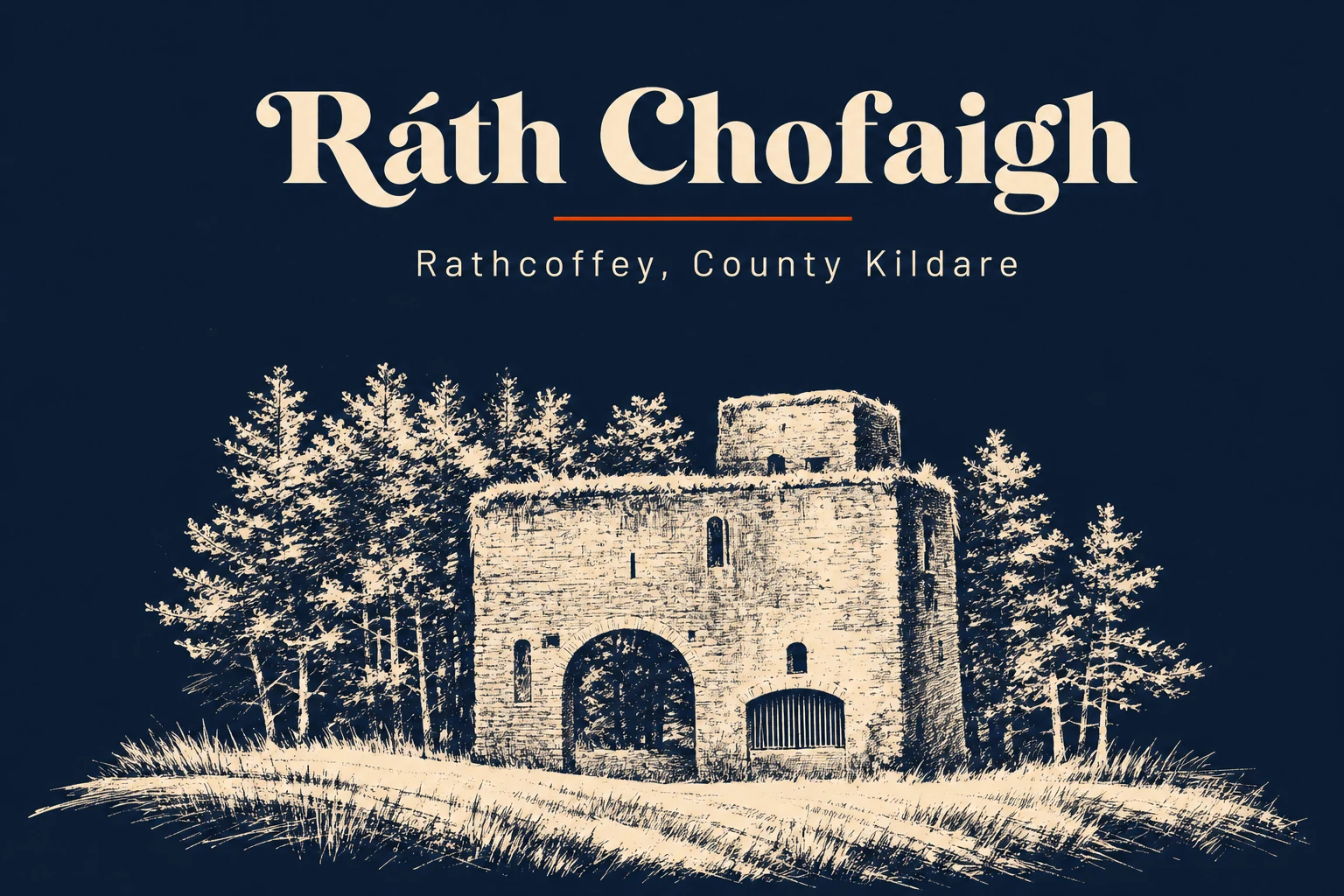
Rathcoffey is a small north Kildare village sitting between Clane and Kilcock, about 30 kilometres west of Dublin. The name gives it away: Ráth Chofaigh — Cofaigh's ringfort — a pre-Norman chieftain who left his name on the land long before the Normans arrived to build on top of it.

The castle is the reason most people come. Rathcoffey Castle is a late-medieval tower house, first documented in Wogan family dower records in 1417, though the family had held the manor since Sir John Wogan — Justiciar of Ireland — was granted it by parliament in 1317. The Wogans ran north Kildare for generations. In 1453 the family turned on itself: Richard Wogan led an armed assault on the castle to wrest it from his cousin Anne Eustace, who had inherited it. He won. The castle is a national monument now. The ruins still stand.

In 1785 the estate was bought by Archibald Hamilton Rowan, a founding member of the Dublin Society of United Irishmen. He built a Georgian mansion around parts of the old castle structure and filled it with nearly 3,000 books. After the 1798 rebellion he went into exile in France and America, returning in 1806. The mansion is long gone. The castle ruins and a quiet rural road are what remain. The 1710 Catholic church — built during the Penal Laws on the site of a stable the Wogans had used as a Mass house — is said to be the oldest Catholic church in the Diocese of Kildare and Leighlin.
Population
271
Founded
pre-Norman
Coords
53.33° N, 6.69° W
01 / 03

The pubs.

None of these are themed Irish pubs, because they don't need to be. A few that earn the trip:

Farrington's Mill

Mill heritage, own-brewed beer
Pub, restaurant & craft brewery

A 200-year-old former working mill on Long Road, Moortown, now operating as a pub, restaurant, and small brewery. They brew their own beer and run an organic farm on the grounds. The food leans toward quality rather than chipper fare. Worth the detour if you are in the area.

02 / 03

Stories & lore.

The reason to come back. The things every local will eventually tell you about, usually after the second pint.

Wogan vs Wogan

The 1453 Private War

In 1453, Richard Wogan raised an army and marched on Rathcoffey Castle — which was held by his cousin Anne Eustace, née Wogan. The dispute was over inheritance. He took the castle by force. Anne's Eustace descendants ended up with lands at Clongowes Wood instead. The castle stayed in Richard's branch of the Wogans. Medieval family law, settled by armed force.

The United Irishman

Archibald Hamilton Rowan

Rowan bought the Rathcoffey estate in 1785. He was a founding member of the Society of United Irishmen, the organisation that attempted revolution against British rule in 1798. When the rebellion failed, he fled — first to France, then to America. He returned to Rathcoffey in 1806. His library, catalogued in 1836, held nearly 3,000 books and pamphlets. The mansion he built around the old Wogan castle structure is gone, but his name and his politics left a mark on the place.

The Penal Laws

The Mass House Stable

During the Penal Laws of the early 18th century, Catholics in Rathcoffey held Mass in a stable on the Wogan estate. In 1710, that stable was converted into a proper church — Lady Frances, Duchess of Tyrconnell, and the Wogans funded the build. The resulting church is recorded as the oldest Catholic church in the Diocese of Kildare and Leighlin. It still serves the Clane and Rathcoffey parish.

+

Getting there.

By car

Off the R407 between Clane and Kilcock. About 30km west of Dublin. The M4 motorway to Kilcock exit is the quickest approach from the city.

By bus

No direct bus service to Rathcoffey village. Nearest bus connections are in Clane (Bus Éireann) or Kilcock.

By train

Nearest rail station is Maynooth, about 12km east, on the Dublin–Sligo line.