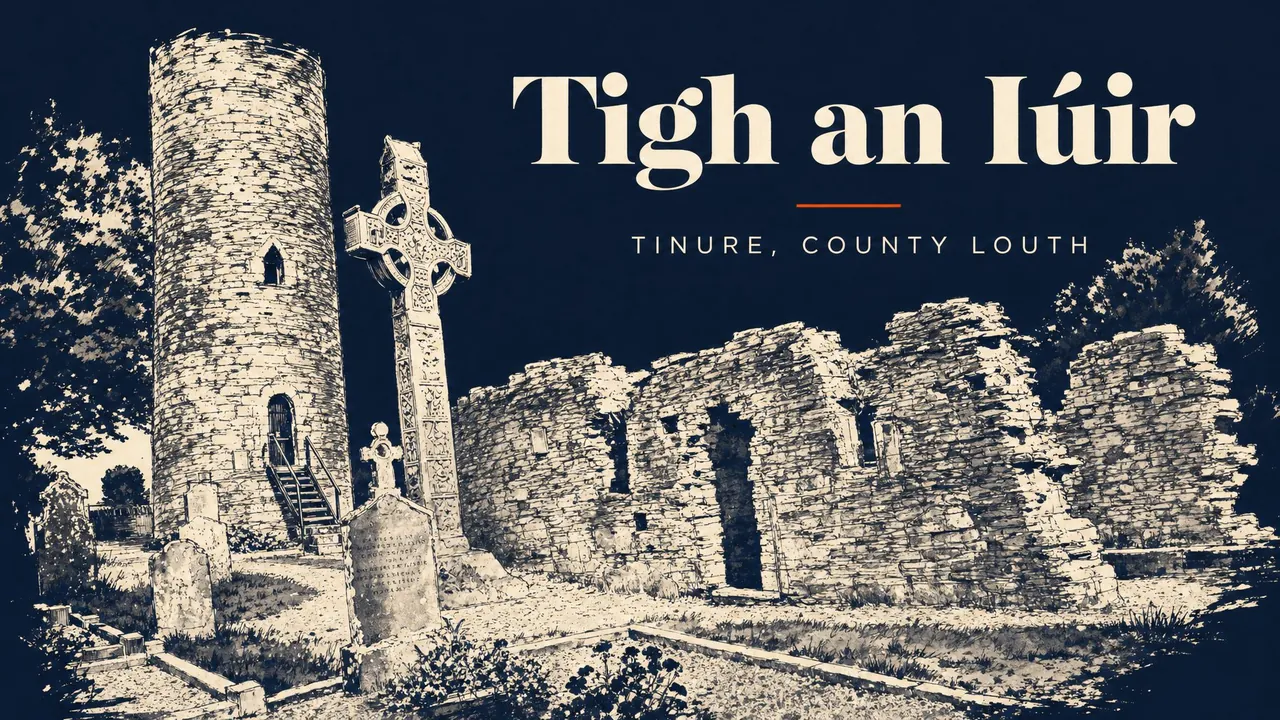
Tigh an Iúir · Co. Louth
A five-road junction with a church, a couple of houses, and the M1 humming a kilometre away.
Tinure is a small crossroads village between Drogheda and Dunleer, in the civil parish of Monasterboice, sitting where five small roads come together at a 19th-century church. Four hundred and sixty-four people in the 2016 count, up from under three hundred at the start of this century - the M1 a kilometre east is the reason. The Irish name, Tigh an Iúir, means 'house of the yew', and the yew is the older history of the place.
There is no main street. There is no village centre other than the road junction itself. The Church of Our Lady of the Immaculate Conception, built in 1894, sits at the apex of the five roads; the houses are scattered along each radiating arm. Most of the residents commute - to Drogheda four kilometres south, to Dunleer five kilometres north, to Dublin an hour down the M1. This is a commuter parish that happens to have an old name and an older neighbour.
The neighbour is what makes Tinure worth slowing down for. Two minutes south on the back road is Monasterboice - Mainistir Bhuithe, the monastery of Saint Buithe - one of the most important early-Christian sites on the island. A 10th-century round tower, two of the finest high crosses in Ireland (including the great west cross of Muiredach, dated to around 900 AD), a small ruined church, and a graveyard still being used by the surrounding parishes. Free, open year-round, and quieter than most sites of its rank because nobody in the visitor industry has worked out how to package it.
Don't come for Tinure. Come for Monasterboice and Mellifont, both inside ten minutes of the junction, and stop in Tinure for the church and a sense of how a parish works without a town to lean on. Then drive on. Sleep, eat and drink in Drogheda or Collon. The pints are five minutes up the road in Dunleer.