County Sligo Ireland · Co. Sligo · Achonry Save · Share
POSTED FROM
ACHONRY
CO. SLIGO · IE

Achonry
Achadh Conaire, Co. Sligo

The Ireland's Hidden Heartlands
STOP 05 / 05
Achadh Conaire · Co. Sligo

A name that outgrew the place - a 6th-century monastery that gave a diocese its title, and a deconsecrated cathedral standing over the graves.

Achonry is not a village in the way a stranger expects a village. There is no street, no square, no shop and no pub - it is a townland and civil parish on a low rise of bog and farmland in south Sligo, roughly nine kilometres east of Tubbercurry and four north-west of Bunnanadden, in the old barony of Leyney. What sits on the rise is a cathedral, a graveyard and a parochial hall, and a name that travelled a great deal further than the place ever did.

The name belongs to the Diocese of Achonry, one of the suffragan sees of the Archdiocese of Tuam. The tradition is sixth-century. St Nath Í - Anglicised as Nathy, and remembered in the parish as the saint of Achonry - founded a monastery here on land granted by the local Clan Conaire. One strand of the annals has St Finian of Clonard, teacher of the twelve apostles of Ireland, granted the place around AD 530 and putting his disciple Nathy in charge. Either way Nathy is the founding figure, and the diocese that grew out of his monastery still carries the name of his field.

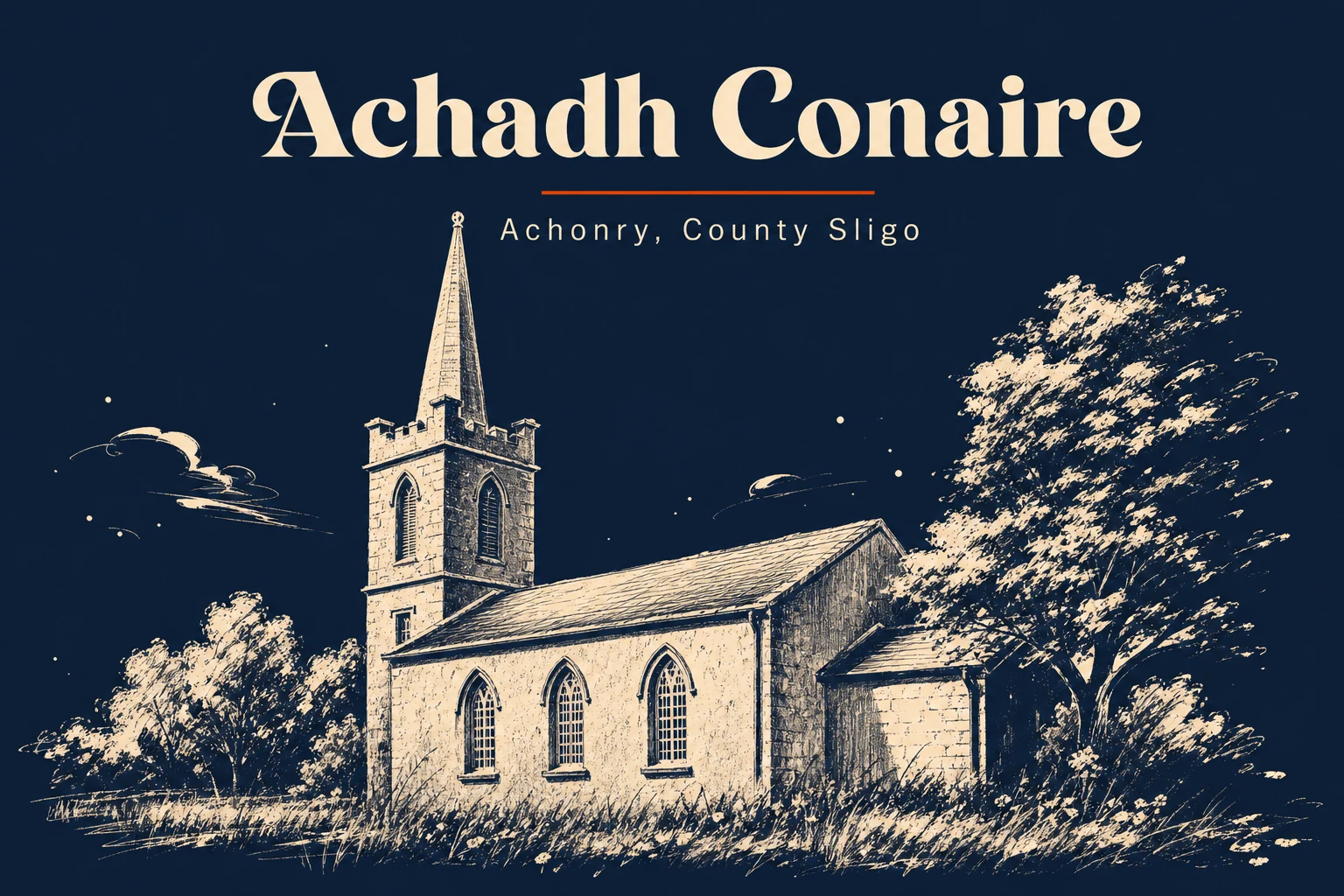
The cathedral you see is much later. St Crumnathy's was built for the Church of Ireland in 1822 with a Board of First Fruits grant of just over a thousand pounds, on the site of the older monastic settlement - a plain rendered nave, an engaged three-stage tower, an octagonal spire and a ball finial. By the mid-nineteenth century the Catholic diocese had moved its own cathedral south to Ballaghaderreen in Roscommon under Bishop Durcan, where the larger population sat. St Crumnathy's soldiered on as a Church of Ireland cathedral until it closed in 1997 and was deconsecrated in 1998. It is a protected structure now, disused, with the graveyard kept around it.

So come for the layers, not the amenities. The monastic rise, the Georgian cathedral over it, the headstones, and the strange fact of a diocese named for a field with no town in it. Then drive the ten minutes to Tubbercurry for a pint and a bed.
Population
No separate village figure - a dispersed parish; the parish centre of population is Tubbercurry
Walk score
A cathedral, a graveyard and a scatter of houses on a low rise
Founded
Monastery on the site in the 6th century; the diocese took its shape at the Synod of Kells, 1152
Coords
54.0828° N, 8.6669° W
01 / 05

At a glance.

Three things every local will eventually mention. Read these and you've already understood more than most day-trippers do.

02 / 05

Stories & lore.

The reason to come back. The things every local will eventually tell you about, usually after the second pint.

The 6th-century foundation

Nathy's field

The Irish is Achadh Conaire - Conaire's field, after the Clan Conaire who held this land. The monastery is credited to St Nath Í ua hEadhra, the O'Hara saint remembered as the patron of the diocese, whose feast falls on 9 August. An older strand of the record brings St Finian of Clonard into it: granted Achonry by the chief of Luigne around AD 530, Finian is said to have founded the house and set his pupil Nathy over it, making him the first bishop. The two traditions are not really in conflict - Finian the teacher, Nathy the man on the ground - and both end with Nathy's name on the diocese.

The name in Sligo, the cathedral in Roscommon

A diocese with no town

The Diocese of Achonry was given its modern shape at the Synod of Kells in 1152 and ran co-extensive with the barony of Leyney, taking in most of south Sligo, a large part of east Mayo and a corner of north Roscommon. The catch is that its named centre never grew into a town. In the mid-nineteenth century, under Bishop Patrick Durcan, the Catholic see moved its cathedral - the Cathedral of the Annunciation and St Nathy - to Ballaghaderreen in Roscommon, where the population could support it. So the diocese is run from one county, named for a second, and its old cathedral stands in a third place entirely from where most of its people live.

Board of First Fruits Gothic on a monastic rise

St Crumnathy's, 1822

The cathedral that stands today is a Board of First Fruits church of 1822, built for a little over a thousand pounds on the site of the early monastery. It is a modest Gothic Revival building - a three-bay nave, an engaged three-stage tower to the west, an octagonal spire with a ball finial, ashlar limestone dressings and Y-traceried timber windows with cusped heads. A datestone over the door reads 1822. It was one of three cathedrals in the united Diocese of Tuam, Killala and Achonry until it closed in 1997 and was deconsecrated the following year. It is now on the Record of Protected Structures for County Sligo, disused, its graveyard still in use.

03 / 05

Things to do outside.

Wear waterproofs. Bring a sandwich. Tell someone where you're going if it's the mountain.

The cathedral and graveyard The deconsecrated cathedral and the grass churchyard around it, inside rubble stone walls and wrought-iron gates. Headstones run back into the 18th century. The rise is the old monastic ground. Quiet, frequently empty, worth the short stop for the layering of monastery, Georgian cathedral and graves.
0.3 km on sitedistance
20-30 mintime
04 / 05

What to skip.

Honestly? Don't bother.

If a local was sitting beside you, this is the bit where they'd lean in.

×
Arriving expecting a village

There is no street here - no pub, no shop, no café. Achonry is a cathedral, a graveyard and a parochial hall on a rise of farmland. If you want a pint, a meal or a bed, Tubbercurry is ten minutes west and Ballymote about twenty east.

×
Hunting for the Catholic cathedral at Achonry

It is not here. The Cathedral of the Annunciation and St Nathy was built at Ballaghaderreen in Co. Roscommon in the nineteenth century, where the population was. The building at Achonry is the former Church of Ireland cathedral, St Crumnathy's, deconsecrated in 1998.

+

Getting there.

By car

Off the back roads of south Sligo between Tubbercurry and Bunnanadden. Tubbercurry (on the N17) is about 9 km west, 10-15 minutes. Bunnanadden is 4 km south-east, Ballymote about 20 minutes east. Sligo town is roughly 35 minutes north on the N4/N17 and local roads.

By bus

No direct service. Local Link covers parts of south Sligo on certain days; the nearest regular stop is Tubbercurry on the Bus Eireann 64 (Galway-Sligo).

By train

No station. Nearest active stations are Ballymote (about 20 min) and Sligo MacDiarmada (about 35 min) on the Dublin-Sligo line.

By air

Ireland West Airport Knock (NOC) is about 35 minutes south. Dublin is roughly 2h 45m.