County Sligo Ireland · Co. Sligo · Ballynacarrow Save · Share
POSTED FROM
BALLYNACARROW
CO. SLIGO · IE

Ballynacarrow
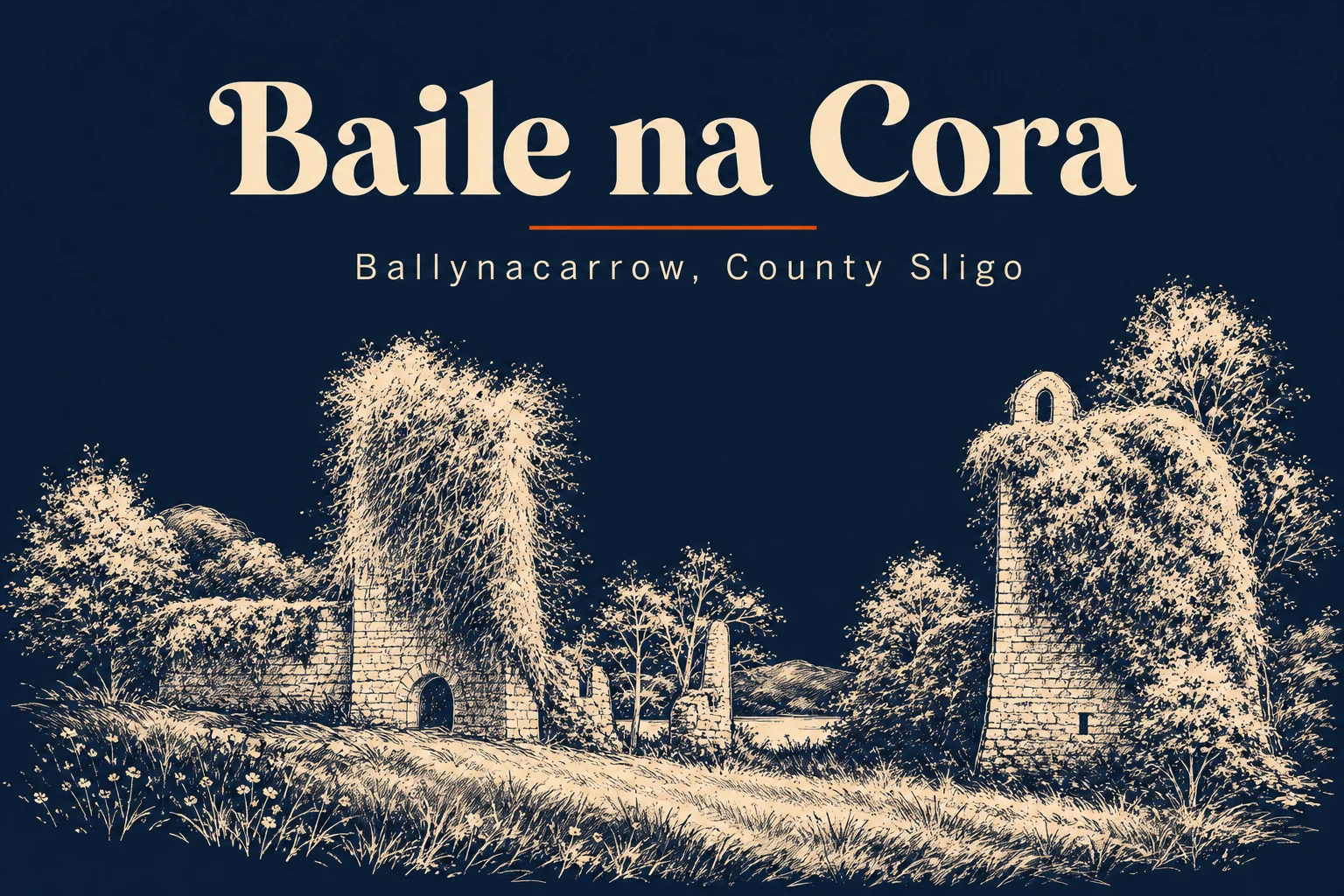
Baile na Cora, Co. Sligo

The Wild Atlantic Way
STOP 07 / 07
Baile na Cora · Co. Sligo

A small village strung along the Galway road, with one good singing pub and Temple House at its back.

Ballynacarrow, Baile na Cora, is a small village in south-west Sligo, strung along the N17 about nineteen kilometres from Sligo town and a few minutes north of Ballymote. The 2022 census counted 220 people. It splits across two townlands, Ballynacarrow North and South, in the civil parish of Kilvarnet and the Catholic parish of Collooney-Ballinacarrow. This is the Galway road, not the Wild Atlantic coast, so most of what passes through is doing exactly that - passing through.

What is here is a real village in miniature: the national school, St Lassara's, in the middle of it; the parish church of St Fechin and St Lassara set back in its own grounds just outside; and Durkin's Bar, which is the heart of the place. The bar is known well beyond the village for its music - the Sligo Traditional Singers Circle meets here once a month, and there are trad sessions besides. It fills to the rafters on a good night.

The thing worth knowing is what sits behind the village. South toward Ballymote is Temple House, a thousand-acre Perceval estate built around a Georgian manor, with the ruins of a Knights Templar castle on the lake shore - the order's most westerly foundation, granted the land in 1216. It runs now as a country house to stay in. That, the pub, and the long evening light over south Sligo are the reasons to slow down here. Otherwise the road carries on to Collooney and the N4, or south to Tubbercurry and on to Galway.

Population
220 (2022 census)
Pubs
1and counting
Walk score
A roadside village strung along the N17
Founded
Census town since 2016; parish church c. 1905
Coords
54.1339° N, 8.5611° W
01 / 07

At a glance.

Three things every local will eventually mention. Read these and you've already understood more than most day-trippers do.

02 / 07

The pubs.

None of these are themed Irish pubs, because they don't need to be. A few that earn the trip:

Durkin's Bar

Singers and trad sessions, fills to the rafters
Village pub & music house, on the N17

The village pub, on the main road. It punches well above its weight for music. The Sligo Traditional Singers Circle meets here on the second Wednesday of every month for an unaccompanied singing session, and there are trad sessions besides. People come from across Ireland and further for a good night. For a village of 220 people, having one genuinely good music pub is the whole point - this is it.

03 / 07

Where to sleep.

PlaceTypeLocal note
Temple House Georgian country house, signposted south of the village The Perceval family's manor on a thousand-acre estate, with a Knights Templar castle ruin on the lake below the house. Run as a country guesthouse - large period rooms, dinner by arrangement, the kind of place people make a destination of in itself. Seasonal; book ahead. It is the reason a lot of visitors come to this corner of Sligo at all.
04 / 07

Stories & lore.

The reason to come back. The things every local will eventually tell you about, usually after the second pint.

The order's most westerly foundation

Temple House and the Knights Templar

Just south of Ballynacarrow, on the road to Ballymote, the Knights Templar were granted land in 1216 and built a castle on the lake shore - the most westerly Templar foundation in Ireland. When the order was suppressed the lands passed to the Knights Hospitaller, then to the O'Haras, the native sept, who put up their own castle by the lake in 1360. The ruins of it still stand at the water's edge. The Perceval family has held the estate since 1665, and the Georgian manor you see today, Temple House, was built around 1825 and enlarged in the 1860s. It runs as a country guesthouse on grounds of over a thousand acres. The whole layered history - Templar, Hospitaller, Gaelic chief, Anglo-Irish gentry - sits in one demesne behind a small roadside village.

A restrained classical church, c. 1905

The church of St Fechin and St Lassara

The Catholic church just outside the village, set back from the road in its own grounds, dates to around 1905. It is a plain, well-built thing - a five-bay nave under a slate roof, a restrained classical west front with an ashlar limestone bellcote and pediment, round-headed windows with stained-glass margins. The interior keeps a well-preserved timber truss roof and an arcaded balcony at the west end. It is dedicated to St Fechin and St Lassara, the same Lassara who gives the village school its name. Nothing grand, but honest and intact, and the kind of early-twentieth-century parish church that quietly anchors a place this size.

05 / 07

When to go.

There is no bad time. There are different times.

Spring
Mar-May

Quiet roads, long light coming back. The estate grounds at Temple House look their best.

◉ Go
Summer
Jun-Aug

Long evenings, the best chance of catching music in Durkin's. South Sligo stays quiet even at its busiest.

◉ Go
Autumn
Sep-Oct

The singers circle and sessions keep going. Good light on the south Sligo hills.

◉ Go
Winter
Nov-Feb

Wet and dark, and the N17 carries fast traffic through the village. Drive carefully, especially after dusk.

◐ Mind yourself
06 / 07

What to skip.

Honestly? Don't bother.

If a local was sitting beside you, this is the bit where they'd lean in.

×
Treating Ballynacarrow as a sightseeing stop

There is no signposted attraction in the village itself. The draws are the pub on a music night and Temple House behind it - plan around those, not around a walk down the main street.

×
Crossing the N17 carelessly

This is a fast through-road, not a quiet lane. The village strings along it. Mind the traffic.

+

Getting there.

By car

On the N17 between Collooney (about 12 minutes north, for the N4) and Tubbercurry (south). Sligo town is about 25 minutes north. Ballymote is a few minutes south.

By bus

Bus Eireann Expressway route 64 (Galway-Sligo-Derry) runs along the N17 through the village.

By train

No station. Ballymote, a few minutes south, is on the Dublin-Sligo line and is the nearest railhead.

By air

Ireland West Airport Knock (NOC) is about 40 minutes south.