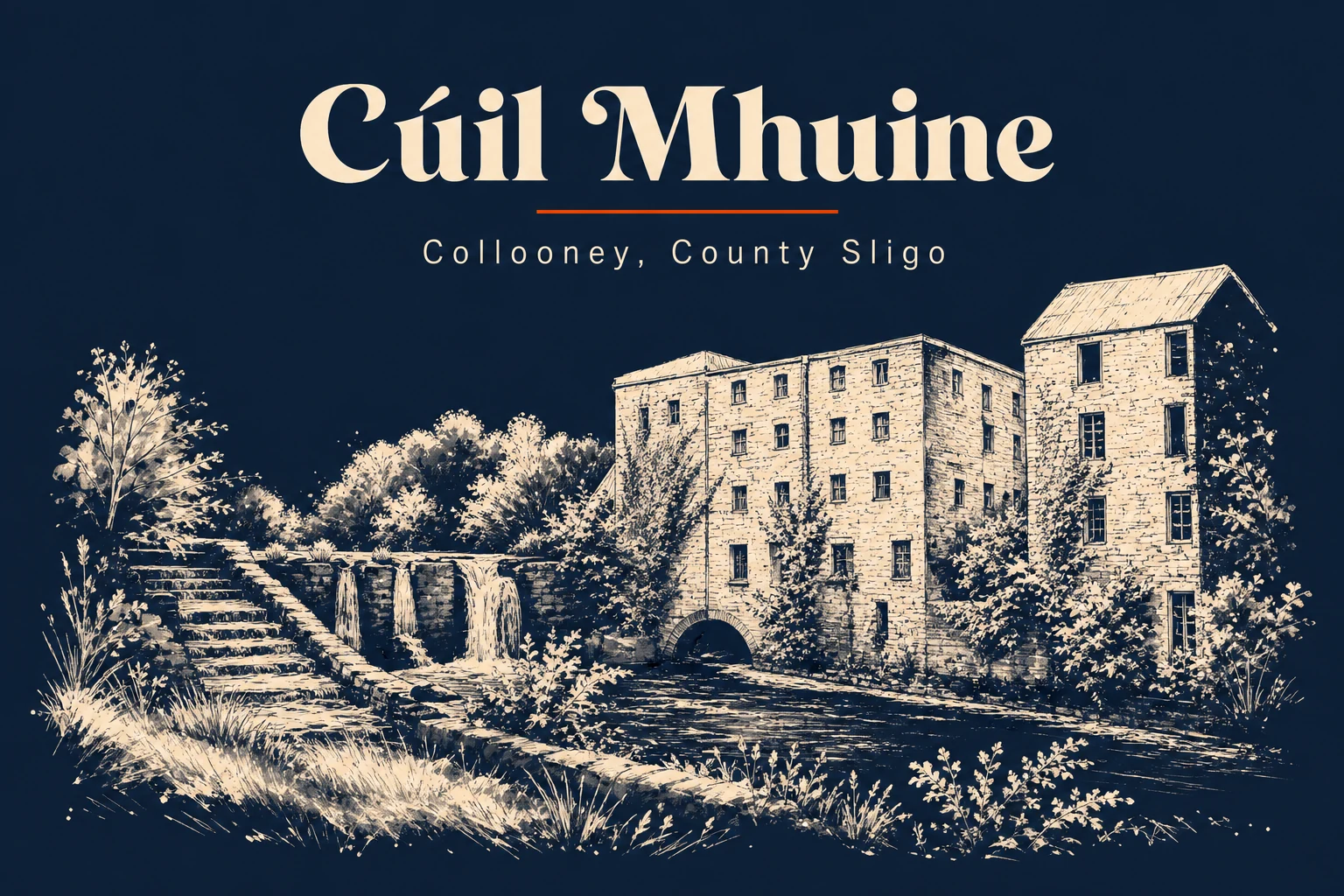
Cúil Mhuine · Co. Sligo
Where a French army marched through, and an Irish lieutenant took the cannon.
Collooney sits ten kilometres south of Sligo on the old road, the new motorway and the Dublin-Sligo railway line. Most people drive past it on the M4 without registering anything more than a sign and a turn. The village earns a closer look. It was the site of one of the few clear-cut victories the United Irishmen ever had, in September 1798. A horseman called Bartholomew Teeling rode at a British cannon on Union Rock, shot the gunner, and took the gun. The road to Donegal opened. Three weeks later the same army was beaten at Ballinamuck and Teeling was hanged at Arbour Hill. The monument in the village core has been there since 1898 - Yeats spoke at the unveiling.
The other Collooney story is the Coopers. Same family in Markree Castle since 1663 - one of the longest unbroken country-house lineages in Ireland. The colonel of the family in the 1830s, Edward Joshua Cooper, was a member of parliament who turned a wing of the estate into the best private astronomical observatory in Europe. The 13.3-inch lens at Markree was the largest telescope in the world when it was installed in 1831. An assistant called Andrew Graham used a small comet-seeker on the same grounds and bagged an asteroid in 1848. The 60,000-star catalogue Markree produced through the 1850s was a serious piece of work.
The castle is a hotel now. The village is a commuter belt with a few good pubs, a railway station that still runs four trains a day to Dublin and three back to Sligo, and a 1798 monument that gets a wreath every September. There is a reason to come. There is not a reason to stay three nights.