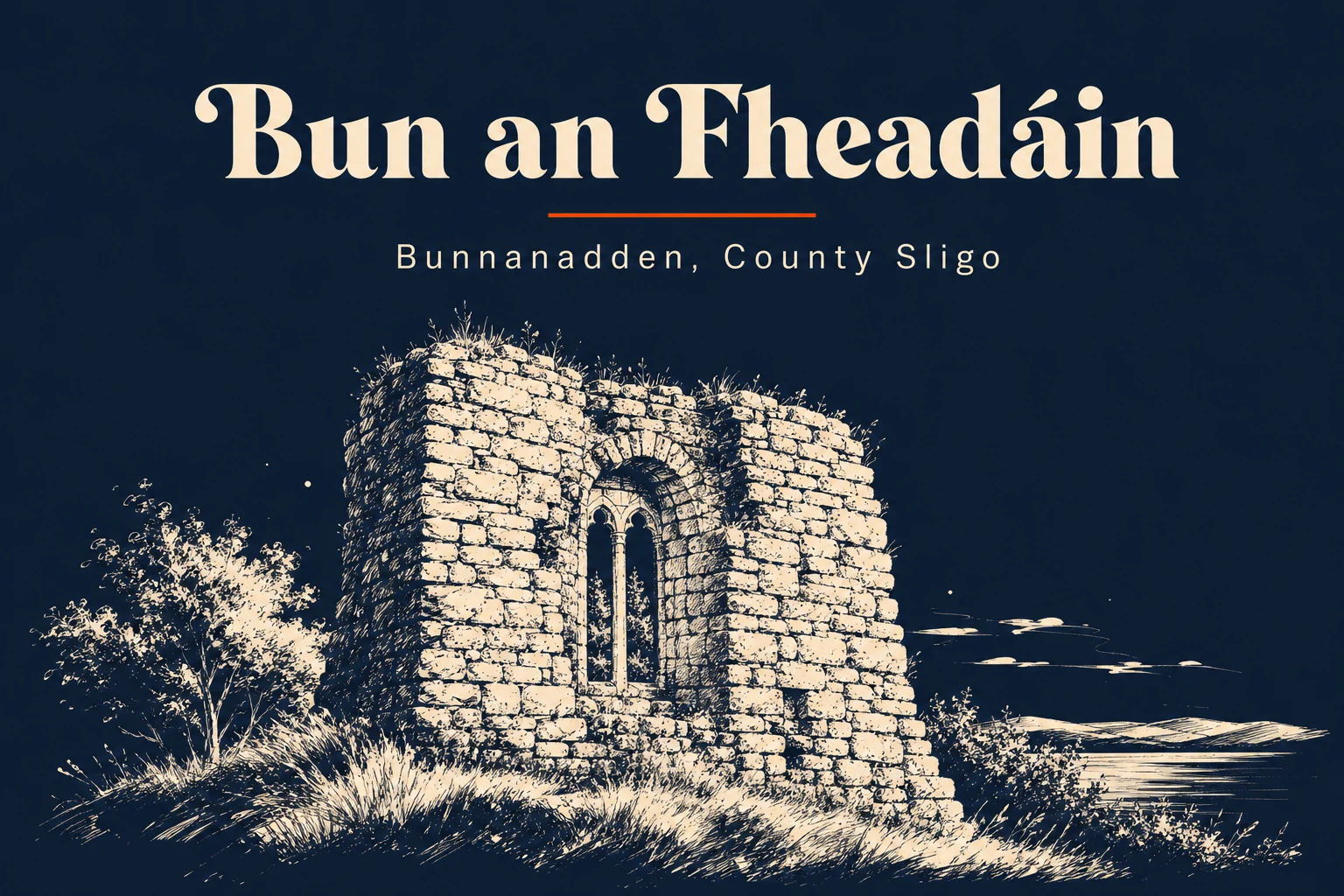
Bun an Fheadáin · Co. Sligo
A small south Sligo crossroads in the heart of the country that produced the Sligo fiddle style.
Bunnanadden is a small village in south Sligo on the R296, nine kilometres from Tubbercurry and eight from Ballymote, sitting about seventy metres up in rolling drumlin country. The Irish name, Bun an Fheadáin, places it at the foot of a small stream. The 19th-century maps mark a busier spot than you will find today - a mill, two churches, a Royal Irish Constabulary barracks and a street of houses, with fairs held six times a year. Modern reality is a crossroads with two pubs, a church, a national school and a sports hall. The post office closed in 2011.
What gives this place its weight is not what you can see but what came out of it. This is the heart of the country that produced the Sligo fiddle style - fast, ornamented, flamboyant - the sound that travelled to New York in the early 1900s and came back on 78s to change Irish music. Martin Wynne, whose reels are session standards from here to San Francisco, was born in the townland of Everlawn just outside the village. Michael Coleman, the most famous of all the Sligo fiddlers, came from Knockgrania in Killavil, the neighbouring parish, a short hop up the road.
There is one piece of stone worth the detour: Cloonameehan Friary, a ruined Dominican house founded in 1488 by Eugene Mac Donogh and dissolved around 1584. It sits in a graveyard in the townland that gives the village its name, quiet and unsignposted, the kind of ruin you find by asking rather than by following a brown sign.
Bunnanadden is part of the south Sligo road network rather than a stop on a tour. There are no beds in the village and no restaurant. Use it as a pass-through and a music pilgrimage, base yourself in Ballymote or Tubbercurry, and time a visit for a festival week when the parish pubs fill with fiddles.