County Sligo Ireland · Co. Sligo · Lissadell Save · Share
POSTED FROM
LISSADELL
CO. SLIGO · IE

Lissadell
Lios an Daill

The Wild Atlantic Way
STOP 04 / 12
Lios an Daill · Co. Sligo

Two girls in silk kimonos, both beautiful, one a gazelle. That house.

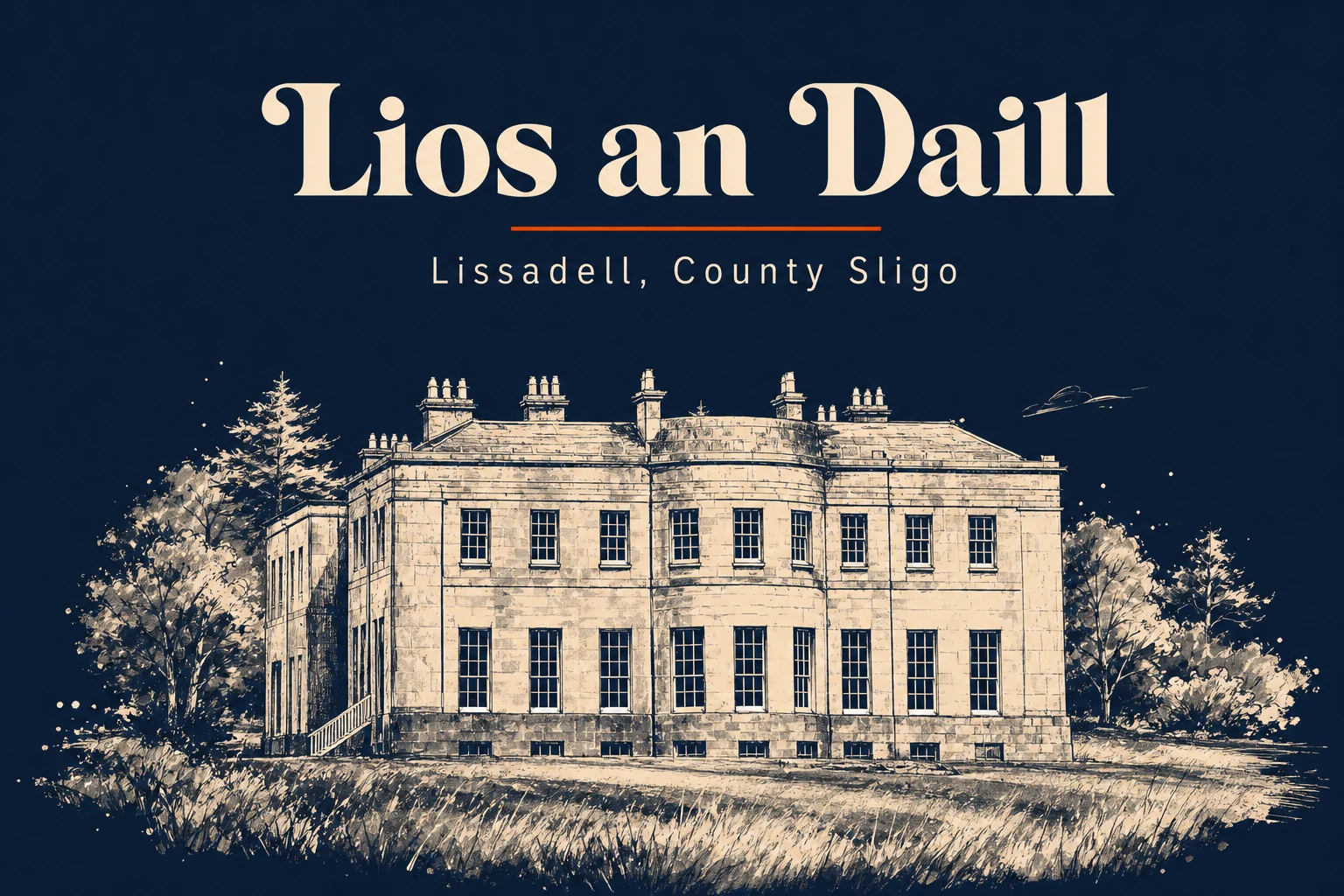
Lissadell is not a village. It is a parish on the north side of Sligo Bay, west of Drumcliff, dominated by a single neoclassical house and the demesne around it. The house was built between 1830 and 1835 for Sir Robert Gore-Booth, the 4th Baronet, to designs by the English architect Francis Goodwin — a Greek Revival pile of grey limestone with tall south-facing windows looking out across Sligo Bay to Knocknarea. The Gore-Booth family lived here for nearly two centuries.

Two children born at Lissadell carried it into history. Constance, born 1868, became Constance Markievicz — Easter Rising commander at the College of Surgeons in 1916, first woman elected to the Westminster House of Commons in 1918, Minister for Labour in the First Dáil. She did not take the Westminster seat. Eva, born 1870, became a published poet and a trade-union organiser among Manchester barmaids and tea-pickers. The two sisters lived very different lives but the bond was lifelong. Yeats spent two long visits at Lissadell in 1894 and 1895 and twenty years after both sisters' deaths wrote the famous elegy that opens the light of evening, Lissadell, great windows open to the south.

The Gore-Booths sold the estate in 2003 to the Dublin barristers Edward Walsh and Constance Cassidy, who undertook a long restoration and reopened the house and demesne to the public. The walled and Alpine gardens were rebuilt. Yeats memorabilia, much of it the largest private collection in the country, is on display. There is a café in the courtyard, woodland walks, and beach access at the bottom of the demesne. The house is open seasonally — typically from Easter through September. Check the website before you drive out.
Walk score
House, gardens and beach in one afternoon
Founded
Lissadell House, 1830-1835
Coords
54.3500° N, 8.5667° W
01 / 06

At a glance.

Three things every local will eventually mention. Read these and you've already understood more than most day-trippers do.

02 / 06

Stories & lore.

The reason to come back. The things every local will eventually tell you about, usually after the second pint.

Five generations at Lissadell

The Gore-Booths

The Gore-Booth family built and held Lissadell from the late 18th century through to 2003. The present house was commissioned by Sir Robert Gore-Booth, 4th Baronet (1805–1876) and built 1830–1835 by Francis Goodwin, a London-based architect best known otherwise for civic buildings in the English Midlands. Sir Robert was the first Lissadell baronet to live in the new house; the family had previously occupied an older house on a nearby site. The Gore-Booths produced soldiers, MPs, polar explorers (Sir Henry Gore-Booth went to Spitsbergen in 1882) and the two revolutionary sisters of the next generation.

1868–1927

Constance

Constance Georgine Markievicz was born in London on the 4th of February 1868 to the Gore-Booth family and raised at Lissadell. She trained as a painter in London and Paris, married the Polish count Casimir Markiewicz, and threw herself into Dublin nationalist politics in the 1900s. She was second-in-command at the College of Surgeons during the Easter Rising in 1916, sentenced to death and commuted because of her sex. In December 1918 she was elected for Sinn Féin in Dublin St Patrick's — the first woman elected to the United Kingdom Parliament — and refused to take the Westminster seat, sitting instead in the First Dáil. She became Minister for Labour in 1919, the first woman cabinet minister in Western Europe. She died in a public ward in Dublin in 1927.

Poet, suffragist, organiser

Eva

Eva Gore-Booth was born at Lissadell in 1870 and lived most of her adult life in Manchester with her partner Esther Roper, organising trade-union work among working-class women — barmaids, pit-brow lasses, circus performers — and writing poetry. She published several collections during her lifetime. Yeats responded to her sympathetic ear by confiding his unrequited love for Maud Gonne. She died in 1926, a year before Constance.

Two long visits, 1894 and 1895

Yeats at Lissadell

Yeats visited Lissadell as a young poet in 1894 and 1895, brought there through family connection — the Pollexfens and Middletons of Sligo town knew the Gore-Booths. He left a lasting record of the place in In Memory of Eva Gore-Booth and Con Markievicz, published in 1933 after both sisters had died: The light of evening, Lissadell, / Great windows open to the south, / Two girls in silk kimonos, both / Beautiful, one a gazelle. The gazelle is Eva. The other was Constance.

03 / 06

Things to do outside.

Wear waterproofs. Bring a sandwich. Tell someone where you're going if it's the mountain.

The demesne and walled gardens House admission includes garden access. The Alpine garden has been rebuilt since 2003. Old yew avenue and a long lawn down to the bay.
2-3 kmdistance
2 hourstime
Lissadell Beach Long, flat strand at the foot of the demesne. Walking access from the estate or the public car park to the east. Looking south the view is of Knocknarea across the bay.
3 km of stranddistance
However long you havetime
Carney to Lissadell road The avenue and back lanes through Carney village to the demesne gates. Mature trees, stone walls, a quiet road most of the time.
4 km returndistance
1 hourtime
04 / 06

When to go.

There is no bad time. There are different times.

Spring
Mar–May

Alpine garden in May is the standout. House opens for the Easter weekend; check the website for dates.

◉ Go
Summer
Jun–Aug

House fully open. Concerts and literary events in the courtyard. Beach below the house empties out in the evening.

◉ Go
Autumn
Sep–Oct

Last open weeks usually mid-September. Beach walking at its best. Light on the great south windows is the angle Yeats was writing about.

◉ Go
Winter
Nov–Feb

House closed. The demesne is private — access only via Lissadell Beach car park and the public road. Drive on; come back at Easter.

◐ Mind yourself
05 / 06

What to skip.

Honestly? Don't bother.

If a local was sitting beside you, this is the bit where they'd lean in.

×
Showing up out of season

Lissadell House is open seasonally and the schedule shifts year to year. Check the website before you drive out from Sligo or you will be looking at a gate.

×
Looking for a pub in Lissadell

There is no village pub at Lissadell. The café in the courtyard is the food on the estate; otherwise drive to Grange, Drumcliff or Carney for a pint.

×
Trying to do Lissadell in an hour

The house tour, the gardens and the beach are a half-day. Treat it as a full afternoon and leave room for Drumcliff or Mullaghmore afterwards.

+

Getting there.

By car

Sligo to Lissadell is 20 minutes via the N15 and the R291 through Carney. Drumcliff is 10 minutes east. Mullaghmore is 15 minutes north.

By bus

No direct service. Bus Éireann 480 (Sligo–Bundoran) passes Drumcliff and Grange; taxi or hire car for the final stretch.

By train

No station. Sligo MacDiarmada is 20 minutes south.

By air

Ireland West Airport Knock (NOC) is 1h 30m. Dublin is 3 hours.