County Sligo Ireland · Co. Sligo · Riverstown Save · Share
POSTED FROM
RIVERSTOWN
CO. SLIGO · IE

Riverstown
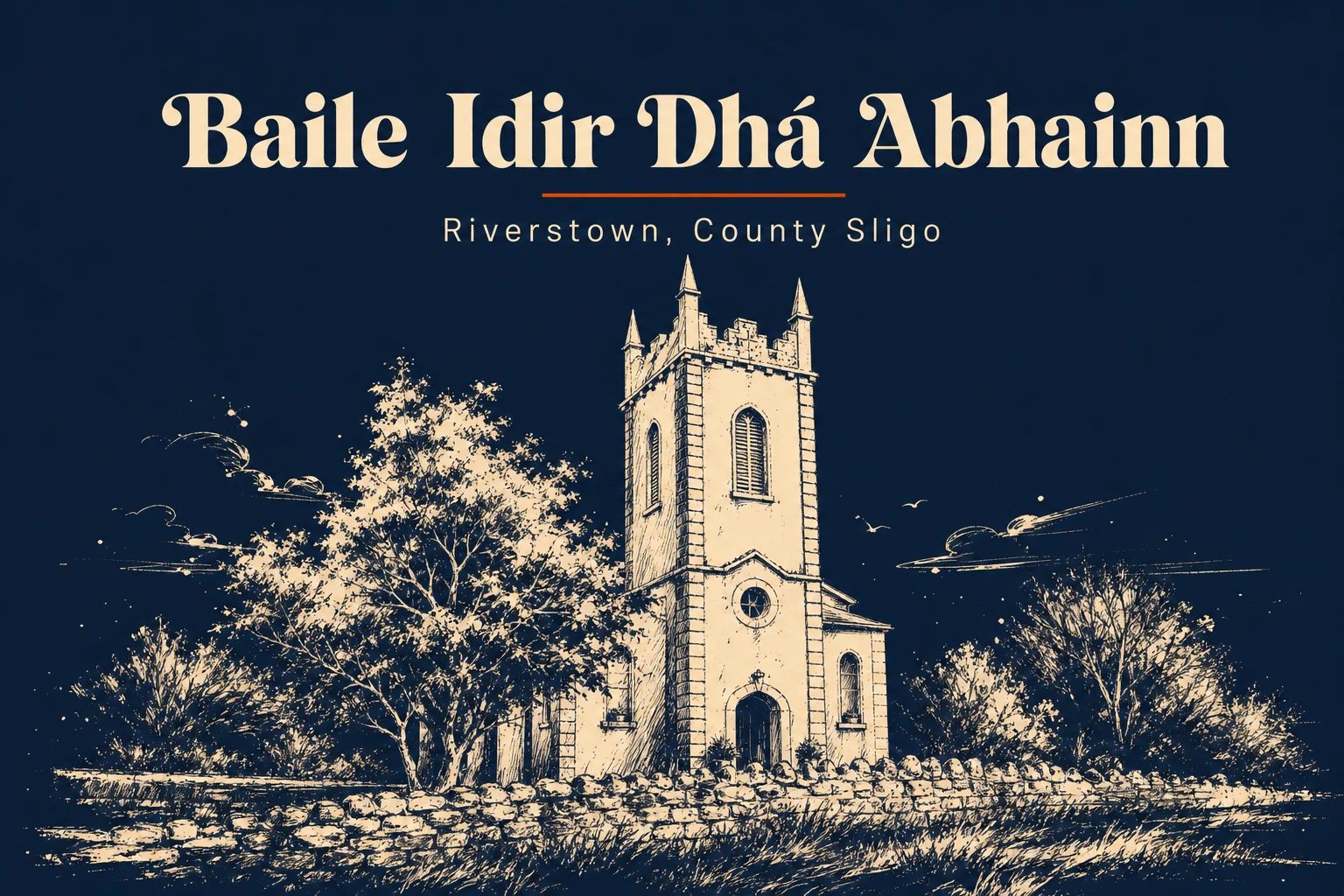
Baile Idir Dhá Abhainn

The Wild Atlantic Way
STOP 11 / 12
Baile Idir Dhá Abhainn · Co. Sligo

A small Georgian estate village at the foot of Carrowkeel, with a folk park and a country house.

Riverstown sits in the south-east corner of Sligo, between Lough Arrow and the Bricklieve Mountains, fifteen kilometres south-east of Sligo town. The name means the town between two rivers — the Unshin runs through the middle, the Owenboy joins it just below. The village is small: a green, a couple of pubs, a primary school, a community hall. The reasons to come are around it rather than in it.

Carrowkeel is the big one. Up in the Bricklieves above the village, fourteen passage tombs sit on a high limestone shelf — built between roughly 3,200 and 2,400 BC, contemporary with Newgrange and Maeshowe in Orkney. You drive up to the gate, park on the grass, walk fifteen minutes up the bog road, and you are inside one of the most important Neolithic cemeteries in Western Europe. There is no visitor centre. There are no rope barriers. Cairn G aligns with the midsummer sunset and you can crawl into the chamber to see it — bring a torch and trust the limestone.

Sligo Folk Park at the edge of the village is a community-run heritage attraction built around Millview House — a small farmhouse put up in 1873 by George Reid, a local farmer and shoemaker. A forge, a thatched cottage, a creamery, a parish schoolroom and a small museum of agricultural objects sit around the original house. It opens seasonally and runs traditional craft days.

Two kilometres west is Coopershill, the Georgian seat of the O'Hara family — completed in 1774, married into the O'Haras in 1810, same family seven generations later. The house is open as country-house accommodation. Their red deer herd runs on the estate and supplies the venison on the kitchen table. Riverstown is a small village. It is also the door to four serious things.
Population
~300
Walk score
Village green to folk park in fifteen minutes
Coords
54.0728° N, 8.3517° W
01 / 06

At a glance.

Three things every local will eventually mention. Read these and you've already understood more than most day-trippers do.

02 / 06

Stories & lore.

The reason to come back. The things every local will eventually tell you about, usually after the second pint.

Fourteen Neolithic tombs, c. 3,200–2,400 BC

Carrowkeel

The Carrowkeel passage tomb cemetery sits on a limestone shelf in the Bricklieve Mountains, five kilometres south of Riverstown. The site contains 14 known passage tombs and cairns — lettered A through P, with G the headline monument. It is roughly contemporary with Newgrange in the Boyne Valley and Maeshowe in Orkney. R.A.S. Macalister led the first excavation in 1911 and removed substantial human remains and grave goods. Cairn G is accessible — a small passage opening into a cruciform chamber. Its lightbox over the entrance aligns with the midsummer sunset, the way Newgrange aligns with the midwinter sunrise. There are no facilities, no admission, no marked safe path. The walk up from the parking area takes fifteen minutes.

Same family since 1774

Coopershill

Arthur and Sarah Cooper paid an architect with two buckets of gold sovereigns to build their house on a hill on their Sligo estate in the early 1750s. The house took nineteen years to complete and was finished in 1774. Their son married Jane O'Hara of Annaghmore in 1810 and the house has been in the O'Hara line ever since — seven generations in direct descent. Coopershill operates as country-house accommodation with eight bedrooms, runs a working farm and red-deer herd, and supplies its own venison.

Around Millview House, 1873

Sligo Folk Park

Millview House is a modest two-storey farmhouse built in 1873 by George Reid, a local farmer who also worked as a shoemaker and as sexton of the parish church. The house and its yard have been preserved as the heart of Sligo Folk Park, with a forge, a cottage, a small creamery and a school room moved or rebuilt around it. The park is community-run and opens seasonally. The visitor centre stocks crafts from the wider south Sligo area.

Limestone lake and mayfly

Lough Arrow

Lough Arrow is a limestone lake on the south side of Riverstown, fed by springs and famous among coarse and game anglers for its mayfly hatch and wild brown trout. It is the centre of a serious freshwater fishery — fly-fishing only in season — and the western edge of the lake at Castlebaldwin is the entry point. Quiet, deep, and surrounded by drumlins.

03 / 06

Things to do outside.

Wear waterproofs. Bring a sandwich. Tell someone where you're going if it's the mountain.

Carrowkeel passage tomb cemetery Park at the gate off the L4604 (signposted from the N4 at Castlebaldwin). Walk up the bog road. Bring a torch and waterproofs. Cairn G is the headline; do not approach Cairn O, which is unsafe.
4 km returndistance
2-3 hours on sitetime
Sligo Folk Park walkthrough Forge, cottage, schoolroom, creamery, museum. Seasonal opening — check times before driving out. Allow a coffee in the tea room.
500 mdistance
1.5 hourstime
Lough Arrow shore Access at Castlebaldwin or via the back roads from Riverstown. Mayfly time in late May is a fly-fisher's pilgrimage; the rest of the year it is a quiet lake.
2 km along shoredistance
1 hourtime
04 / 06

When to go.

There is no bad time. There are different times.

Spring
Mar–May

Lambs on the Bricklieves, mayfly on Lough Arrow late May, Carrowkeel dry underfoot.

◉ Go
Summer
Jun–Aug

Folk Park open seven days, Coopershill at its peak. Midsummer sunset at Cairn G — if you can stand the midges.

◉ Go
Autumn
Sep–Oct

Folk Park winds down, the Bricklieves are at their colour best, deer rut at Coopershill in October.

◉ Go
Winter
Nov–Feb

Folk Park closed. Coopershill open by arrangement. The road up to Carrowkeel can be glassy in frost.

◐ Mind yourself
05 / 06

What to skip.

Honestly? Don't bother.

If a local was sitting beside you, this is the bit where they'd lean in.

×
Driving Carrowkeel road in a low car

The L4604 up to the tombs is rough, single-track and steep in places. Take a high vehicle or walk the last kilometre.

×
Lighting fires inside the tombs

The chambers have been there for five thousand years. Smoke and candle wax do real damage. Bring a torch.

×
Showing up at Coopershill without booking

It is a private country house operating as accommodation — not a museum, not a public bar. Book a room or book a dinner; do not turn up on spec.

+

Getting there.

By car

Sligo to Riverstown is 25 minutes via the N4 and R284. Boyle is 25 minutes south on the N4. From Galway, 1h 50m.

By bus

Local Link 471 runs Sligo–Boyle via Riverstown most days. The Expressway 23 (Dublin–Sligo) stops at Castlebaldwin three kilometres south.

By train

No station — nearest is Boyle (20 min south) or Sligo MacDiarmada (25 min north).

By air

Ireland West Airport Knock (NOC) is 1h 10m. Dublin is 2h 30m.