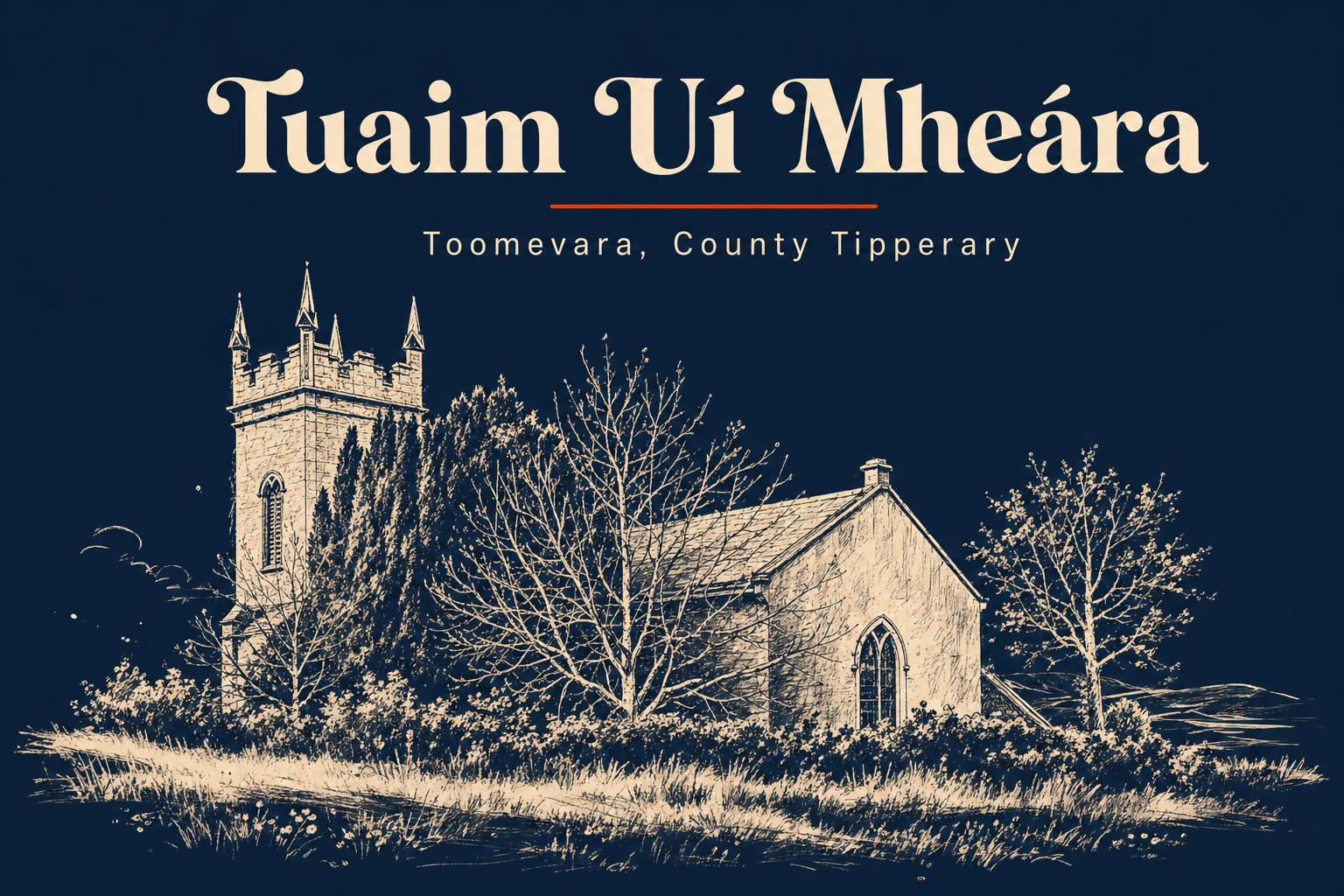
Tuaim Uí Mheára · Co. Tipperary
The motorway went around it. The hurling never stopped.
Toomevara sits between Nenagh and Roscrea on what used to be the main Dublin-Limerick road, and it is worth saying that up front: the old N7 was the village's spine, its reason for the petrol station and the roadhouse and the people who stopped for forty minutes and kept moving. The M7 motorway opened in December 2010 and the through-traffic went with it. What remained is a village of about 500 people that has had to be itself rather than a convenient stopping point.
The name tells one history: Tuaim Uí Mheára - the mound or tomb of the Meara family - reaches back to Gaelic land-holding that predates the Normans. Then the Normans arrived, and with them the Knights Hospitaller, who established a preceptory here in the 12th century. The Hospitallers were a military-religious order: they ran hospitals, they fought crusades, they managed estates across Europe with considerable efficiency. Their Irish houses are not well-known. Toomevara was one of them. Almost nothing survives above ground, but the ecclesiastical footprint on the townland is real.
What Toomevara is actually known for - in Tipperary, in hurling country - is the GAA club. Toomevara, nicknamed the Greyhounds, have punched well above their population weight in North Tipperary senior hurling for decades. In a county where every second village has a hurling field and a grievance about the county board, producing consistently competitive teams from a population of 500 is the kind of thing people notice. The club has county titles and Munster club championships behind it. This is hurling country at its most concentrated: small place, long memory, serious about the game.