County Tyrone Ireland · Co. Tyrone · Coalisland Save · Share
POSTED FROM
COALISLAND
CO. TYRONE · IE

Coalisland
Oileán an Ghuail, Co. Tyrone

The Mid Ulster
STOP 09 / 09
Oileán an Ghuail · Co. Tyrone

Ireland's first commercial canal is a drainage ditch now, and the town that built it sent the first civil rights marchers into the road in 1968.

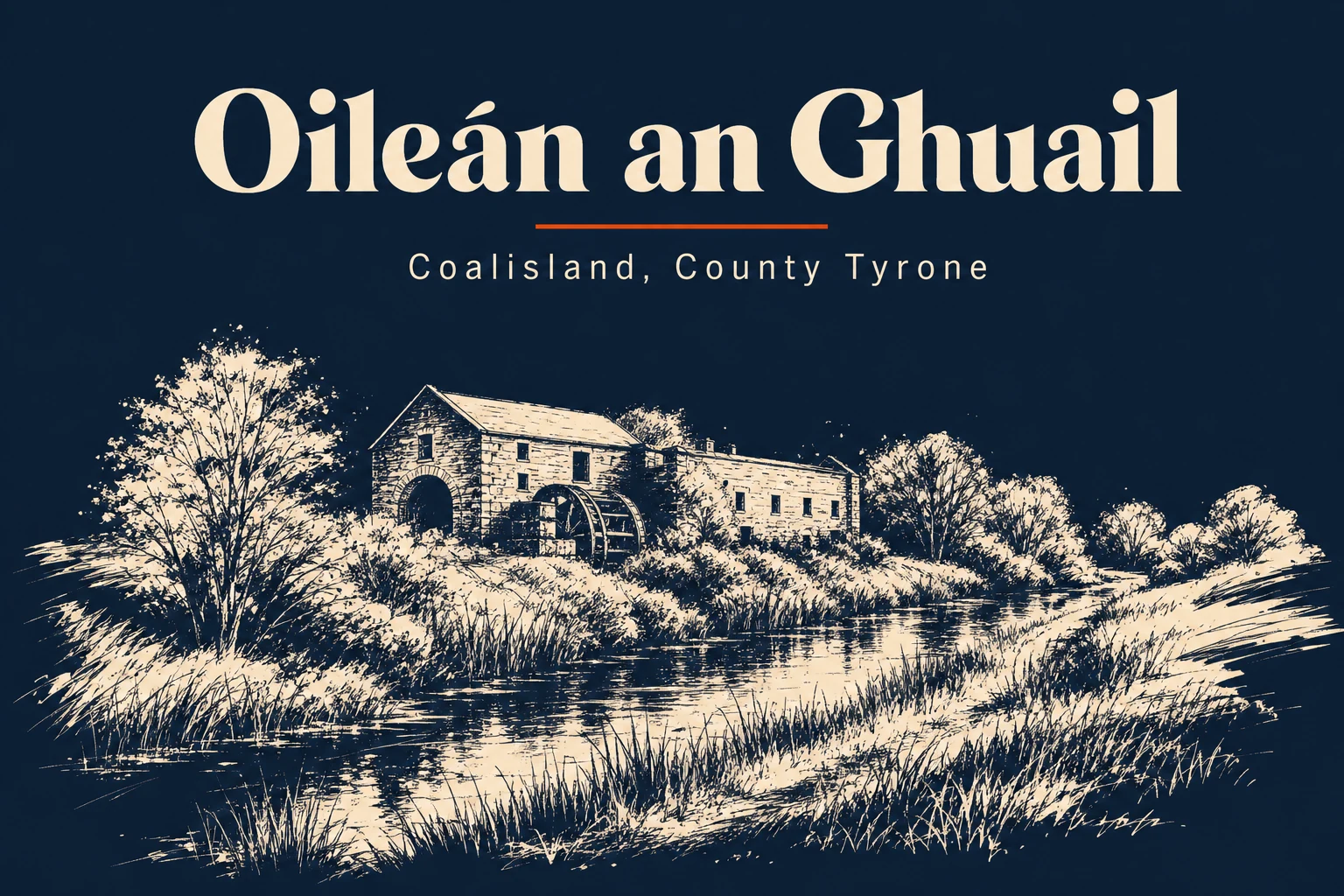
Coalisland is a town of about 6,300 people in east Tyrone, four miles from Lough Neagh, that was built around a canal that was never quite right from the start. The Tyrone Navigation - also called the Coalisland Canal - took fifty-four years to complete. It was designed to carry coal from the Drumglass collieries south of town down to the River Blackwater, and from there along the Lough Neagh system toward Dublin. The coal never travelled as planned. After the Act of Union in 1800, Dublin imported cheap English coal and the whole economic justification for the canal collapsed. What the canal actually ended up moving was bricks, tiles, earthenware, sulphuric acid, and agricultural goods - a decent trade, but not the one anyone had in mind when they spent £25,000 of public money building the thing.

The canal closed in 1954. The basin was drained in 1961. If you park in the car park beside the old Coalisland Cornmill today, you are standing on what was once the head of navigation. The channel south toward the Blackwater is mostly still intact - the towpath walk along it runs about 4.5 miles, flat, through decent Tyrone farmland. The lock structures are derelict. A group affiliated with the Inland Waterways Association of Ireland has been working since the 1990s to keep the restoration question alive.

The other thing Coalisland is known for is 24 August 1968. On that evening, the Campaign for Social Justice and the newly-formed Northern Ireland Civil Rights Association organised a march from the town to Dungannon - three miles on the main road, with around 2,500 people, taking their cues explicitly from the US civil rights movement. The march was about housing discrimination: nationalist families in Dungannon were overcrowded and disadvantaged while vacant council houses were allocated to unionist families. The RUC stopped the marchers at Dungannon Market Square, where Ian Paisley had organised a counter-demonstration as a pretext for the ban. The marchers sat down and sang 'We Shall Overcome'. It was Northern Ireland's first civil rights march and, as historians have noted, its last bloodless one. The Derry march on 5 October 1968 was beaten off the street by police with batons.

The town has a strong GAA tradition. Coalisland Na Fianna was founded in 1903, won the first Tyrone senior championship the following year, and has ten senior county titles on the board - the last in 2018. Michelle O'Neill, First Minister of Northern Ireland, is from the town. Dennis Taylor, who potted the black on the last ball of the 1985 World Snooker Championship final, is also from here. The Craic Theatre and Arts Centre runs from a converted weaving factory on the Dungannon Road and has been staging youth and touring shows since 1996.
Population
6,323 (NISRA 2021)
Walk score
Canal towpath to the River Blackwater and back - flat, 9 km
Founded
Canal basin established 1787; town grew from it
Coords
54.5486° N, 6.7106° W
01 / 09

At a glance.

Three things every local will eventually mention. Read these and you've already understood more than most day-trippers do.

02 / 09

The pubs.

None of these are themed Irish pubs, because they don't need to be. A few that earn the trip:

Gervin's Bar

Local sport and snooker
Pub and snooker club

At 5 Platers Hill (also listed at Barrack Square). A pub-and-snooker-club combination that is the kind of place a town of this size generally produces - busy on match days and quieter the rest of the week. Food served. Phone: 028 8774 8230.

Central Bar

Main Street local
Traditional pub

At 28 Main Street. A straightforward pub in the centre of town. Listed on CAMRA. Phone: 028 8774 8107.

03 / 09

Where to eat.

PlaceTypeLocal note
Gervin's Bar Pub kitchen £ Food served in the bar. Pub staples. The kind of plate that keeps you going if you have walked the canal towpath.
04 / 09

Where to sleep.

PlaceTypeLocal note
The Ryandale Inn 4-star inn, restaurant, 17+ rooms - Moy village, 5 miles In Moy village, about five miles from Coalisland on the A29. Family-run, 17 rooms in the main house plus further rooms in a building nearby, all en suite. Full restaurant with a weekday carvery at lunch and an à la carte evening menu. Country bands most weekends. It is the most substantial accommodation option in the immediate area. Book well ahead for weekends. Phone: 028 8778 4629.
Dungannon town Range of B&Bs and hotels, 5 miles west Dungannon, five miles west on the A45, has a wider range of accommodation including the Cohannon Inn (near junction 14 of the M1) and Kensington Lodge B&B. If the Ryandale is full, Dungannon is the practical fallback.
05 / 09

Stories & lore.

The reason to come back. The things every local will eventually tell you about, usually after the second pint.

Fifty-four years to build. Closed in 1954.

The Tyrone Navigation

The canal now called the Coalisland Canal - officially the Tyrone Navigation - was authorised by the Irish Parliament in 1732 and work began in 1733. It took until 1787 to complete: seven locks, 7.2 kilometres, dropping 51 feet from the basin at Coalisland to the River Blackwater. The delays were structural and political as well as financial. The upper two locks were built on sand, the lower three in peat bog; the feeder from the River Torrent silted the basin continually; and the collieries at Drumglass remained a road-haul away from the canal's head of navigation, meaning the coal connection that justified the whole project was never properly made. Between 1746 and 1782, over £25,000 of public money went into construction. Total traffic reached its peak in 1931 at 57,000 tons, more than half a century after the coal market for which it was built had collapsed. After the Second World War, road haulage killed what river trade remained. The canal was officially abandoned in April 1954 and relegated to a drainage ditch. The Coalisland basin was drained in 1961 and is now a car park beside the old Cornmill. The rest of the channel, owned by the local council and the Department of Agriculture, is mostly still intact. A small boat rally was held on surviving sections in April 2008 - the first boats in fifty years.

24 August 1968 - Northern Ireland's first civil rights march

The March to Dungannon

The Campaign for Social Justice (CSJ) and the Northern Ireland Civil Rights Association (NICRA), along with other groups, organised a march from Coalisland to Dungannon on 24 August 1968. Around 2,500 people gathered and walked three miles to Dungannon, led by five nationalist bands and carrying placards reading 'End discrimination' and 'Justice for all'. The immediate issue was housing discrimination: in Dungannon, council housing allocation was structured to maintain unionist electoral control, leaving nationalist families overcrowded. The march was modelled explicitly on the US civil rights movement. At the edge of Dungannon Market Square, the RUC stopped the column. Ian Paisley had organised a counter-demonstration in the square, which the police used as justification for banning the NICRA parade from entering. The marchers sat down on the road and sang 'We Shall Overcome'. No one was beaten that day - it was Northern Ireland's last bloodless civil rights march. The Derry march on 5 October 1968, forty-three days later, was baton-charged by police and covered by international television cameras. The footage from Derry drew global attention. The march that started everything had come from Coalisland.

Founded 1903. Third on the Tyrone roll of honour.

Coalisland Na Fianna

Coalisland Na Fianna GAC was founded at a meeting in the cellar of St. Patrick's Hall in 1903. The name Fianna - the legendary Irish warrior band - was the suggestion of Master Peter Kelly. The club entered the first Tyrone senior football championship and won it, defeating Strabane Lámh Dhearg in the 1904/05 final. Ten senior county titles have followed: 1904/05, 1907/08, 1928, 1930, 1946, 1955, 1989, 1990, 2010, and 2018. That puts the club third on the Tyrone county roll of honour. Their home ground is Fr. Peter Campbell Park on the edge of the town. The 1989 and 1990 back-to-back wins put them into the Ulster Senior Club Championship - they were finalists in Ulster in 1989. The club also runs juvenile grades from nursery to minor, and underage county titles across the decades fill the rest of the board.

06 / 09

Things to do outside.

Wear waterproofs. Bring a sandwich. Tell someone where you're going if it's the mountain.

Coalisland Canal Walk From the town centre south along the disused canal towpath to the River Blackwater. Tarmac path for the first section, then a dirt track. Completely flat. The lock structures are derelict but visible along the route. Signposted from the town. Listed on WalkNI and Discover Northern Ireland. Good footwear recommended for the lower dirt sections in wet weather.
9 km return (4.5 km one way)distance
2-2.5 hours returntime
07 / 09

When to go.

There is no bad time. There are different times.

Spring
Mar-May

The canal walk is at its best in April and May - the towpath is dry, the hedgerows are coming into leaf, and the lock structures are accessible. Long evenings from late April.

◉ Go
Summer
Jun-Aug

The main period for GAA club football - check Coalisland Na Fianna fixtures if you want to catch a match at Fr. Peter Campbell Park. The civil rights march anniversary falls on 24 August; some years see commemorative events in the town.

◉ Go
Autumn
Sep-Oct

Senior championship season. The canal walk stays good through October before the lower dirt sections get muddy.

◉ Go
Winter
Nov-Feb

The lower sections of the canal walk are muddy and wet from November onward. The town works fine year-round but there is no particular winter draw.

◐ Mind yourself
08 / 09

What to skip.

Honestly? Don't bother.

If a local was sitting beside you, this is the bit where they'd lean in.

×
Expecting a restored canal

The Coalisland Canal is derelict. The basin is a car park. The towpath walk is worthwhile but you are walking alongside a drainage ditch, not a working waterway. The restoration campaign has been active since the 1990s with no current completion date.

×
Expecting a nightlife scene

Two confirmed pubs and a bar-and-snooker-club. The town has things to do and places to be, but it is not an evening destination. Dungannon, five miles west, has more options.

×
Treating the civil rights history as a backdrop

The people who walked to Dungannon in August 1968 and who lived through what followed are alive and in this town. The history is not an exhibit - read something before you arrive, and do not reduce it to a photo stop.

+

Getting there.

By car

Coalisland is 5 miles east of Dungannon on the A45. From Belfast take the M1 to junction 14 (Dungannon) and follow the A45 east - roughly 45 minutes. From Dublin take the M1/A1 to Dungannon (about 1 hour 30 minutes) and the A45 east.

By bus

Translink Ulsterbus connects Coalisland with Dungannon (route T0, Brackaville Road to Dungannon Bus Station). Onward Goldline express services from Dungannon connect to Belfast (Europa) and Dublin.

By train

No rail service at Coalisland - the station closed for passenger traffic in January 1956. Nearest mainline stations are Portadown (25 miles south-west) or Belfast Great Victoria Street, both on the Dublin-Belfast Enterprise line.

By air

Belfast International Airport is approximately 40 miles north-west, about 50 minutes by car. Belfast City (George Best) Airport is 35 miles north-east, about 45 minutes.