County Tyrone Ireland · Co. Tyrone · Donaghmore Save · Share
POSTED FROM
DONAGHMORE
CO. TYRONE · IE

Donaghmore
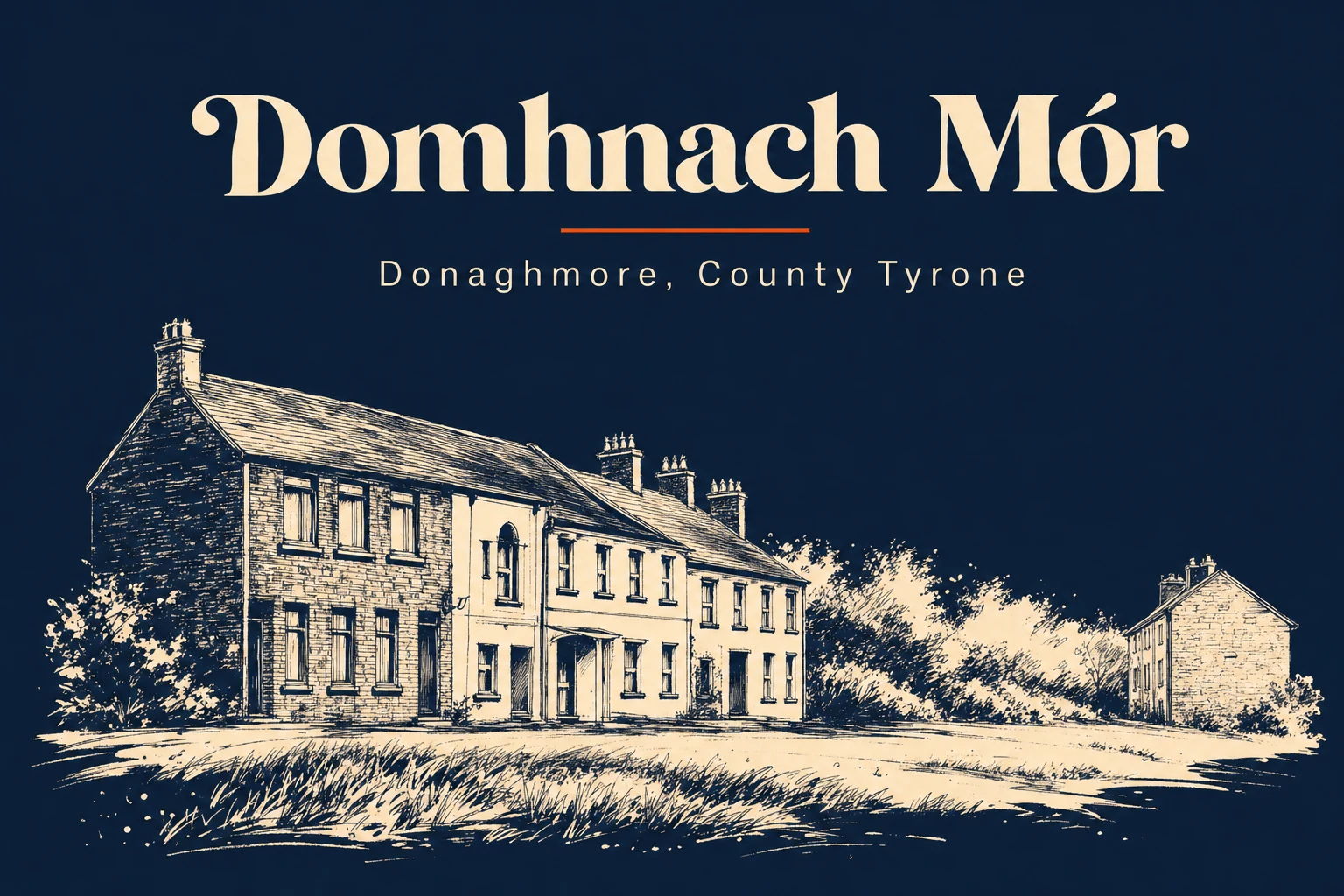
Domhnach Mór, Co. Tyrone

The Mid Ulster
STOP 09 / 09
Domhnach Mór · Co. Tyrone

A 9th-century High Cross stands in the village graveyard, 4.8 metres tall, carved with scenes from Genesis to the Resurrection. It was thrown down in the 17th century, buried in the Torrent River for a century, and put back up in 1776. It has been there ever since.

Donaghmore is a small village in mid-Tyrone, three miles from Dungannon on the road that runs north-west through O'Neill country. The name is a shortened form of Domhnach Mór Magh Imchlair - 'the great church in the plain of Imchlair' - which tells you the two things that define the place: a church site, and flatlands. St Patrick is credited with the original monastic foundation in the 5th century; his companion Colum Cruither was left in charge. Whether that is history or hagiography, there has been a Christian site here for at least 1,500 years.

The High Cross in the old graveyard is what draws people from outside the village. It stands 4.8 metres tall, a composite monument carved from two separate crosses, its shaft and base dating to the 9th century. The head, from a companion cross of similar vintage, was fitted when the monument was re-erected in 1776 - the two halves having been found buried in the bed of the Torrent River, where they had lain since the cross was thrown down in the 17th century. The carving covers both faces systematically: Old Testament scenes on the west (Adam and Eve, Cain and Abel, the Loaves and Fishes), New Testament on the east (the Annunciation to the Shepherds, the Marriage Feast at Cana, the Baptism, the Crucifixion, the Resurrection). It is badly weathered in places - these stones have been outside for over a thousand years - but the narrative programme is still legible if you work your way around it slowly.

The village has two establishments that give it a food and drink reputation out of proportion to its size. The Brewer's House on Castlecaulfield Road is a gastropub with its own microbrewery, reviving a tradition of brewing in Donaghmore that dates to a brewery founded here in 1797. It won Best Gastro Pub at the Irish Restaurant Awards in 2018. The Lower House Bar, in the centre of the village, has been a pub since the 18th century, with self-catering accommodation in a converted neighbouring house. Between them they cover most of what you need for a night or two.

Donaghmore is not a destination that tries to be more than it is. The cross is real and specific - one of the best preserved examples of 9th-century scriptural carving in the North, and worth the detour from Dungannon for anyone with an interest in early Christian Ireland. The Heritage Centre holds the local record for those who want to go deeper. The rest is a working village in mid-Tyrone, with two good pubs, a microbrewery, and a graveyard that has been in use since the early medieval period.
Population
~1,100-1,500 (NISRA 2011: 1,122; 2021 settlement-level data not yet disaggregated)
Walk score
Flat village centre; cross and old graveyard a short walk from any door
Founded
Monastic foundation attributed to St Patrick, 5th century; name means 'great church'
Coords
54.5380° N, 6.8020° W
01 / 09

At a glance.

Three things every local will eventually mention. Read these and you've already understood more than most day-trippers do.

01 The High Cross

One of the finest early Christian carved crosses remaining in Ulster.

The Donaghmore High Cross is a composite of two crosses - the shaft and base date to the 9th century, the head is believed to be from a separate cross of similar age. Both halves were joined when the monument was re-erected in 1776, after being found buried in the bed of the Torrent River. The east face carries New Testament scenes; the west face carries Old Testament scenes including Adam and Eve, Cain and Abel, and the Baptism of Christ. Stand close enough to make out the figures and allow time for it.

Stories & lore →
02 The Heritage Centre

The Donaghmore Historical Society runs the village's own archive and exhibition space.

The Donaghmore Heritage Centre is operated by the Donaghmore Historical Society and houses local history records, artefacts, and exhibition material. Access is by appointment. If you are coming specifically for the centre, contact the Society in advance - they are active, have run events for European Heritage Days, and are glad to open for genuine visitors.

Stories & lore →
03 O'Neill country

The O'Neill clan came to the Donaghmore district in the 12th century and left their mark on it.

During the Reformation, Shane O'Neill unroofed several churches in Tyrone - including those in Donaghmore - to prevent Queen Elizabeth's clergy from using them. The ruins of the medieval church still stand in the old graveyard where the High Cross is sited. The village sits in the broader O'Neill territory that radiates out from Dungannon, three miles to the south-east.

Stories & lore →
02 / 09

The pubs.

None of these are themed Irish pubs, because they don't need to be. A few that earn the trip:

The Lower House Bar

18th-century village local, whiskey and weekend music
Traditional pub, Main Street, Donaghmore

Has been at the centre of Donaghmore village since the 18th century. Confirmed on Discover Northern Ireland and Visit Mid Ulster. Known for whiskey, gin, and local beers. Live music at weekends. The McCauslands self-catering rooms are in the adjacent 18th-century house (separate entrance from the bar). The combination makes it the obvious base for a stay in the village.

The Brewer's House

Food-led, own-brewed ales, evening and weekend
Gastropub and microbrewery, 73 Castlecaulfield Road, Donaghmore BT70 3HB

Also the main food destination in the village - see food section. As a pub it is worth noting that it brews its own ale on-site, reviving the tradition of a brewery that operated in Donaghmore from 1797. The bar side of the operation runs alongside the restaurant. Hours: Mon-Thu 16:30-20:30, Fri 12:00-21:00, Sat 12:00-22:00, Sun 12:00-20:00. Book ahead at weekends.

03 / 09

Where to eat.

PlaceTypeLocal note
The Brewer's House Gastropub and restaurant, 73 Castlecaulfield Road, Donaghmore BT70 3HB ££ The main food option in the village and the reason many people make the detour. Local sourcing, own-brewed ale, a Sunday roast at lunchtime. Won Best Gastro Pub and Best Wine Experience at the Irish Restaurant Awards 2018. Confirmed on Discover Northern Ireland, Visit Mid Ulster, Georgina Campbell's Ireland Guide. Booking advised for Friday and Saturday evenings. thebrewershouse.com.
04 / 09

Where to sleep.

PlaceTypeLocal note
McCauslands Rooms at The Lower House Self-catering apartments, Main Street, Donaghmore (thelowerhouserooms.com) Five newly refurbished self-catering units in a converted 18th-century house next to The Lower House Bar - three one-bedroom units and two two-bedroom units. Minimum two-night stay. Separate entrance from the pub. For availability: info@thelowerhouserooms.com or book via thelowerhouserooms.com. Confirmed on Discover Northern Ireland.
The Brewer's House rooms Self-catering, The Lower Houses, Donaghmore (thelowerhouserooms.com) The Brewer's House also has seven self-catering units in a neighbouring refurbished building. Mix of one- and two-bedroom apartments. Described in Georgina Campbell's Ireland Guide. Same booking channel as McCauslands (thelowerhouserooms.com). Minimum two-night stay.
05 / 09

Stories & lore.

The reason to come back. The things every local will eventually tell you about, usually after the second pint.

9th century to 1776

The High Cross: thrown down, buried, and put back

The Donaghmore High Cross is a composite monument assembled from two separate early Christian crosses, both dating to the 9th century. The shaft and base form one unit; the head was fitted from a companion cross when the monument was re-erected in 1776. Before that date, the cross had been thrown down - the 17th century is the period generally cited - and the components were discovered buried in the bed of the Torrent River, preserved by the water. They were raised again and joined to make a single standing monument. The cross measures 4.8 metres in total height. It stands in the old graveyard in the centre of the village, beside the ruins of a medieval church. The carving on both faces is narrative and didactic - designed to be read, in the tradition of scriptural high crosses across Ireland, as a visual Bible for a largely illiterate population. The west face: Adam and Eve, Cain and Abel, the Annunciation to the Shepherds, the Loaves and Fishes, the Mocking of Christ. The east face: the Baptism of Christ, the Marriage Feast at Cana, the Crucifixion, the Resurrection, the Ascension. The stone is badly weathered and the detail has softened in places, but the programme is still there. Take time with it.

Local history in the village centre

Donaghmore Heritage Centre

The Donaghmore Heritage Centre is run by the Donaghmore Historical Society, which has been active in recording the history of the village and the surrounding area for decades. The centre holds local history records, photographs, artefacts, and exhibition material relating to the village, the parish, and the broader area. It is not a large visitor attraction - it opens by appointment and does not operate set daily hours. For European Heritage Days in 2023 it ran a dedicated public opening. The Society can be contacted through their website at donaghmorehs.org. If you are making a journey specifically to see the centre's collection, contact them in advance; they are a volunteer-run organisation and they appreciate knowing someone is coming. The Heritage Centre is separate from the High Cross, which is always accessible in the graveyard.

5th century to the Reformation

The name and the monastery

The name Donaghmore derives from Domhnach Mór Magh Imchlair - 'the great church in the plain of Imchlair.' Domhnach in early Irish denotes a church founded on a Sunday (Latin: dominica), which is how the oldest Patrician foundation sites were named. The Tripartite Life of St Patrick records that Patrick established seven episcopal churches in the area around Slieve Gallion and Lough Neagh; Donaghmore is among them. A priest named Colum Cruither was left to lead the congregation after Patrick moved on. A monastic community followed, believed to have occupied the area of the old graveyard where the High Cross now stands. The O'Neill clan arrived in the Donaghmore district in the 12th century. During the Reformation, Shane O'Neill ordered the unroofing of several churches in Tyrone - Donaghmore among them - to prevent them being taken over by Protestant clergy serving the Elizabethan crown. The medieval church ruins in the graveyard are what remains of that history.

06 / 09

Things to do outside.

Wear waterproofs. Bring a sandwich. Tell someone where you're going if it's the mountain.

Village and Cross Walk Start at The Lower House Bar on Main Street. Walk to the old graveyard to see the High Cross and the ruins of the medieval church - five minutes on foot. Take time with both faces of the cross before moving on. From the graveyard, the road east leads toward the Torrent River valley (the same river in whose bed the cross pieces were found). The village is flat and easily walked in any direction. No formal waymarked trail exists, but the cross is the destination and the route is straightforward. The graveyard is always accessible.
1-2 km depending on routedistance
30-45 minutestime
07 / 09

When to go.

There is no bad time. There are different times.

Spring
Mar-May

The old graveyard is at its best when the grass is green and the light is low. The Brewer's House runs its full evening service from Thursday. A quiet time to have the cross largely to yourself.

◉ Go
Summer
Jun-Aug

The Brewer's House is busiest at weekends - book ahead for Friday and Saturday evenings. The Heritage Centre may run additional open days; check with the Historical Society. The cross is outdoors and accessible in any weather, but summer light gives the best photography.

◉ Go
Autumn
Sep-Oct

The village quiets down after summer. The Brewer's House continues its full week. The cross and graveyard are genuinely atmospheric in autumn light. A good time for walkers coming through the mid-Tyrone countryside.

◉ Go
Winter
Nov-Feb

The Brewer's House runs limited weeknight hours (from 16:30 Mon-Thu). The Heritage Centre is appointment-only at the best of times. The cross is always there and the graveyard is always open, but there is less to build a day around in winter unless you are combining it with Dungannon, three miles away.

◐ Mind yourself
08 / 09

What to skip.

Honestly? Don't bother.

If a local was sitting beside you, this is the bit where they'd lean in.

×
Driving past on the way to Dungannon without stopping

The High Cross is three minutes off the main road. It is one of the better-preserved 9th-century scriptural crosses in the North of Ireland and it does not require any planning to visit - park, walk to the graveyard, look at it carefully. The detour pays for itself.

×
Arriving at the Heritage Centre without an appointment

The Donaghmore Heritage Centre is run by volunteers and opens by arrangement, not on a set daily schedule. Contact the Donaghmore Historical Society via donaghmorehs.org before your visit. Walking in on spec is likely to find the door closed.

×
Trying The Brewer's House on a Monday lunchtime

The Brewer's House opens at 16:30 Monday to Thursday. It does not run a lunchtime service mid-week. If you want food in the village before 16:30 on a weekday, the Lower House Bar is your alternative.

+

Getting there.

By car

Donaghmore is 3 miles north-west of Dungannon on the B43/Castlecaulfield Road. From Belfast, take the M1 to junction 15 and follow the A29 to Dungannon, then the B43 north - total about 50 minutes. From Dublin, the A3/M1 corridor takes about 1h 50m. Omagh is 40 minutes west on the A4 via Dungannon.

By bus

Ulsterbus service 80 (Dungannon-Cookstown) stops in Donaghmore village. From Dungannon bus station the journey takes about 10 minutes. Dungannon is served by Translink Goldliner 261 from Belfast Grand Central (approx. 1 hour, roughly hourly) and Bus Éireann X4 from Dublin (approx. 2h 30m, six times daily). Change at Dungannon for the Donaghmore service.

By train

No rail service to Donaghmore or Dungannon. The nearest station is Portadown, about 17 miles east - frequent NI Railways services from Belfast. From Portadown, Ulsterbus 75 runs to Dungannon (approx. 50 minutes, six weekday services), then change to the 80 for Donaghmore.

By air

Belfast International (BFS) is about 50 minutes by car. City of Derry Airport (LDY) is about 1 hour north-west. Dublin Airport is about 1h 50m.