County Tyrone Ireland · Co. Tyrone · Cookstown Save · Share
POSTED FROM
COOKSTOWN
CO. TYRONE · IE

Cookstown
An Chorr Chríochach, Co. Tyrone

The Mid Ulster
STOP 09 / 09
An Chorr Chríochach · Co. Tyrone

A planned market town with the longest main street in Ireland - 1.25 miles of tree-lined boulevard, 135 feet wide, pointing straight at a Plantation-era demesne.

Cookstown owes its peculiar shape to two men and one ambition. The first was Dr. Alan Cooke, who got a market patent from Charles I in 1628 and gave the town its name. The second was William Stewart, who bought up the surrounding land in the 1670s and whose family spent the following century turning a Plantation village into something grander. Inspired, according to local accounts, by the Wide Street Commission's work in Dublin, the Stewarts laid out a boulevard 135 feet wide and 1.25 miles long - one ruler-straight line connecting their Killymoon demesne at the south end to the old town at the north. The trees went in. The Georgian terraces went up. The street has had seven different names along its length ever since, but they are all the same street, and there is nothing quite like it anywhere else in Ireland.

The surrounding landscape rewards the extra half day. West of town, on Tyrone moorland near the Sperrins, the Beaghmore Stone Circles were buried under peat for perhaps four thousand years before peat-cutters exposed them in the late 1930s. Seven circles, ten rows of stones, twelve cairns - the current thinking places the earliest activity at around 2900 BC, with the monuments built and modified over many centuries. One circle is solid with 800-odd small upright stones known as the Dragon's Teeth. There is no visitor centre, no admission charge, and in reasonable weather you can have the whole site to yourself for an hour.

Four kilometres south of town the Iron Age earthwork of Tullyhogue Fort sits on a tree-ringed drumlin. For several centuries this was where the O'Neills were made rulers of Tyrone and recognised as kings of Ulster. The ceremonies had specific parts: O'Cahan threw a golden sandal over the new lord's head; O'Hagan placed the shoe on his foot and gave him a rod. Hugh O'Neill was the last man inaugurated here, in 1595. Seven years later Mountjoy had the inauguration stone destroyed to prevent any recurrence. The earthwork remains, owned by the State, freely accessible, and usually empty.

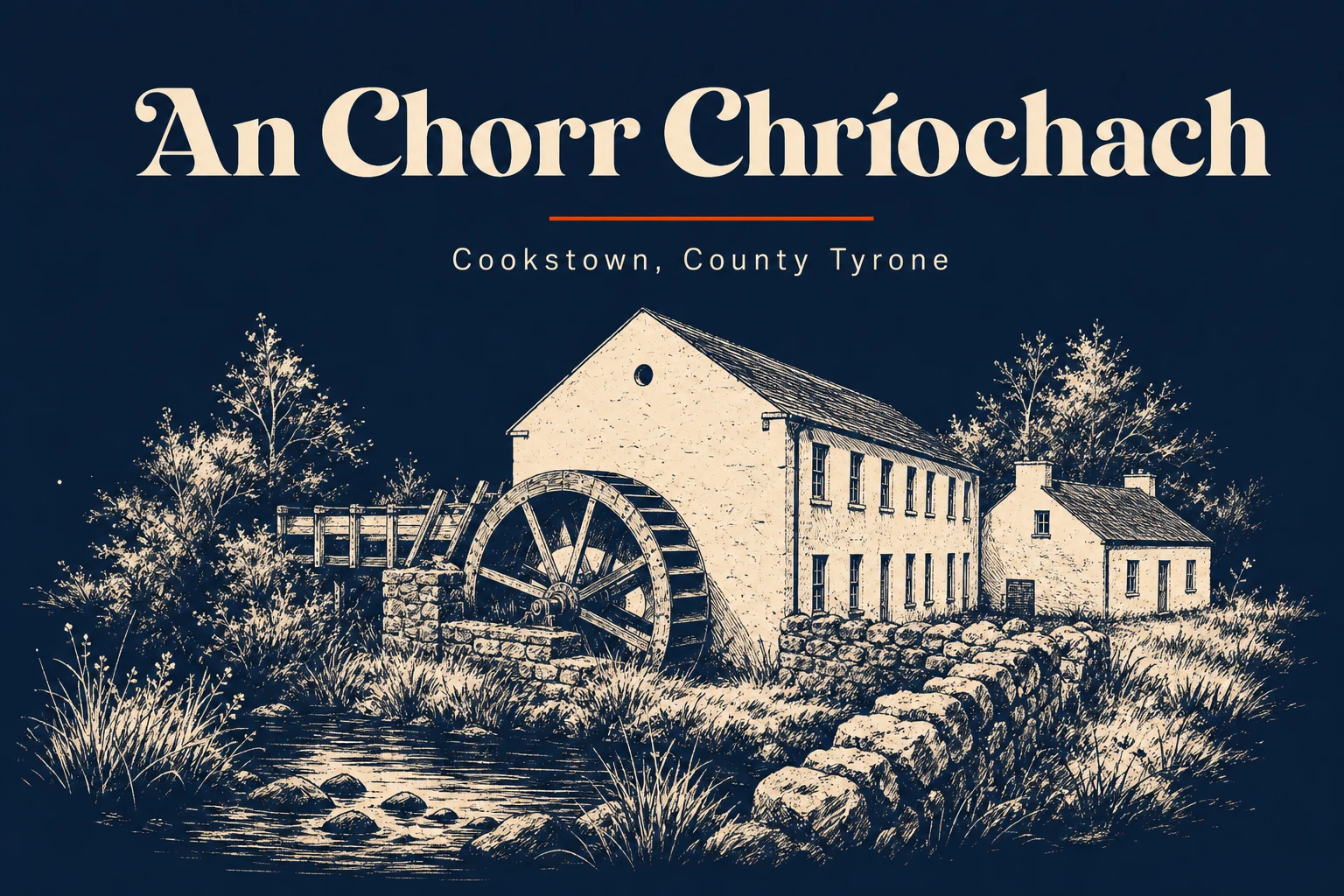
Six miles west of town on the Ballinderry River, the National Trust's Wellbrook Beetling Mill is the last working water-powered beetling mill in Ireland. Beetling is the final stage of linen finishing - hammering the cloth with heavy wooden beams to give it its characteristic sheen. The mill at Wellbrook ran from 1764 to 1961 and has been preserved with its machinery intact. Guided tours run Saturdays and Sundays, March to September (last admission one hour before 5 pm). It is a quiet, specific, very Irish kind of industrial monument.
Population
12,546 (NISRA 2021)
Walk score
The main street takes twenty minutes end to end - if you don't stop
Founded
Plantation grant to Dr. Alan Cooke, 1628; replanned by William Stewart, c.1750s-1790s
Coords
54.6437° N, 6.7447° W
01 / 09

At a glance.

Three things every local will eventually mention. Read these and you've already understood more than most day-trippers do.

01 The main street

One and a quarter miles long, 135 feet wide. There is nothing else like it.

William Stewart laid out this boulevard in the second half of the 18th century, connecting his Killymoon demesne to the old town in a single ruled line. The trees went in along both sides. Today the same street runs - under seven different name changes - from Killymoon Street at the south end to Milburn Street at the north, and the Georgian proportions are still legible under the shopfronts. Walk the whole thing once before you do anything else.

How the town was planned →
02 Beaghmore Stone Circles

Seven circles, ten stone rows, twelve cairns - pulled out of the peat in the 1930s.

About 13 km south-west of town on the Tyrone moorland, a complex of Bronze Age and Neolithic monuments sat unnoticed under the bog until peat-cutters broke through in the late 1930s. One circle - called the Dragon's Teeth - is packed with over 800 small upright stones. The site is underfenced, undervisited, and completely extraordinary at dawn.

The stone circles →
03 Tullyhogue Fort

Where the O'Neills were made kings of Ulster for three centuries.

Four kilometres south-south-east of town, an Iron Age hill fort became the inauguration site of the O'Neill dynasty. From roughly the 12th to the 16th century, each new lord received a golden sandal thrown over his head and a rod of office on this hill. Hugh O'Neill was inaugurated here in 1595 - the last time the ceremony was performed. Lord Mountjoy had the inauguration stone smashed in 1602.

The O'Neill inauguration →
02 / 09

The pubs.

None of these are themed Irish pubs, because they don't need to be. A few that earn the trip:

Ma Quinn's Bar

Local, live music most weeks
Traditional pub

65 James Street. Traditional music session on Wednesdays; live band on Saturdays. The kind of pub that keeps the town honest - no door charge, conversation at full volume, Guinness in good nick.

The Royal Hotel bar

Central, mixed crowd
Hotel bar

On the main street. The bar does pub food alongside the restaurant; useful if you want a pint and a hot plate without committing to a full sit-down. Popular on match days.

03 / 09

Where to eat.

PlaceTypeLocal note
The Cellar Restaurant Hotel restaurant £££ Glenavon House Hotel, 52 Drum Road. Head Chef Patrick Mallon runs a seasonal menu drawing on local Mid Ulster produce. Part of the Taste Mid Ulster Food Trail. Evenings Tuesday-Sunday; Sunday lunch. Book ahead at weekends.
The Windsor Restaurant Hotel restaurant ££ The Royal Hotel, main street. A la carte and high tea menus; Sunday carvery is a town institution. Family-friendly, professional service, not trying to be something it isn't.
04 / 09

Where to sleep.

PlaceTypeLocal note
Glenavon House Hotel 3-star country house hotel 52 Drum Road. Nine acres of grounds on the edge of town, full leisure facilities, the Cellar Restaurant on site. The town's most comfortable option; the grounds are worth it in autumn.
The Royal Hotel 3-star town-centre hotel Main street, two minutes from the town centre. Family-run, en-suite rooms, free parking, restaurant and bar in-house. The practical choice if you want to be in the thick of the main street.
Greenvale Hotel Hotel, short walk from centre Greenvale is a converted early-19th-century mansion in its own grounds, a short walk from the main street. Comfortable rather than luxurious; popular for local events and Sunday carvery.
05 / 09

Stories & lore.

The reason to come back. The things every local will eventually tell you about, usually after the second pint.

How William Stewart drew the longest main street in Ireland

The planned town

Cookstown started with a market patent. In 1628 Charles I granted Dr. Alan Cooke the right to hold markets and fairs in what was still a small Plantation settlement - the name stuck even as the Cooke family's influence faded. By 1671 the surrounding land had passed to William Stewart of Killymoon, and it was the Stewarts who gave the town its defining shape. Inspired by the Wide Street Commission's Georgian street-planning in Dublin, they set out a boulevard 135 feet wide and just over a mile long, planted with lime trees, connecting the Killymoon demesne to the old settlement at the north end. The plans were laid out across the second half of the 18th century, fully in place by the 1790s. Today the same single axis carries seven different street names - Killymoon Street through to Milburn Street - but it is obviously, unmistakeably one long decision. No town in Ireland has anything quite like it.

Four thousand years of monuments, invisible until the 1930s

Beaghmore - the stone circles under the bog

The Beaghmore complex sits on Tyrone moorland about 13 km south-west of Cookstown, near the foothills of the Sperrins. The monuments - seven stone circles, ten stone rows, twelve cairns - were built and modified over a long period beginning around 2900 BC; the circles and cairns are generally attributed to around 1200-2000 BC. All of it was buried under growing peat and completely invisible until the late 1930s, when peat-cutting operations broke through the surface and began exposing the stones. Excavations continued into the 1940s and beyond. The most striking feature is Circle E - the Dragon's Teeth - packed with over 800 small upright stones, unlike any of the other six rings. The stone rows are astronomically aligned, though scholars argue about the specifics. There is no café, no admission gate, and no crowds; the Department for Communities manages the site. Come early or come late.

The last water-powered beetling mill in Ireland

Wellbrook and the linen trade

Ulster's linen industry was built on a sequence of specialised processes - scutching, hackling, weaving, bleaching, and finally beetling - and by the 18th century the Ballinderry valley west of Cookstown was full of mills performing each stage. Beetling is the last: the woven cloth is hammered with heavy wooden mallets driven by waterwheel, which closes the weave and gives linen its particular smooth sheen. The mill at Wellbrook on the Ballinderry River was built around 1764 and continued working until 1961. When commercial linen production collapsed, most mills were demolished. Wellbrook survived because the National Trust acquired it; the original machinery - the great wooden beams, the waterwheel, the hammers - is still there and still demonstrated on guided tours. It is one of the very few places you can watch a pre-industrial textile process running as it was designed to run.

Where each O'Neill was made lord of Ulster, until 1595

Tullyhogue and the O'Neill inauguration

The hill fort at Tullyhogue, 4 km south-south-east of Cookstown, is an Iron Age earthwork that became, in the later medieval period, the ritual centre of O'Neill power. The ceremony of inauguration was carefully choreographed: O'Cahan, the O'Neill's principal sub-chief, threw a golden sandal over the new lord's head as a gesture of good fortune; O'Hagan, hereditary guardian of Tullyhogue, placed the shoe on his foot and presented him with a white rod of office. The last inauguration was in 1595, when Hugh O'Neill - later to lead the Nine Years' War - received the title An Ó Néill on this hill. In 1602, with the war going against the Gaelic lords, Lord Mountjoy marched to Tullyhogue and had the inauguration stone smashed - a deliberate act to destroy the legitimacy it conferred. The earthwork itself survives. There is a small car park; the hill is a five-minute walk up through grazing land.

06 / 09

Things to do outside.

Wear waterproofs. Bring a sandwich. Tell someone where you're going if it's the mountain.

The main street end to end Start at Milburn Street at the north end and walk south all the way to Killymoon Street. Seven street names, one boulevard. The Georgian proportions are clearest on the Chapel Street and Church Street sections where the shopfronts haven't been redone. Turn around at the Killymoon demesne gates and walk back on the other side.
2 km one waydistance
30-45 mintime
Wellbrook Beetling Mill woodland walk The National Trust maintains a woodland loop along the Ballinderry River beside the mill, 6 miles west of Cookstown on the Wellbrook Road. Flat, wooded, mixed-age oak and ash. Start at the mill car park; the walk connects back to it. Best in spring before the canopy closes. Combine with a guided tour of the mill (Sat-Sun, Mar-Sep, last admission 4 pm).
2.5 km loopdistance
1-1.5 hourstime
Beaghmore Stone Circles Drive 13 km south-west on the A505 and Beaghmore Road to the free car park. The circles, rows, and cairns are spread across rough moorland - wear waterproof boots year-round. The Dragon's Teeth circle is the unmissable feature. No formal trail; the site is open ground. Allow time to stand in it rather than just photograph it.
1 km on sitedistance
1 hour minimumtime
07 / 09

When to go.

There is no bad time. There are different times.

Spring
Mar-May

Wellbrook Mill reopens its tours in March. The woodland walk beside the Ballinderry is good in April before the canopy fully closes. The moorland at Beaghmore is at its least muddy from April onwards.

◉ Go
Summer
Jun-Aug

Long evenings make the main street walk genuinely pleasant. Beaghmore in early morning light with the heather coming into colour is the seasonal payoff. Tullyhogue is accessible and dry. All three hotels are at full operation.

◉ Go
Autumn
Sep-Oct

The best season for Beaghmore - the heather spent, the bog showing its full range of browns and ochres, low light across the stone rows. Wellbrook runs tours until the end of September. The main street in October has more atmosphere than it does in July.

◉ Go
Winter
Nov-Feb

Wellbrook closes in October; Beaghmore and Tullyhogue are open but exposed. The town functions normally - pubs, restaurants, hotels all operating - but the main draws are better in dry weather. The main street is worth seeing even in rain; the stone circles are a different experience in cold mud.

◐ Mind yourself
08 / 09

What to skip.

Honestly? Don't bother.

If a local was sitting beside you, this is the bit where they'd lean in.

×
Treating the main street as a through road

Most traffic uses the bypass. If you drive through on the A29, you see Cookstown as a place to pass. Stop the car, park anywhere on the main street itself, and walk a section of it. The Georgian scale only registers on foot.

×
Beaghmore in poor visibility

The site is moorland. In thick mist the stone rows vanish at twenty metres. Check the forecast; the A505 from Cookstown is quick enough to come back another day.

×
Arriving at Wellbrook on a weekday outside season

The mill is only open Saturdays and Sundays, March to September. The woodland walk is accessible year-round, but the machinery - the reason to come - is behind locked doors mid-week and from October to February. Check nationaltrust.org.uk before you drive out.

×
Expecting a food scene beyond the hotels

Cookstown is a working mid-Ulster market town. The Glenavon and the Royal do the serious cooking. There are cafés and takeaways on the main street, but if a proper dinner is the goal, book the Cellar and call it done.

+

Getting there.

By car

Belfast to Cookstown is about 1h on the M1 and A29 (40 miles). Derry is 45 minutes north-west via the A6 and A29 (35 miles). Dungannon is 16 km south on the A29. The A505 west leads to Beaghmore and on towards Omagh.

By bus

Translink Ulsterbus 80 (Belfast-Omagh) serves Cookstown. Local services connect to Dungannon, Magherafelt, and Stewartstown. The bus station is on Loy Street, one block off the main street.

By train

No station in Cookstown. Nearest is Portadown (25 km south-east, then bus or car) or Antrim (30 km east).

By air

Belfast International (BFS) is 35 minutes south-east. City of Derry (LDY) is about 50 minutes north-west.