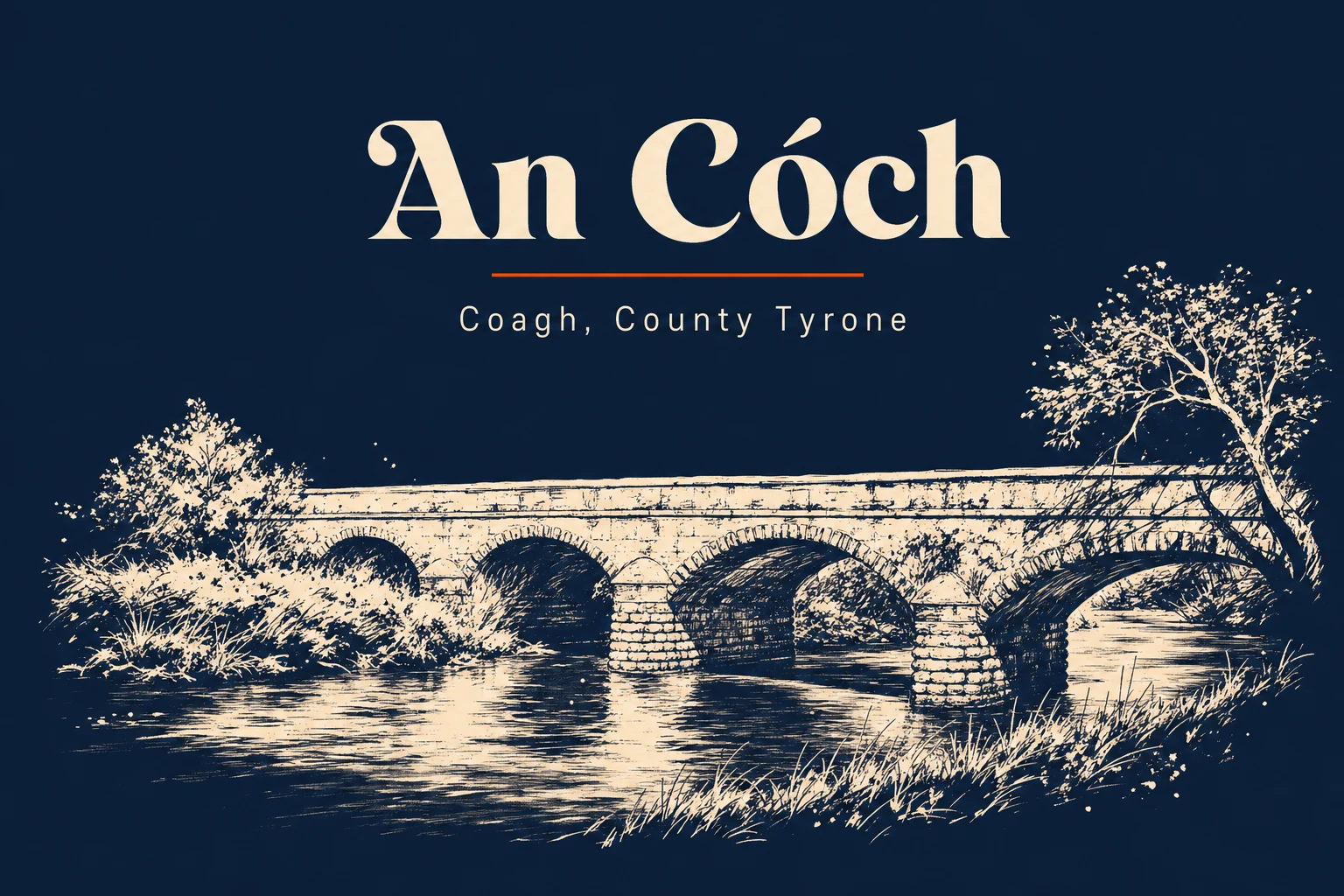
County Tyrone Ireland · Co. Tyrone · Coagh Save · Share
POSTED FROM
COAGH
CO. TYRONE · IE

Coagh
An Cóch, Co. Tyrone

The East Tyrone
STOP 04 / 04
An Cóch · Co. Tyrone

A quiet east Tyrone farming village on the Ballinderry River, five miles from Lough Neagh - and the place where, on a June morning in 1991, a street ambush marked one of the sharpest edges of the east Tyrone conflict.

Coagh is a small village in east County Tyrone, five miles south-east of Cookstown, where the Ballinderry River marks the border between Tyrone and County Londonderry. Part of the village sits on the Tyrone bank; part crosses the bridge into the civil parish of Tamlaght in Londonderry. The population is a few hundred households. The Ordnance Survey Memoirs and the 1837 Topographical Dictionary both describe it as a small market and agricultural settlement. Those descriptions hold now.

The village has a formal origin: in 1728, George Butle Conyngham received a royal charter from George II to hold a market and four annual fairs. He named the central square Hanover Square, after the king's house. A battle had been fought at the ford here in 1641 - parliamentarians destroyed the chapel of Tamlaght - and in 1688 James II crossed the river at this point on his march toward the siege of Derry. These are the kind of facts a place carries without advertising them. The wars passed through; the farming continued.

The Ballinderry River, which runs along the village's southern edge, is one of the better brown trout rivers in Northern Ireland. It flows east from Cookstown to empty into Lough Neagh at Ballinderry Bridge, about a mile beyond the village. Coagh Angling Club manages the local fishing. The Upper Ballinderry is formally protected as an Area of Special Scientific Interest, rated for its surviving population of freshwater pearl mussels - one of the last viable ones in Northern Ireland. Otters and kingfishers are present along the length of it.

Population
c.700-900 (NISRA 2021 small settlement)
Walk score
Main street and riverbank in twenty minutes
Founded
1728 market charter under George II
Coords
54.6461° N, 6.6972° W
01 / 04

At a glance.

Three things every local will eventually mention. Read these and you've already understood more than most day-trippers do.

02 / 04

Stories & lore.

The reason to come back. The things every local will eventually tell you about, usually after the second pint.

The Coagh ambush

3 June 1991

At around 7.30 in the morning on 3 June 1991, three members of the IRA's East Tyrone Brigade drove a stolen Vauxhall Cavalier from Moneymore in County Londonderry into Coagh. The three men - Tony Doris, aged 21; Pete Ryan, 35; and Lawrence McNally, 39 - were travelling to kill Allister Harkness, a kitchen factory worker who had been a part-time soldier with the 8th Battalion Ulster Defence Regiment. A Special Air Service unit was waiting for them. Eight SAS soldiers, some in a disguised red Bedford lorry and others positioned on both sides of the main street, opened fire on the car as it entered the village. The three men were killed; the car burst into flames; up to 150 rounds were discharged. The operation followed the IRA bombing of Glenanne UDR barracks on 30 May, four days earlier, in which three soldiers died. The Coagh ambush was one of several SAS operations in east Tyrone between 1987 and 1992 in which IRA East Tyrone Brigade members were killed - operations that produced persistent questions about intelligence sources, planning constraints, and whether alternatives to lethal force had been genuinely considered. A coroner's inquest completed in 2024 found the use of force 'reasonable and proportionate' but concluded the operation had not been planned in a way that minimised to the greatest extent possible the need for lethal force. That distinction - justified in outcome, flawed in planning - was the same tension that ran through the Loughgall ambush in 1987 and through every similar operation in this period.

River, lough, and the last pearl mussels

The Ballinderry

The Ballinderry River leaves the Sperrin foothills west of Cookstown and runs thirty miles east to Lough Neagh. By the time it reaches Coagh it has widened enough for serious trout fishing. The stretch at Coagh Bridge, where the river approaches Lough Neagh's western shore, is rated among the best on the river - brown trout, migratory dollaghan, and, from July onwards in a wet year, salmon moving up from the lough. Coagh Angling Club manages local access. The upper reaches of the river above Cookstown carry a protected population of freshwater pearl mussels - a filter-feeding bivalve that is functionally extinct in most of Europe's rivers and hangs on in a handful of clean, undisturbed beds in north-west Ireland and parts of Scotland. The mussel needs clean gravel, undisturbed banks, and healthy trout populations to survive - the young attach to the gills of juvenile fish for the first years of life. Their presence is a measure of what the river still has. Otters are regularly seen on the Ballinderry at Coagh. Kingfishers work the lower reaches. A riverside walk runs from the village toward Ballinderry Bridge.

03 / 04

What to skip.

Honestly? Don't bother.

If a local was sitting beside you, this is the bit where they'd lean in.

×
Looking for pubs or a restaurant in the village

Coagh is a small agricultural settlement. There are no confirmed operating licensed premises in the village itself at the time of writing. Cookstown is five miles north-west for food and a pint, or Magherafelt fifteen minutes east.

×
Expecting a marked memorial or heritage site for the 1991 ambush

There is nothing formally marked on the main street. The ambush is documented history, not a tourist site. If you come, come knowing what happened, not looking for a sign to tell you.

×
Treating the riverside walk as a long-distance trail

The walk toward Ballinderry Bridge is quiet and good, but short. It is a village riverside path, not a waymarked trail. Bring your own sense of direction.

+

Getting there.

By car

Coagh is on the B40, five miles south-east of Cookstown via the A29 and then east on local roads. Magherafelt is about fifteen minutes east on the B40/A31. The village is about twelve miles north-west of Dungannon.

By bus

Translink Ulsterbus serves the Cookstown-Magherafelt corridor, which passes through or near Coagh. Services are infrequent - check the Translink Journey Planner before relying on the bus.

By train

There is no station at Coagh. The nearest rail access is at Antrim (for the line to Belfast) or at Portadown, both around thirty minutes by car.

By air

Belfast International Airport (BFS) is about thirty-five minutes north-east on the A26/M2. Belfast City Airport (BHD) is about forty-five minutes east.