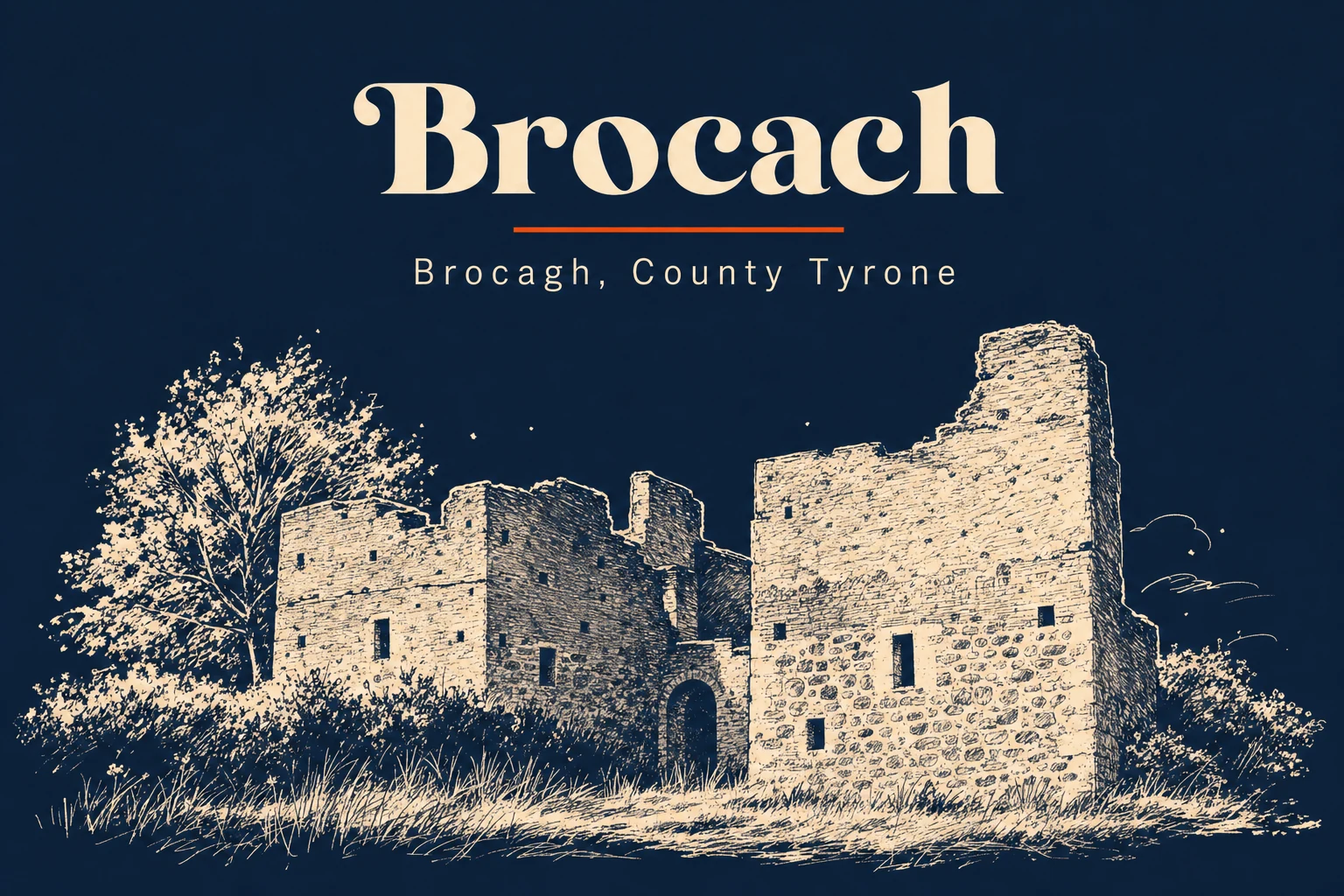
County Tyrone Ireland · Co. Tyrone · Brocagh Save · Share
POSTED FROM
BROCAGH
CO. TYRONE · IE

Brocagh
Brocach, Co. Tyrone

The Mid Ulster
STOP 03 / 03
Brocach · Co. Tyrone

A small community on the Lough Neagh shore with a ruined Elizabethan castle on the hill above it - begun in the final years of the Nine Years War.

Brocagh sits on the western shore of Lough Neagh, about seven kilometres east of Coalisland in east Tyrone. The name comes from the Irish Brocach - badger warren. The lough is the largest body of fresh water in Ireland and Britain and its western shore runs flat and open here, reed-fringed and often grey. The village itself is small: scattered houses, a church, a GAA pitch, a road running to the water's edge.

The thing that marks this place on a map is Mountjoy Castle, a ruin on the hill above the village overlooking the lough. Construction began in the summer of 1602 and was completed around 1605 - the final phase of the Nine Years War, the long Gaelic Irish resistance to English expansion - by Charles Blount, Lord Mountjoy, who was Queen Elizabeth's Lord Deputy. The castle is built of red clay bricks, manufactured locally at Coalisland, and sits on a slight rise with a clear view of the lough and the low Armagh shore beyond it. It changed hands several times during the seventeenth century - captured and recaptured in 1641, 1642, and 1645 - and King William's forces used it in 1690. The walls still stand, two storeys of them, with four angled corner towers.

The civil parish is Clonoe. The Church of St Brigid at Brocagh is within that parish. Brocagh Emmetts GAC has been running football in this community since 1923, when the club was formed under the name Mountjoy Emmetts. The name changed to Brocagh in the late 1970s.

Walk score
Village to the castle site in ten minutes
Coords
54.5897° N, 6.6447° W
01 / 03

Stories & lore.

The reason to come back. The things every local will eventually tell you about, usually after the second pint.

Begun 1602. Completed c.1605. The last years of the Nine Years War.

Mountjoy Castle

Charles Blount, Lord Mountjoy, arrived at the western shore of Lough Neagh in the summer of 1602 with a military column and a supply of locally-made brick. The Nine Years War - the confederation of Gaelic Ulster against Elizabethan expansion, led principally by Hugh O'Neill, Earl of Tyrone - had been grinding toward its end since the defeat at Kinsale in January 1601. Mountjoy was pressing deep into O'Neill's territory. On the same day his soldiers reached Brocagh, they had already destroyed the inauguration stone of the O'Neill at Tullaghogue, fifteen kilometres to the west. The castle they built here - a rectangular block with four spear-shaped angle towers, gun loops, local red brick over a stone base - was a statement of occupation. O'Neill submitted in March 1603. The castle remained strategically useful for the rest of the century, changing hands in the 1641 rising, again in the wars of the 1640s, and used by Williamite forces in 1690. The ruin on the hill is a scheduled monument, accessible from the village.

Founded 1923 as Mountjoy Emmetts.

Brocagh Emmetts GAC

The club was formed in 1923 under the name Mountjoy Emmetts - the castle on the hill giving the original name, Robert Emmet the inspiration for the rest. The name shifted to Brocagh in the late 1970s. The club plays Gaelic football in the Tyrone county competitions at junior and intermediate level. Their ground is on the Mountjoy Road. In 2019, Brocagh Emmetts claimed the Ulster Junior Club Football League title, defeating Magilligan from Derry in the final. The club also runs underage football through the parish.

St Brigid at Brocagh, St Patrick at Clonoe.

Clonoe Parish

The civil parish of Clonoe takes in the Brocagh area along with the surrounding townlands east of Coalisland. The old Church of St Michael at Clonoe, mentioned in the 1837 Topographical Dictionary, was a small ancient structure repaired in 1699. Within the Catholic parish the two principal chapels were at Clonoe itself and at Mountjoy - the latter built in 1835, the year of Catholic Emancipation's first generation. The Church of St Brigid at Brocagh serves the village today. The parish records held at the Public Record Office of Northern Ireland and through the Archdiocese of Armagh are one of the better genealogical sources for east Tyrone families.

02 / 03

Things to do outside.

Wear waterproofs. Bring a sandwich. Tell someone where you're going if it's the mountain.

Mountjoy Castle and lough shore From the village up to the castle ruin on the hill, then down to the lough edge and back. The castle sits on a small rise with an open view of the lough and the Armagh shore. No formal waymarking. The ground around the castle can be soft. Bring boots in wet weather. The site is a scheduled monument - do not disturb the stonework.
2-3 kmdistance
45-60 minutestime
+

Getting there.

By car

Brocagh is on the Mountjoy Road (B160), approximately 7 km east of Coalisland. From Coalisland take the Mountjoy Road east toward the lough shore. From Dungannon, take the A45 east to Coalisland, then the B160. The castle site has limited roadside parking.

By bus

No direct bus service to Brocagh village. Translink Ulsterbus serves Coalisland from Dungannon (route T0). From Coalisland the village is a seven-kilometre road walk or a short taxi.

By train

No rail access. Nearest useful stations are Dungannon (limited services) or Portadown on the Enterprise line, both approximately 20-25 minutes by car.

By air

Belfast International (BFS) is approximately 40 minutes north-east via the M1. Belfast City (BHD) is 45-50 minutes.