Tenth century, sandstone, 22 carved panels
Ardboe High Cross
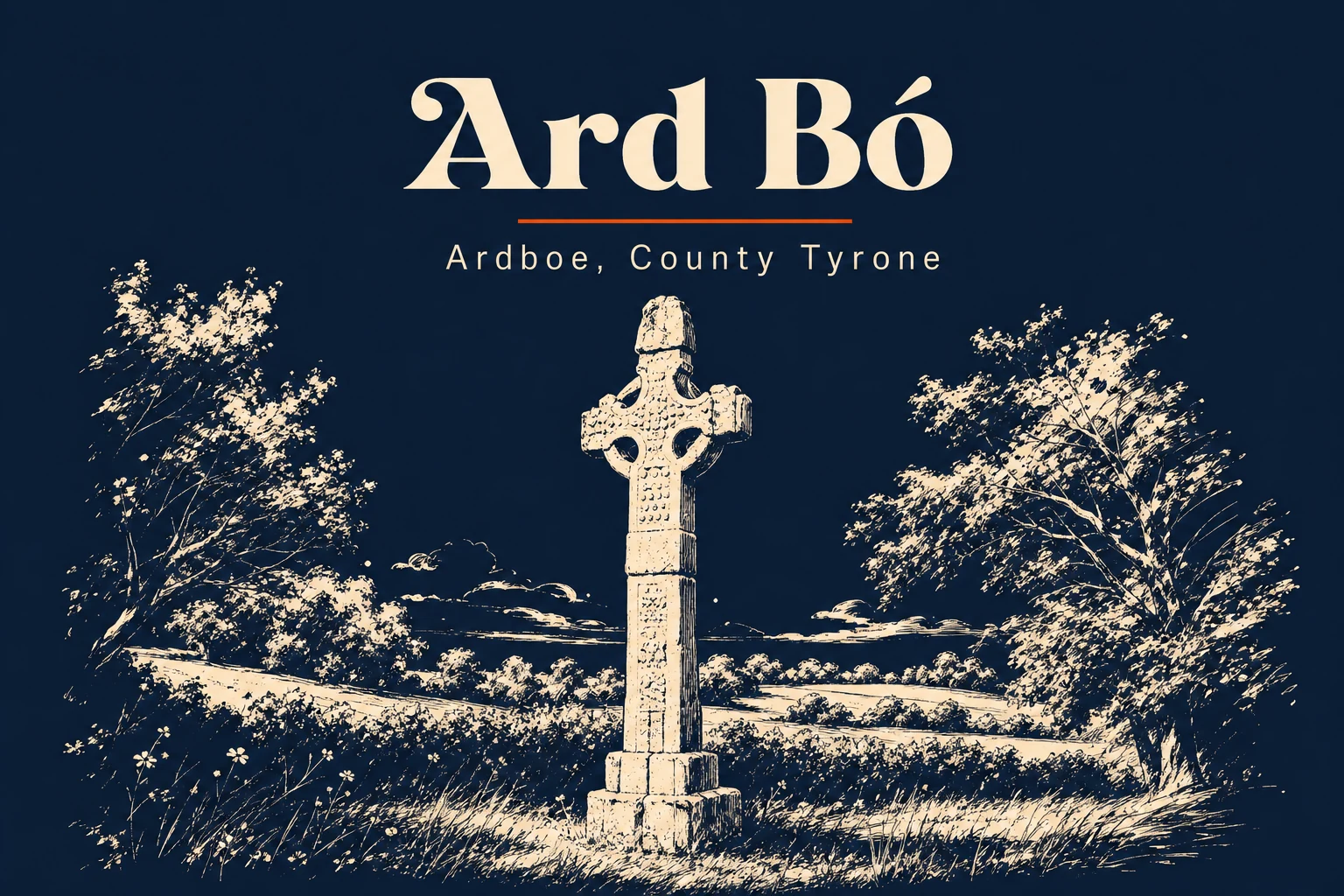
The cross was probably carved in the ninth or tenth century - the exact date is not established, but it is one of the earliest high crosses in Ulster and stylistically belongs to the great flowering of Irish stone carving in that period. It stands 5.6 metres tall, constructed from local sandstone, and is decorated with 22 panels of figurative carving arranged across the shaft and head. The east face carries Old Testament scenes: Adam and Eve at the Fall, Cain and Abel, the Sacrifice of Isaac, Daniel in the lions' den, the Three Hebrews in the Fiery Furnace, the Multiplication of the Loaves. The west face runs through the New Testament: the Adoration of the Magi, the baptism of Christ, the Last Supper, the arrest in Gethsemane, the Crucifixion. The ring of the head, which gives Irish high crosses their distinctive shape, is damaged - the upper arm and part of the ring are missing. But the shaft is largely intact. Standing beside it, you realise how large it is. It is not a decorative object. It was meant to be read from a distance by a largely illiterate population, a stone bible in a landscape with no printing presses.
Founded c.590 AD, burned 1166
St Colman and the monastery
The annals record that St Colman mac Aedha founded a monastery at Ardboe around 590 AD, in the late period of early Irish monasticism when the shore settlements of Lough Neagh were being colonised by church communities. Ardboe - Ard Bó, the height of the cow - was one of them. The monastic settlement that grew here was not large by the standards of Armagh or Clonmacnoise, but it was significant enough to survive several hundred years and to commission or receive the great cross. The annals record the monastery being burned in 1166, one of the many destructions of the Gaelic and Norse period. The church ruin that stands beside the cross today is not Colman's church - it is a later medieval structure, probably sixteenth century, built on the same ground. The graveyard around it has been in use from the early Christian period to the present. People buried here this century are buried in the same ground as people buried fourteen centuries ago.
The largest lake in Ireland and Britain
Lough Neagh
Lough Neagh covers around 396 square kilometres - roughly 30 kilometres long and 15 kilometres wide - and holds the largest body of fresh water in Ireland or Britain by area. Five of the six northern counties touch it. It drains through the River Bann into the north Atlantic. The lough is shallow for its size, averaging around nine metres, and its floor is largely basalt. It formed after the last ice age, filling a depression in a lava plateau. The fishing has been continuous for millennia. The Lough Neagh Fishermen's Co-operative, headquartered at Toomebridge, runs what is still Europe's largest wild-caught eel fishery - around 400 tonnes a year. Ardboe sits on the western shore, where the water is open and the far shore is barely visible on a grey day. The lough doesn't frame the high cross so much as it holds the whole landscape in which the cross has always stood. You cannot look at the cross without the water. They are not separate things.