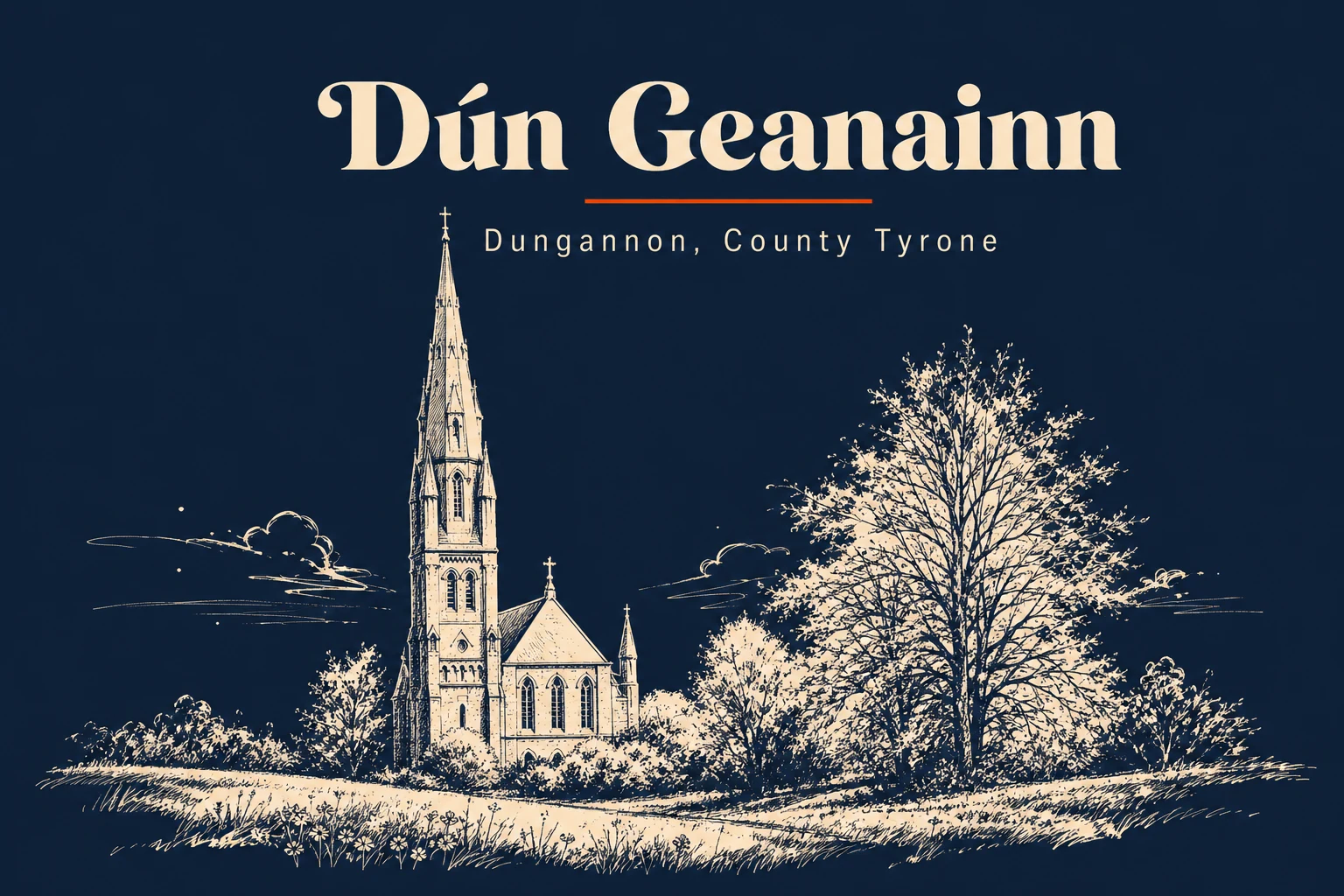
County Tyrone Ireland · Co. Tyrone · Dungannon Save · Share
POSTED FROM
DUNGANNON
CO. TYRONE · IE

Dungannon
Dún Geanainn, Co. Tyrone

The Mid Ulster
STOP 09 / 09
Dún Geanainn · Co. Tyrone

The O'Neills ruled most of Ulster from this hill. They burned the castle themselves rather than hand it over.

Dungannon sits in mid-Tyrone where the drumlin country flattens briefly into a market town that has been at the centre of things for longer than most Irish towns can claim. The hill in the middle is the reason - high enough to see seven of the nine Ulster counties on a clear day, which made it exactly the kind of ground that gets fought over. The O'Neill kings of Ulster chose it in the 14th century and kept it for nearly 300 years.

The town Hugh O'Neill left behind in 1602 - his castle burned, the Nine Years' War ending badly - became a linen town by the 18th century and one of the more prosperous ones in the North. By the 1820s the Thursday market in Market Square was drawing Belfast buyers every week. The trade disappeared with industrialisation and the mills of Belfast and Lisburn, but the grid of streets around Market Square still reads like a prosperous linen town, which is what it was.

In 1968, Dungannon became the starting point of something else. On 24 August, the Northern Ireland Civil Rights Association organised a march from Coalisland three miles to Dungannon - 2,500 people, protesting the allocation of public housing to a 19-year-old Protestant woman ahead of two large Catholic families in the same area. A police cordon blocked entry to Market Square, where a counter-demonstration had gathered. The march stopped. No one was hurt. It was, the historians note, Northern Ireland's last bloodless civil rights march. October in Derry changed that. But the sequence started here.

The town today is a working mid-Ulster market centre - a large Dungannon Park on the southern edge, the Hill of The O'Neill visitor centre on Market Square, a food scene that punches modestly above its weight, and a glass-making heritage that traces back to 1771. Tyrone Crystal, founded in 1971, closed its Dungannon factory in 2010. A successor operation, Tyrone Crafted Glass, opened in 2021 run largely by former employees, though it has faced relocation pressure since. The hill is still there, and the view is still the view.

Population
~17,127 (NISRA 2021)
Walk score
Town centre flat; Dungannon Park loop 2.3 km
Founded
O'Neill stronghold from the 14th century; chartered 1612
Coords
54.5011° N, 6.7664° W
01 / 09

At a glance.

Three things every local will eventually mention. Read these and you've already understood more than most day-trippers do.

02 / 09

The pubs.

None of these are themed Irish pubs, because they don't need to be. A few that earn the trip:

McAleer's Bar

Local, recently refurbished, dependable
Traditional bar, 5-11 Donaghmore Road

One of the main traditional bars in town. Listed on Discover Northern Ireland and on Visit Mid Ulster. Has gone through a significant refurbishment. On the Donaghmore Road a few minutes from the town centre.

The Square Bar

Town-centre pub, overlooking the square
Bar, 35 Market Square

On Market Square, which is where you want to be if you want a pint with a sense of the town's layout. Confirmed active 2025 on Yelp and Facebook. One of the longest-established bars on the square.

Fort Dungannon

Town-centre, straightforward
Bar, Scotch Street

On Scotch Street, listed in multiple pub directories. The kind of town-centre bar that fills on a Friday. No frills, no fuss.

Central Bar

Local, unpretentious
Pub, BT71

In the town centre. Confirmed in local listings. For the pint without the event around it.

03 / 09

Where to eat.

PlaceTypeLocal note
Deli on the Green Café, deli, bistro and butchery ££ Has its own website (delionthegreen.com) and is listed on Discover Northern Ireland. Runs breakfast and lunch, deli counter, a butchery section, and a cheese counter. Has a Sunday menu. More than a café - call it a food shop that happens to have tables.
SEED Vegan and vegetarian restaurant, Castle Court, 2 Thomas Street £ Stands out in a town where the default is an Ulster fry. Specialises in fresh plant-based cooking at prices that encourage you to try it. Confirmed at 2 Thomas Street, Dungannon BT70 1HJ.
Prego Pizzeria £ Comes up consistently on Tripadvisor Dungannon listings. Strong repeat reviews for the pizza. A useful option if the deli is full.
04 / 09

Where to sleep.

PlaceTypeLocal note
Grange Lodge Country House Country house B&B, Moy Road - 3 miles from town Run by Ralph and Norah Brown. Norah is a Rick Stein-named Food Hero and runs cookery sessions ('Cook With Norah') from the property. Set in 20 acres, furnished with antiques, the breakfast is the thing. Ranked top of three hotels in Dungannon on Tripadvisor. The place to stay if you have any interest in food. Book ahead.
Cohannon Inn and Autolodge Hotel, 212 Ballynakilly Road (M1 junction 14) 42 rooms, restaurant and bar, 400 metres from the M1. Has a Spar on site. The practical choice if you're arriving late or leaving early - the kind of place that does the job without making a thing of it. About 3 km from the town centre.
05 / 09

Stories & lore.

The reason to come back. The things every local will eventually tell you about, usually after the second pint.

14th century to 1607

The O'Neill capital

The O'Neill dynasty - the dominant Gaelic power in Ulster - held Dungannon as their principal seat from the 14th century. They built their castle on what is now called the Hill of The O'Neill (Cnoc Uí Néill), a natural vantage point from which, in clear weather, you can see into seven of the nine Ulster counties. The most famous O'Neill to occupy it was Hugh O'Neill, 2nd Earl of Tyrone, who led the Nine Years' War (1593-1603) against the Elizabethan crown in one of the most sustained Gaelic resistances to English rule. When Mountjoy's forces finally closed in, in 1602, Hugh burned his own castle rather than leave it intact. In 1607 he left Ireland entirely, sailing from Rathmullan in Donegal in the event known as the Flight of the Earls - 99 Ulster chieftains departing for the continent, the end of Gaelic Ulster's political independence. The Hill of The O'Neill and Ranfurly House arts and visitor centre now stands at Market Square, at the foot of the hill, with a permanent exhibition on the Flight of the Earls and a glass viewing tower added in May 2016.

18th and 19th centuries

The linen town

By 1802 a surveyor for the Dublin Society described Dungannon as 'one of the most prosperous towns in the North of Ireland in the linen trade' and 'inferior to no other for its rapid progress in building.' The Thursday market in Market Square was the engine of this - every week, buyers for the bleachers arrived from Belfast and took their standing places on the east side of the square to purchase raw, unbleached linen woven by farming families in the surrounding townlands. The trade was driven out by the industrialisation of linen-making in Belfast and the Lagan Valley mills during the mid-19th century. The market square grid remains, though what's sold there now is considerably different.

24 August 1968

The first march

The Northern Ireland Civil Rights Association organised a march from Coalisland to Dungannon on 24 August 1968 - the first civil rights march in Northern Ireland. The proximate cause was specific: a council house in the Dungannon area had been allocated to a 19-year-old Protestant woman who worked for a local unionist councillor, ahead of two large Catholic families. Around 2,500 people walked the three miles into town. When the front ranks reached Market Square, a police cordon blocked them - a Paisleyite counter-demonstration was already assembled inside. The march stopped without violence. No arrests. The civil rights organisers sat down and sang 'We Shall Overcome.' Historians describe it as Northern Ireland's last bloodless civil rights march. The Derry march six weeks later, on 5 October, ended very differently. But the sequence, and the political mobilisation it triggered, began in Dungannon.

Tyrone Crystal, 1971-2010

The crystal

A glass-making tradition in Dungannon traces back to 1771. The modern chapter began in 1971 when Father Austin Eustace established Tyrone Crystal to create employment in the area, bringing two Austrian craftsmen - a master blower and a master cutter - to train local workers. The factory on Killyglass Road became one of the better-known Irish crystal brands and, from 2005, manufactured the trophy for the Canadian Formula One Grand Prix. It closed on 12 March 2010 with the loss of 31 jobs. In 2018 a group of former employees formed the Dungannon Crystal Regeneration Group, and in April 2021 they opened Tyrone Crafted Glass to preserve the hand-crafted techniques. The successor business has since faced pressure to relocate out of Dungannon.

06 / 09

Things to do outside.

Wear waterproofs. Bring a sandwich. Tell someone where you're going if it's the mountain.

Dungannon Park - The Park Trail The main trail through Dungannon Park's 70 acres. The park has a 12-acre fishing lake at its centre, a stone masonry dam with a waterfall, a Lady's Well at the far side of the lake, and willow-lined paths. Accessible paths throughout - good for pushchairs and wheelchairs. There's a children's play area, fishing jetties, and a caravan and camping site open March to September. From Belfast, leave M1 at junction 15 onto the A29 and follow signs for Dungannon Park. The trail is easy and flat - bring a flask and walk slowly.
2.3 km loopdistance
30-45 minutestime
Hill of The O'Neill From the Ranfurly House visitor centre at the top of Market Square, follow the path up to the glass viewing tower. The climb is short and the view - on a clear day, across seven counties - explains immediately why anyone would build a castle here. The visitor centre itself has a permanent exhibition on the O'Neill dynasty and the Flight of the Earls. Open Monday-Saturday 09:00-17:00, Sunday 13:00-17:00 (April-September only); guided tours Wednesday-Saturday at 11am and 2pm.
0.5 km from Market Squaredistance
15 minutes to the toptime
07 / 09

When to go.

There is no bad time. There are different times.

Spring
Mar-May

Dungannon Park opens its camping site from March. Fewer visitors than summer, the park walks are pleasant when the ground is drying out. The Hill of The O'Neill visitor centre resumes Sunday hours from April.

◉ Go
Summer
Jun-Aug

The park is at its best, the lake is active with anglers, and the visitor centre runs its full guided tour schedule. Mid-Ulster is not overrun with tourists the way the coastal counties are - you can still move freely.

◉ Go
Autumn
Sep-Oct

The park trails are quiet, the surrounding drumlin country turns, and the town returns to itself after any summer trade. A good window for the visitor centre before it drops to winter hours.

◉ Go
Winter
Nov-Feb

The Ranfurly House visitor centre closes Sunday hours from October. The park is open but wet. The town functions fine - market days, pubs - but there's less to organise an itinerary around.

◐ Mind yourself
08 / 09

What to skip.

Honestly? Don't bother.

If a local was sitting beside you, this is the bit where they'd lean in.

×
Driving through on the A29 bypass without stopping

The hill and Market Square are what make this town specific. The bypass shows you a ring road. Ten minutes up to the glass tower earns the view.

×
Expecting a Tyrone Crystal factory visit

The original factory closed in 2010. Tyrone Crafted Glass, the successor operation run by former employees, has been operating from the town but has faced relocation - check current status before making it part of your plan.

×
Skipping Grange Lodge because it is three miles out

Three miles is nothing. Norah Brown has a Food Hero designation from Rick Stein, and the breakfast is the reason you came. Book ahead or lose the room.

×
Arriving on a Thursday expecting a linen market

The linen market ended in the mid-19th century. The Thursday market that replaced it is a standard town market. Worth knowing before you build your Thursday around it.

+

Getting there.

By car

Belfast to Dungannon is 46 minutes on the M1, leaving at junction 15 for the A29 into town. Dublin is about 1h 45m via the A3/M1 corridor. Omagh is 40 minutes west on the A4. Armagh is 30 minutes south-east on the B34/A29.

By bus

Translink Goldliner 261 runs from Belfast Grand Central to Dungannon roughly hourly, taking about 1 hour. Bus Éireann X4 runs from Dublin city and airport six times daily, taking around 2h 30m. Ulsterbus 72 runs from Armagh every two hours (40 minutes via Moy). Ulsterbus 80 from Cookstown runs hourly and takes about 50 minutes via Coalisland.

By train

No direct rail service to Dungannon. The nearest station is Portadown, 17 miles east - frequent NI Railways services from Belfast, Lisburn and Bangor. Ulsterbus 75 connects Portadown to Dungannon in about 50 minutes, with six weekday services.

By air

Belfast International (BFS) is about 45 minutes by car. City of Derry Airport (LDY) is around 1 hour north-west. Dublin Airport is about 1h 45m for early flights.