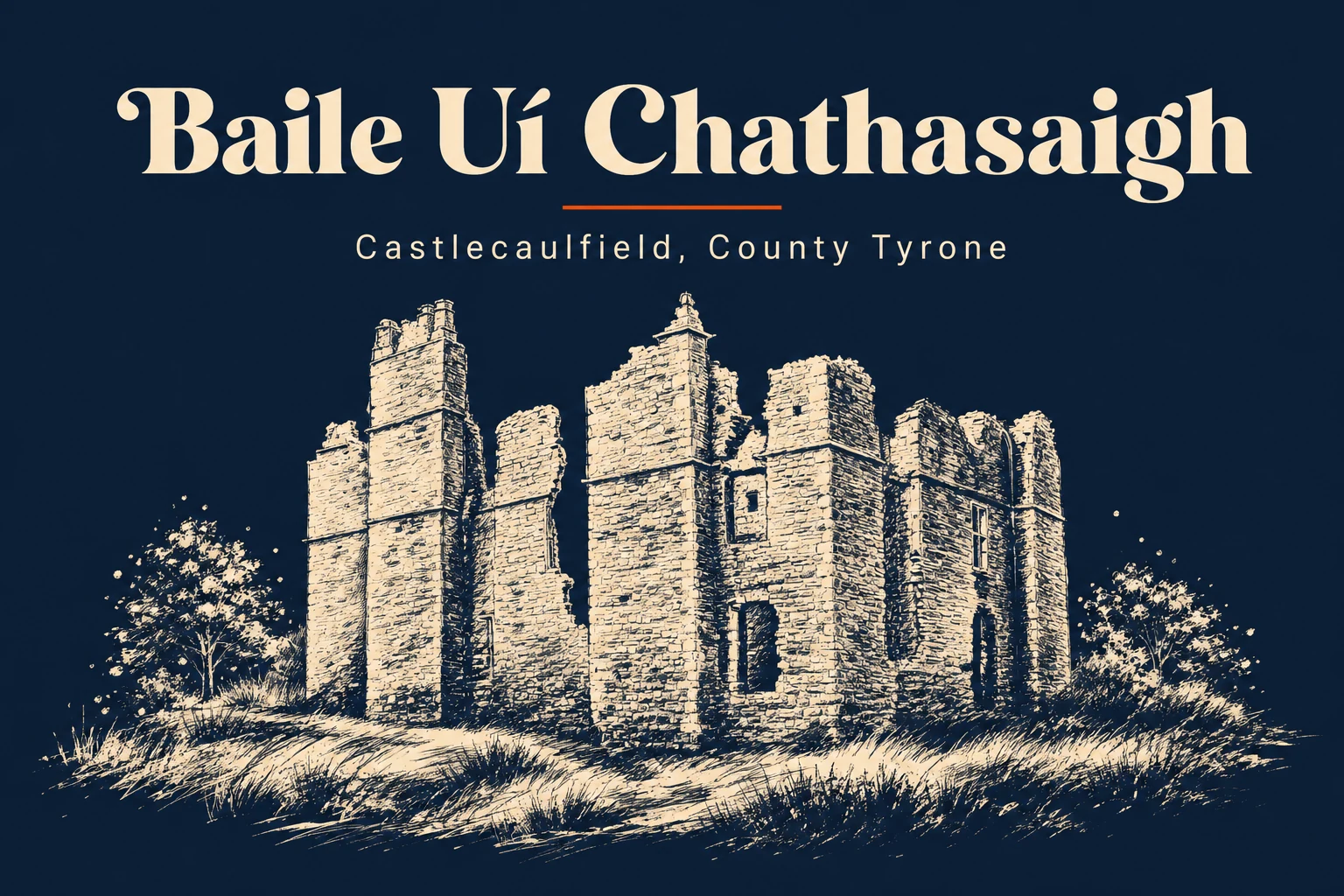
Baile Uí Chathasaigh · Co. Tyrone
One of the largest Plantation mansions ever built in Ulster - ruined, free to enter, and almost nobody stops.
Castlecaulfield sits about three kilometres west of Dungannon on the Omagh road - one main street, two churches, a pub, a chip shop, a post office, and at the eastern end of the village a ruin that once ranked among the grandest houses in Ulster. Most people in the area know the castle is there. Most visitors driving between Dungannon and Omagh do not stop. Both facts are hard to explain.
Sir Toby Caulfeild was an English soldier who arrived in Ireland in the late sixteenth century, served under Lord Mountjoy during the Nine Years' War, and was rewarded at the Plantation of Ulster with a thousand acres in the Dungannon area, confiscated from the O'Donnelly family. Between 1611 and 1619 he built a mansion that was emphatically not a defensive castle: three storeys high with large mullioned windows, many chimneystacks, a formal gateway, and almost none of the military provision that earlier settlers had thought essential. He was, in other words, confident - either that the Plantation had stuck or that he could rely on the fort at Charlemont, six miles east, where he was also constable. He was made 1st Baron Caulfeild in 1620. He died in 1627 without seeing the end of his project.
His confidence was misplaced. In October 1641 the Ulster Irish rose across the province. At Castlecaulfield the O'Donnellys, under Patrick Modder O'Donnelly, came back and burned the mansion. The scorch marks are still visible on the masonry. The Caulfeilds repaired it and reoccupied it - Saint Oliver Plunkett, Archbishop of Armagh, is recorded as having carried out ordinations in the castle courtyard around 1670 - but by the end of that decade it was abandoned. The roof came off; the estate moved on; the building stayed.
What is here now is the substantial shell of that shell: a roofless gateway, the remnant of a corner tower, long stretches of walling with empty window openings, and grass underfoot. The Department for Communities has had it in state care since 1938, and the site is accessible from the village on foot. There is no interpretive centre, no café, no toilets. There is also no charge and no fence. You walk in, you walk around the walls, you read the burns in the stone.