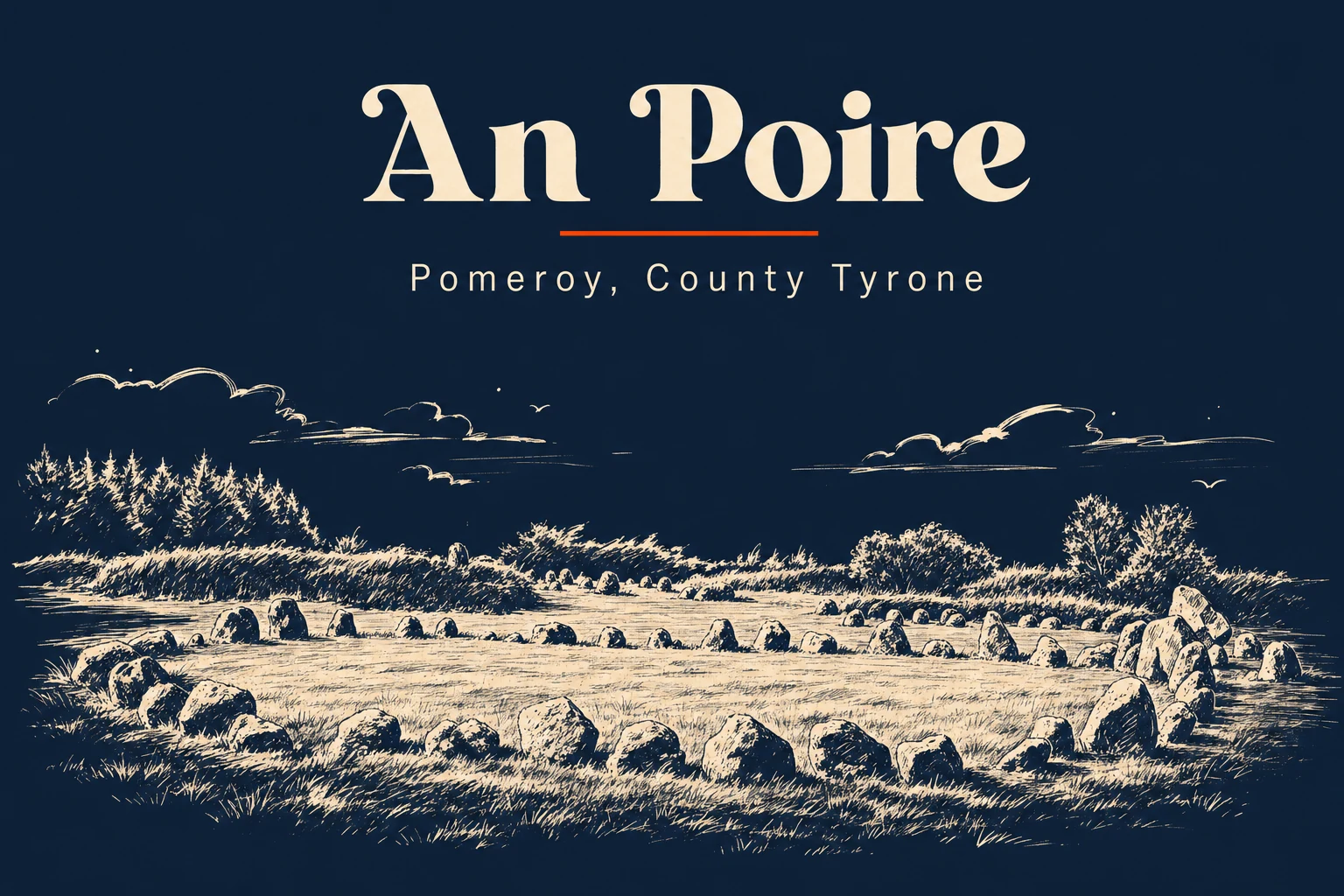
An Poire · Co. Tyrone
The highest village in County Tyrone, sitting on a drumlin top at the near-exact centre of Ulster, with the Sperrins visible to the north and the GAA as the main civic religion.
Pomeroy is on a hilltop. That sounds like a small thing until you arrive and find the land dropping away on all sides - the main street running along the spine of a drumlin, the church square open to the sky, the surrounding countryside laid out below like a map of itself. There was nothing here at all in the late 17th century, just forest granted to Sir William Parsons in the Plantation. By 1750 the Rev. James Lowry had cleared the land, replanted it, established a weekly market, and built the foundations of a village. The Lowry family stayed involved for two hundred years. The Church of Ireland building in the square, with its belfry and tower, was paid for by them.
The GAA club - Pomeroy Plunketts - is named for two men who were killed for Ireland, three centuries apart. St. Oliver Plunkett was the last Catholic martyred in England, hanged, drawn and quartered at Tyburn in 1681 for a fabricated plot. He was canonised in 1975; his head is in a shrine at Drogheda Cathedral. Joseph Mary Plunkett was a poet and republican who signed the 1916 Proclamation of the Republic and was executed at Kilmainham Gaol on 4 May of that year - the same year the club was formed. The dual naming is not accidental. It says something about the village's sense of itself.
During the Troubles, Pomeroy was deep inside the operational zone of the Provisional IRA's East Tyrone Brigade - one of the most active and most heavily armed units of the conflict. The brigade drew its membership from across east Tyrone and suffered 53 killed, the highest figure of any IRA brigade area. Attacks occurred in and around the village on several occasions: a patrol of British soldiers was shot at in 1992; an RUC armoured vehicle was hit by a horizontal mortar outside the village in February 1997. The security base in the village was a fixture of daily life for years. None of this is distant history for anyone who grew up here in the 1970s, '80s or '90s.
What Pomeroy has, apart from its hill and its GAA ground, is a stubborn sense of place. It has not grown into a commuter town for Cookstown or Dungannon. It has not acquired coffee shops or heritage centres. The club and the hill are the reasons people know its name, and that feels like enough.