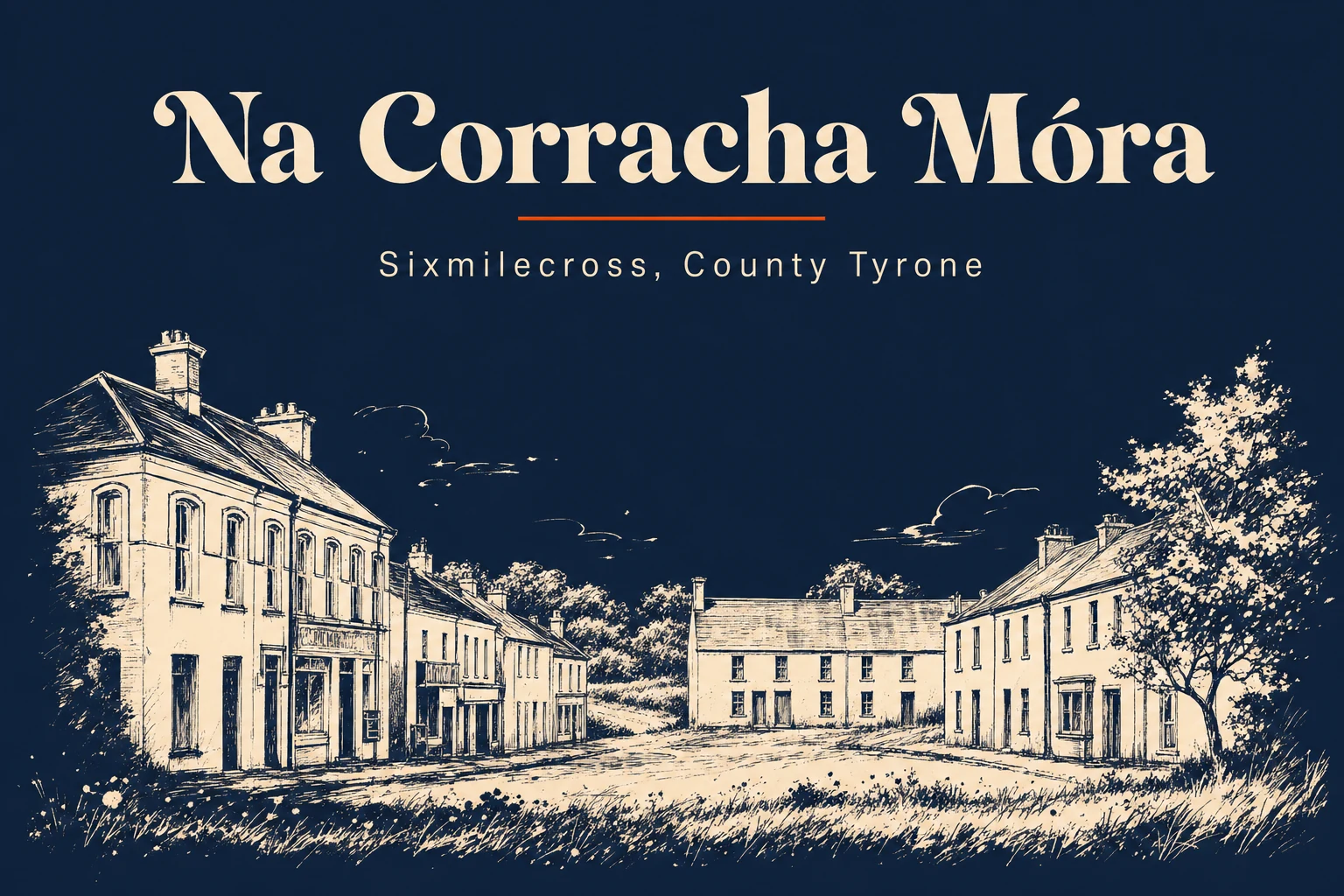
Na Corracha Móra · Co. Tyrone
Six Irish miles from a stone cross in a field. The crossroads that mid-Tyrone funnels through, still.
Sixmilecross is a small crossroads village in the middle of Tyrone, nine miles south-east of Omagh, where the roads from Beragh and Carrickmore and Omagh all decide what to do next. Population 251 at the last count. Wide main street, a few dozen houses, a church on a hill, fields in every direction. It is not a destination in the tourist-brochure sense - there is no heritage centre, no craft shop, no walking festival. It is a working village at the meeting of roads, and that is what it has always been.
The name tells you the geography. A Celtic cross once stood in a field in the townland of Aughnaglea, six Irish miles from Omagh, and the crossroads village that grew up nearby took its measurement from it. The older Irish name - Na Corracha Móra, the great marshy places - describes the flat ground along the Glusha river behind the village more honestly. The two names sit together: one for the road, one for the land.
If you stop here, stop at the Whistler's Inn. Jack and Collette Heaney have run it since 1976, when they bought the old PA Rafferty Spirit Store on the main street and named the new pub after Jack's reputation as a GAA referee - he officiated at the 1981 Ulster Final and the 1982 All-Ireland Minor Final. Half a century of meals, match nights, and people coming in off the Omagh road. The bar is the village memory in the way that only a long-running family pub can be.