County Westmeath Ireland · Co. Westmeath · Castletown-Geoghegan Save · Share
POSTED FROM
CASTLETOWN-GEOGHEGAN
CO. WESTMEATH · IE

Castletown-Geoghegan
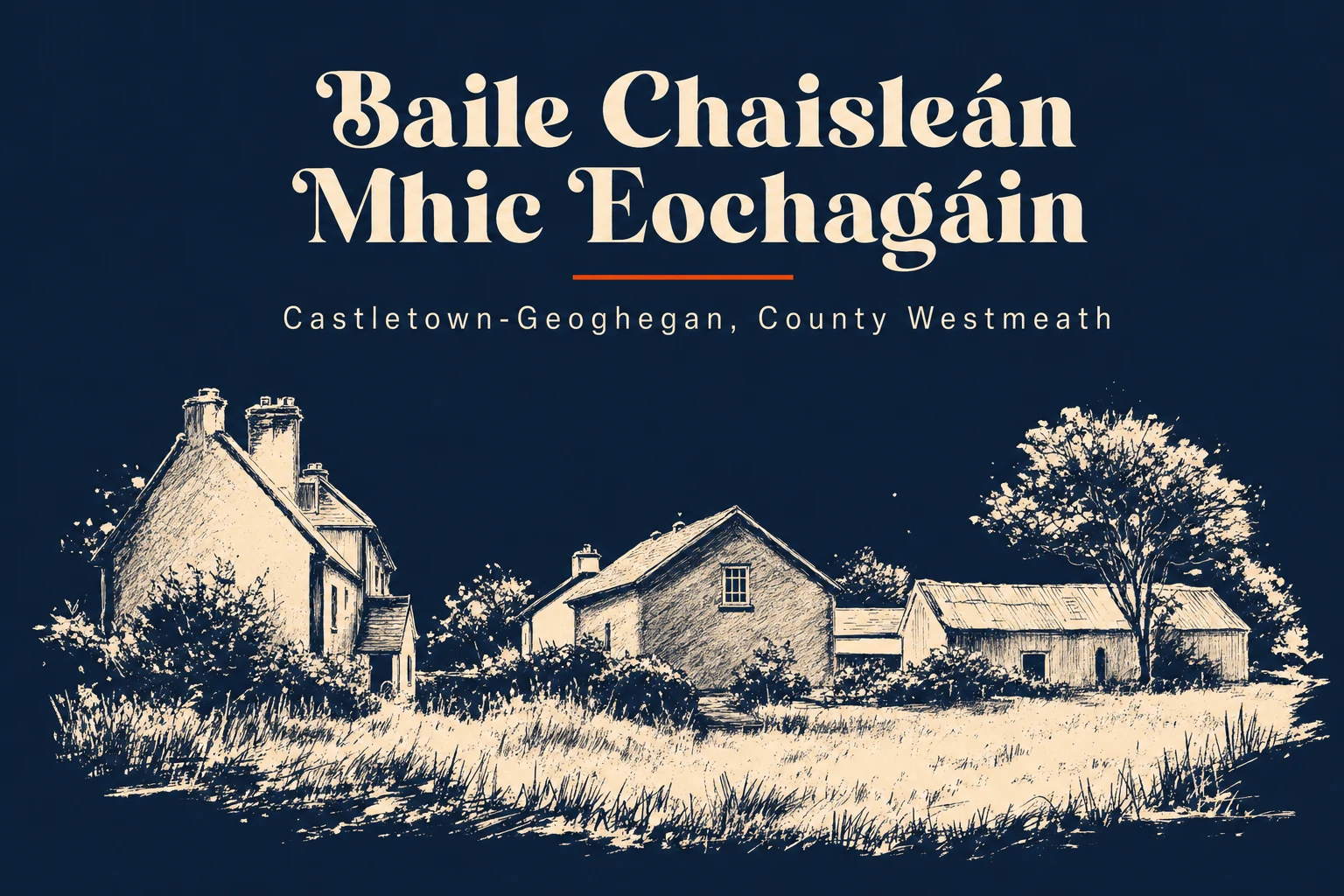
Baile Chaisleán Mhic Eochagáin

The Ireland's Hidden Heartlands
STOP 03 / 03
Baile Chaisleán Mhic Eochagáin · Co. Westmeath

A south-Westmeath crossroads named for a Gaelic family that ran the country for four centuries.

Castletown-Geoghegan is a small village at a crossroads thirteen kilometres south-west of Mullingar, with a pub, a church, a national school, and a hurling pitch. There is no centre to walk because there is no high street to walk it on. The point of the place is what is not visible — the four hundred years of Gaelic lordship the village is named for.

The Mac Geoghegans — Mac Eochagáin in Irish — were the chiefs of Cineál Fiachach, a sub-clan of the southern Uí Néill descended, in the genealogies, from Fiacha, son of Niall of the Nine Hostages. Their territory was the medieval Barony of Moycashel: south Westmeath, into north Offaly, with the principal castle at this village. Fifteen successive chiefs are named in the Annals of the Four Masters between 1291 and 1450. They held the country longer than most.

The end was quieter than the beginning. Under Henry VIII's surrender-and-regrant scheme in the 1540s, the chief of the day handed up his Gaelic title, took a royal grant of his own land back, and got on with it. Later generations submitted further to the Tudor crown and ended as Captain Geoghegan rather than The Geoghegan. The castle came down. The stone went into the church. The name went on the village.

Coords
53.4489° N, 7.4831° W
01 / 03

At a glance.

Three things every local will eventually mention. Read these and you've already understood more than most day-trippers do.

02 / 03

Stories & lore.

The reason to come back. The things every local will eventually tell you about, usually after the second pint.

Chiefs of Cineál Fiachach

The Mac Geoghegans

Mac Eochagáin — anglicised Mac Geoghegan, then Geoghegan, then about a hundred spelling variants — were Gaelic chiefs of the territory of Cineál Fiachach in south Westmeath and north Offaly. The genealogies trace them to Fiacha, son of Niall of the Nine Hostages, the fifth-century high king who is said to have taken Saint Patrick to Ireland as a slave. Whether or not the tree is literal, the lordship is real: fifteen Mac Geoghegan chiefs are named in the Annals of the Four Masters between 1291 and 1450. The principal castle of the lordship was at this village. By the late sixteenth century the chief had submitted to the English crown under the surrender-and-regrant policy and held his land as a tenant of the queen rather than as a Gaelic lord. The castle is gone; the surname is on every second headstone in the midlands.

The translator of the Annals of Clonmacnoise

Conall Mag Eochagáin

In 1627 a gentleman scholar named Conall Mag Eochagáin, of Lismoyny — a townland a few miles south of here, in the same lordship — sat down and translated a now-lost Irish-language annal of the abbey of Clonmacnoise into Elizabethan English. He did it as a favour for his brother-in-law, Toirdhealbhach Mac Cochláin, chief of Delvin Mac Cochlán in Offaly. The original Irish text is gone. Conall's English version is what survives, and it covers the history of Ireland from the creation of the world down to 1408. It is one of the chief sources for early Irish history. The book is now usually called Mageoghegan's Book. Conall died around 1640. There is no monument to him in the village he came out of.

Stone changes job

The castle and the church

There were two fortifications at Castletown over the medieval centuries — an earlier earth-and-timber motte and bailey, and a later stone castle that was the principal seat of the Mac Geoghegan chiefs. After the Cromwellian and later confiscations, the castle stopped being lived in and was let go. The dressed stone was carted up the road and used in the building of the parish church. The motte mound is still in the field and still readable as a motte. The walls of the castle are in the church wall, doing a different job. It is a fairly common Irish ending and a fairly honest one.

+

Getting there.

By car

Off the R391 between Mullingar and Tyrrellspass — about 13 km south-west of Mullingar, 19 km north of Tullamore. Coming off the M6, exit at junction 5 (Kilbeggan) and head north on the L1815 for ten minutes.

By bus

No regular service. The Mullingar town buses do not come this far. Nearest scheduled stops are Tyrrellspass (R446) or Kilbeggan, both about ten minutes by car.

By train

No station. Mullingar is the nearest, on the Dublin–Sligo line.

By air

Dublin Airport (DUB) is roughly an hour and a half by car via the M6.